Bitch. – Third Edition

IMG_0002-1

The purpose of my novel, Bitch., a period not a dot, a verb not a noun, puts the reader on the ground as a student at the University of California at Berkeley in September 1968 and carries through June 1973. It is 200,000 words.

There are loads of details – historical, fictional, contrived. First Edition, First printing was in 2000 – footnotes, bibliography, index and lexicon (words of the Sixties plus sources) e.g. “bummers” came from neither the Hells Angels nor the hippies. In 1864 the scavengers of Sherman’s Army on the March to the Sea through Georgia were known as bummers.

First Edtion, Second Printing is a reediting of the First Printing. Corrected are typos, less “majestically lawless.” In the First Printing one page has one word on it. The Second Printing has fewer obstacles to get to the purpose of the novel than the First Printing.

Before writing and during writing I did extensive research. I was dismayed when bookstores around the University closed in Berkeley: Seven in ten years. Some libraries closed and deprived me of sources. The Undergraduate Library was remodeled and its collection was reduced at least 50 percent. When I arrived to write, the campus had not changed much. I was able to write from memory, research and setting as they had been for decades.

The primary change between the First Printing and the Second was to the name of a character. I was using a pseudonym, Karl Rauh. In German “rauh” means abrupt, rude, sharp, and there was nothing about my writing that was polite, gentle or soft. Bitch. retains the edge of the attack. But I had named a character in the story, Karl Rauh, and a reader who believed she knew characters in the book, observed there was a problem with voices: author/character. I considered that point and took the quickest remedy: I changed the character’s name.

After the Second Printing was published, I was in the City of Berkeley Library Book Store. Someone had brought in loads of boxes filled with Sociology from the Sixties and Seventies. I realized I had a large source of books I had not seen. I bought and began reading, and more out of bookstores and from libraries, perhaps 1000 books. I had 50-100 pages of notes and additions to the text of Bitch.. For instance a little item: I met a woman who would only date on a Dutch treat basis. In a source I found a teenage girl who would only go Dutch treat because she didn’t like the feeling of being “rented” for the evening. That source is end-noted in the Third Edition.

Unprompted by me in 2009 the publisher of the Second Printing relinquished all rights to Bitch.. I was unhappy with the Second Printing because of the errors and its incomplete research and the many references I had overlooked and now made. Scanning the book into word processing would be a complete disservice to me as a writer and to the text which wasn’t perfect. The idea of retyping a manuscript of that length raises NOT the question, Do I want to read this again? Instead, the question becomes, Do I want to type this again? There were words, sentences and paragraphs to insert or move someplace else. Text to add and stuff to delete, and it was all possible because I read the text at 15-20 words a minute, my typing speed. Along the way I was able to reenter the book into my memory, and was able to play with it. I rounded out characters; I made paragraphs complete thoughts; I made the story full, inserting another 10-15,000 words. I added to endnote texts, and I added 90 note references.

[When one is writing about the Sixties and early Seventies, it is good to get facts, thoughts and impressions correct. Many memoirs and recountings are so highly edited to make the representations of those texts farcical and those texts wholly dishonest. Inserting the notes to sources and newspapers of those times at least tell the facts as they occurred. It is difficult for a once famous “personage” of those times to support his fantasies as he likes to remember them today and not as they happened. Many of those people like to write about their feelings. Hence the endnotes and the bibliography in Bitch..]

Under my name, michael ulin edwards, [I jettisoned the pseudonym],I received a copyright for the Third Edition of Bitch., iBookstore. It is the ghost edition. There are no graphics. There is an improved lexicon and bibliography but no index. Epublishing would not support the index. Unfortunately, there is no search function in Epublishing.

Editing a manuscript I believed once perfect was daunting and annoying, and in the end I was grateful. The text needed a sever reading. I learned how to do that. It is a much different mindset than writing, and different from proofreading. When a writer proofs, he accepts the text and makes small changes. But reediting – sentences, phrases, clauses, paragraphs – does not accept the text as it is. The mindset is to deconstruct. Reediting reinvents the text so words do their best work.

IMG

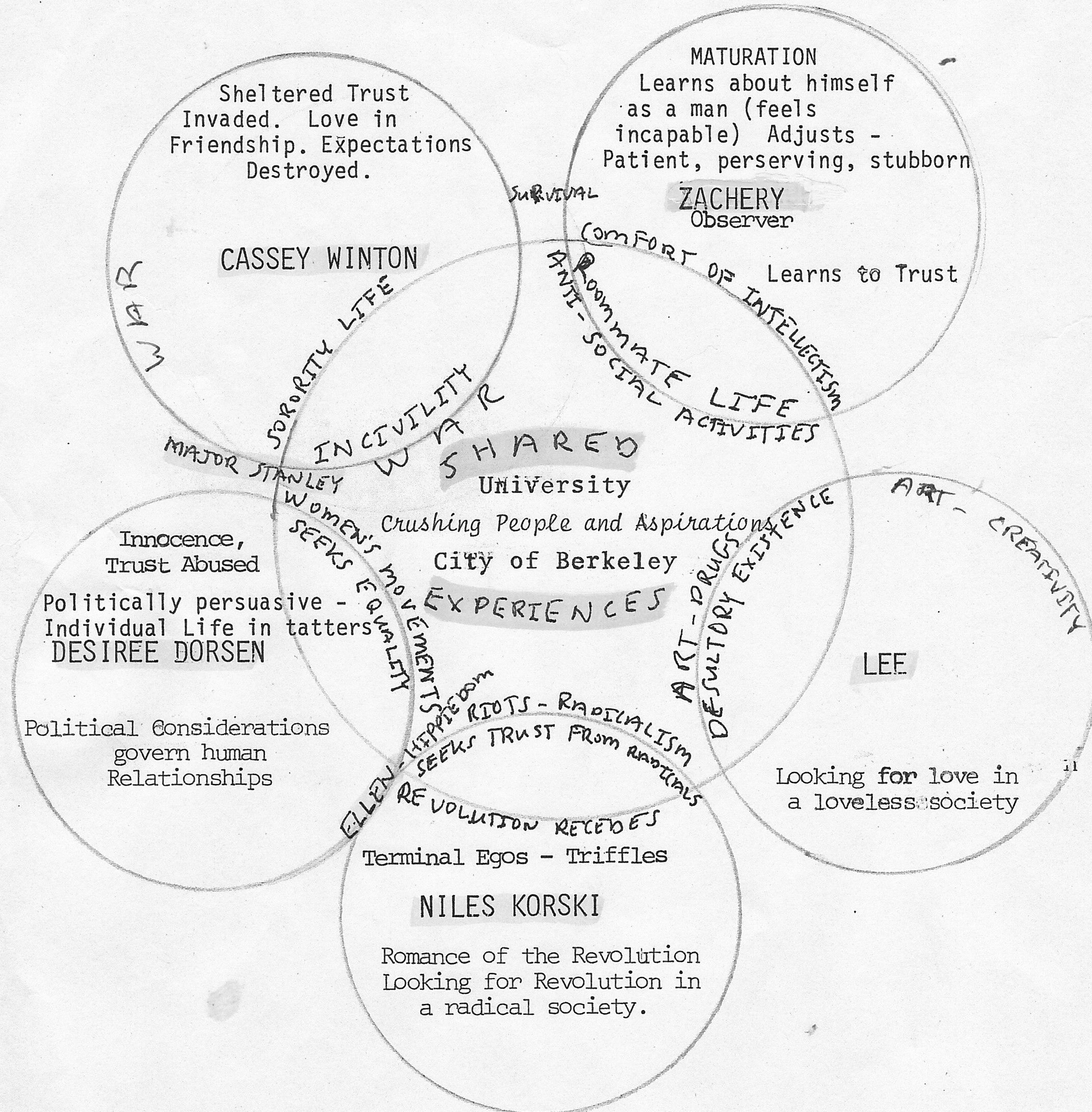
Just a note about writing Bitch.. The more words the more complicated the writing, the organization and the interactions and interface of stories, characters and settings. Before writing I determined there would be five major characters, the names are capitalized in each circle. One subsidiary character, “Ellen,” is mentioned. Not all the characters would have the same experiences, but like many young people during the Sixties and early Seventies, they had shared experiences. Those experiences were by direct participation or vicarious knowledge, because many occurrences during those years had a lot of fallout [unlike today where experiences tend to shut and tie-off]. Once I accepted this organization, the only diagram (“outline”) I made, the text was a matter of writing the stories of each character and how they mixed.

Always paramount was a driving theme found in Lee’s circle: Characters were looking for love in a loveless society.

EXPERIMENTS OVERSEAS

AMERICANS should be careful when spending money and men overseas, especially actively engaging in the Twentieth Century malarkey carried into this millennium. 

There are books – because that is why books are written, to inform and influence – every policy maker and every American should read to access and evaluate plans and policies, and influence action.

In Face of Empire, Frank Golay, tells about the American take over, missteps, gross missteps and high wire acts during its “colonial” relationship with the Philippines (1898-1946). The American perception has been confounded by World War Two: Americans and Philippinos fought the Japanese together. It is not entirely clear whether the Japanese would have invaded the Philippines in 1941, if that land were Philippine ruled and a neutral country. Before the during the War Golay gives many, substantial reasons why MacArthur earned well, the sobriquet of “Dugout Doug.” 

For 40 years Americans tried to teach the Philippine people to support a home-based democracy, and Americans failed: Missing were the infrastructure, institutions and bureaucracy Americans believed the Philippines needed. For instance one American Governor tried to get the Philippine people to accept a summer capital, which was less hot than Manila. None of the insular peoples needed a “cool” capital. He spent millions constructing roads and building edifices. Face of Empire tells of more failures. It is the experience American has throughout the Twentieth Century until today. For decades the Colonial administration was filled with sycophants, toadies, eggheads, do-gooders, pinheads and chuckleheads wanting to try out theories, conceived in academia, on a whim in Washington DC, or the fantasy of Three Cups of Tea, while all were being overpaid at home, in an exotic land or selling books and appearing on radio [and later on TV].

Additionally came the presence and input of the U.S. Military expensively delivering its two-cents worth. Early on the military boasted: “We conquered this land” [under a Republican administration]. “It’s our blood and treasure.” During the Hoover administration (1932) Republicans would only grant independence after an American overlordship of 25 or 30 years. Independence in 1960? How ridiculous is that? Unsure but aware it was stuck to the United States, the Philippines accepted MacArthur during the Thirties, who was to make every wrong military decision before December 11, 1941.

Colonialism and lingering in a country like Afghanistan, is something the United States of America is no good at doing. It is best not to be there formally. Note that The Face of Empire, as reading material, is heavy lumber.

The Quiet American, Graham Greene, mostly famously details the American involvement and experience in Vietnam, a decade before Lyndon Baines Jerk-Creep committed America to enter a Civil War on the losing side. The Quiet American does not just tell the experience of Americans who were in Vietnam, but also for Americans who was aware of that War (60,000 dead over 11 years to failing TV ratings) experienced what Graham Greene wrote about.

Garrison Tales from Tonquin, James O’Neil, Charles Royster, Ed., were written by an American who was in the French Foreign Legion (circa 1890) serving in Vietnam. He tells of the passive resistance and stubbornness of the Vietnam people bypassing French offers to “help” become colonial subjects. The Tales go beyond Vietnam. The experience of an occupied people, whose culture and society extend almost as far back as French society did, crosses borders. Any country with a settled religion, an on-going culture, a long-standing society will not be penetrated by an outside, invading force. Note after World War Two Germany and Japan surrendered “unconditionally.” Each changed its government, but the culture and the societal strictures remained mostly in tact. The changes in Labor Laws in those two countries fed into and supported the political changes.

In Burmese Days, George Orwell presents a remarkable analysis of the colonial experience: For the colonizer and the colonial it is belittling and dehumanizing to lord over the native peoples. Orwell thereby questions the conventional wisdom of The White Man’s Burden.  

EDITION

A lifetime ago, longer as a writer, I wrote two novels: of Little Human Hearts and Bitch.. When I wanted them to be, neither were ready for publication. of Little Human Hearts is the first, and I’ll write about it here.

I self-published of Little Human Hearts, a story of the late 1950s in Mendocino County. A bright, intelligent eight-year-old boy has his first love affair with his third grade teacher and doesn’t know it. He tells the events of that school year.

I appreciated after self-publishing that the story was not ready. The text fit Mark Twain’s description: the spelling is “majestically lawless.” The word processing was done by a friend who cut and paste the same material twice to the same spot. I was impatient to get the book out and missed it and a whole bunch of other stuff.

The FIRST EDITION drew a review from the Anderson Valley Advertiser, Bruce Anderson: “ON SALE at Copy Plus is a book called “Little Human Hearts” by a youngish man named Karl Rauh. Mr. Rauh grew up in Anderson Valley in the late fifties. His book is based on events and personalities of the time, both in Anderson Valley and on the Mendocino Coast as seen through the eyes of an eight year old boy. I would think – based on my own quick reading – a number of the characters and episodes would be remembered by many old timers…”

I did not grow up in the Anderson Valley. I wrote the book, inserting characters into the setting and contriving events. I had no plausible marketing plan. I exhausted myself moving and trying to distribute the book to bookstores, some which didn’t pay after selling the inventory. I didn’t want to self publish again.

An opportunity came along. A new publisher was accepting submissions. of Little Human Hearts was accepted. I entered the text into word processing and caught a lot of mistakes, but not all. I made a few. Unknown to me the publisher italicized the jokes (humor) in the book. Rather than of Little…, the title became Of Little… The spelling was less lawless. The Second Edition was launched.

The characters were set; the setting was laid out, but the story. How did everything hang together, cogently? Was it coherent, at all? Unknown to me was a review by a reader on vacation, now appearing on Amazon: “This strange and curiously interestingly book I found tucked into the reading material of a Lake Tahoe hotel lobby. I wound up reading it for hours in that bed…Beneath the surface…are smoldering of adult trouble…It is very simply written, easy to skim quickly and yet it goes into such charming details…like hiking in a redwood forest, the sense of awe it inspires, the silence it brings to the visitors, all this he writes about with complete naiveté, like a child…Some readers may find the simplistic writing a bit annoying, but it is a valid style to convey the boy’s memories…”

This review indicates that I was able to advance the boy’s voice completely. But the story was wrong. The marketing of this edition was horrible. Not many people saw it. The First and Second Editions are online for sale at high prices.

In 2009 unprompted by me, the publisher relinquished all rights to of Little Human Hearts. I knew a Third Edition was necessary, but I had lost all feel for the book and the story. The setting was no longer attractive – Mendocino is cold, wet and humid. I’m a desert person – hot and dry. It took some concentration to contrive the energy to edit. What I brought were abilities to tell a story and better capacities to edit. I had to enter of Little Human Hearts into word processing again. While doing that I realized there were three sets of relationships – boy-teacher, boy-sibliings-other children, boy-parents. The emotional charges from one relationship had to enlarge, explicate, and  contrast with the other relationships for the book to develop and tell its story.

Along the way I believe I learned a few things: A daughter who talks to her father a lot, and he challenges her so she enjoys that engagement (female-male) is less likely to fall for the first creep who throws her a line. Next, children who squabble with siblings are doing what comes naturally: They emulate their parents; they strive for attention; they are learning to act and react within this small scale of society. The role of the parents are to limit certain activities and certain speech but never to end the squabbling.

I now sense that the emotional stimuli from the three relationships support and improve the story, allowing the reader to build and arrive at the denouement satisfactorily. I eliminated all the italics; no author needs a signpost saying, I’M TRYING TO BE FUNNY HERE! I was happy the Copyright Office gave me a copyright for the Third Edition, of Little Human Hearts, iBookstore, Michael Ulin Edwards.

HUCK VERITAS

Copyright 2006

Since its publication the Adventures of Huckleberry Finn has retained its popularity with the reading public; It’s theme, Motive, Moral and Plot, though, have eluded acclaiming readers, skeptical detractors and literary critics. This confusion was the author’s who wanted the book to sell.

Slavery, Southern society and the Mississippi River seemingly move the story. However, a river of Christianity also runs through the text. Unlike the river waters which purify Huck as Jim and he float into slaveland, Southern constructions of faith, hope and charity from 1 Corinthians 13 are not Christian. This thematic flow gives the novel an ironic soul, making the Adventures a tract against religion as it is practiced.

Samuel Langhorne Clemens, Mark Twain, was raised a Presbyterian, and he was well acquainted with the King James version of the Bible and other works of English protestantism. Despite wide circulation of those works, Southerners had religion but little Christianity. Huck notes the,

pretty ornery preaching – all about brotherly love and such-like tiresomeness, but everybody said it was a good sermon, and they all talked it over, going home, and had such a powerful lot to say about faith, and good works, and free grace, and preforeordestination, and I don’t know what all, that it did seem to me to be one of the roughest Sundays I had run across yet.(147)

Huck’s questioning comes to him naturally. Startled by Pap and quizzed, Huck reads aloud. Pap growls, First you know you’ll get religion, too.(24) Religion practiced in the South corrupts. A note warning Jim’s captors of a plan to free the slave pleads, I am one of the gang, but have got religgion and wish to quit it and lead an honest life again. (334)

Huck learned the Bible from the widow and Miss Douglas. Ye cannot serve God and mammon, Matthew 6:24. If thou wilt be perfect, go and sell that thou hast…and come and follow me. Huck gives Judge Thatcher his money in Chapter 5, and throughout the novel he never thinks he can reclaim the money and buy Jim’s freedom.

Huck seeks the more excellent way. The King James version of the Bible, 1 Corinthians 13, prescribes the conduct of a Christian:

THOUGH I speak with tongues of men and of angels, and have not charity, I am become as sounding brass, or a tinkling cymbal.

2. And though I have the gift of prophecy, and understand all mysteries, and all knowledge; and though I have all faith, so that I could remove mountains, and have not charity, I am nothing.

3. And though I bestow all my goods to feed the poor, and though I give my body to be burned, and have not charity, it profiteth me nothing.

4. Charity suffereth long, and is kind; charity envieth not; charity vaunteth not itself, is not puffed up,

5. Doth not behave itself unseemly, seeketh not her own, is not easily provoked, thinketh no evil;

6. Rejoiceth not in iniquity, but rejoiceth in the truth;

7. Beareth all things, believeth all things, hopeth all things, endureth all things.

8. Charity never faileth: but whether there be prophecies, they shall fail; whether there be tongues, they shall cease; whether there be knowledge, it shall vanish away.

9. For we know in part, and we prophesy in part.

10. But when that which is perfect is come, than that which is in part shall be done away.

11. When I was a child, I spake as a child, I understood as a child, I thought as a child: but when I became a man, I put away childish things.

12, For now we see through a glass, darkly; but then face to face: now I know in part; but then shall I know even as also I am known.

13. And now abideth faith, hope, charity, these three; but the greatest of these is charity.

One must act with charity, a Christian love which burns into the heart and pilots all action. A mere act of liturgy, prophecy or charity without the requisite state of mind and heart is nothing. Christians must not be envious, boastful, conceited, proud, rude, selfish or vengeant; they must seek truth and ride the joy of charity overflowing with kindness while withstanding suffering. Throughout the Adventures Huck narrates without judging; he practices faith, hope and charity and learns the greatest of these is charity.

FAITH

Faith is evinced through prayer and professions to piety: …You had to wait for the widow to tuck down her head and grumble a little over the victuals...(2) Then Miss Watson she took me in the closet and prayed, but nothing come of it.(13) When the King and Duke commenced their swindle of the heirs of Peter Wilkes, …they kneeled down and rested their foreheads on the coffin, and let on to pray, all to their selves.(212)

A preacher at the camp meeting aroused the crowd with imaginary visions of the Holy Ghost. They shout[ed] and cri[ed]… tears running down their faces; singing and flinging…themselves down on the straw, just crazy and wild.(172) And the king got agoing (172) about being a pirate in the Indian Ocean, collecting eighty-seven dollars and seventy-five cents. And then he fetched away a three-gallon jug of whisky, too,that he found under a wagon…(174) Slaveowner/preacher, Silas Phelps come in every day or two to pray with Jim, the captured, runaway slave.(309)

But prayer described in the novel mostly departs from Scripture. Matthew, Chapter 6:5-6 directs,

And when thou prayest, thou shalt not be as the hypocrites are: for they love to pray standing in the synagogues and in the corners of the streets, that they may be seen of men. Verily, I say unto you, They have their reward. 

But thou, when thou prayest, enter into they closet, and when thou has shut the door, pray to thy Father, which is in secret; and thy Father which seeth in secret shall reward thee openly.

Southerners manipulated faith. The widow

…learned me about Moses and the bulrushes, and I was in a sweat to find all about him; but by and by she let it out Moses had been dead a considerable long time; so then I didn’t care no more about him; because I don’t take no stock in dead people.(2)...I wanted to smoke…She said it was a mean practice and wasn’t clean…Here she was a-bothering about Moses, which was no kin to her, and no use to anybody…yet finding a power of fault with me for doing a thing that had some good in it. And she took snuff too; of course that was all right, because she done it herself.(3)

The king’s duds was…all black, and he did look real swell and starchy…when he’d take off his new white beaver and make a bow and do a smile, he looked that grand and good and pious that you’d say he had walked right out of the ark, and maybe was old Leviticus himself.(204)

The king and duke…took on about that dead tanner [Peter Wilkes] like they’d lost the twelve disciples.(212)

Despite biblical interdiction, Acts 17:22, superstition of white people throughout the novel resembles the superstition of black folk. Huck thought differently, I judged that all that stuff was only just one of Tom Sawyer’s lies…It had all the marks of a Sunday school.(17)

Southerners have no greater understanding of Christianity than the sensibility of the slave, Jim. The commandment, Ye shall not steal, is modified: …the best way would be for us to pick out two or three things…and say we wouldn’t borrow them any more..it wouldn’t be no harm to borrow the others…(80) About Solomon and his million wives, Jim poses, Now I want to ast you: .what use is a half a chile? I wouldn’t give a dern for a million un um…He as soon chop a chile in two as a cat. Dey’s plenty mo’. A chile or two, mo’er less, warn’t no consekens to Sollermun…(95,96)

Southern whites ignore the tenets of Christianity. The Grangerfords and Shepardsons go to the same church yet feud: If you notice, most folks don’t go to church only when they’ve got to; but a hog is different.(148)

Educated whites disregard the creed. A new judge leading Pap to temperance fails: The judge he felt kind of sore. He said he reckoned a body could reform the old man with a shot-gun, maybe, but he didn’t know no other way.(28) Silas Phelps …was a-studying over…Acts seventeen…(316), an anti-slavery verse, yet Phelps remained a slaveowner.

CHARITY

These professions of faith accompany the revelation of charity in chapter three. Relying on Mark 11:24 [Therefore, I say unto you, What things so ever ye desire, when ye pray, believe that ye shall receive them, and ye shall have them.], Miss Watson tells Huck, to pray every day and whatever I asked for I would get it. But it warn’t so…Once I got a fish-line, but no hooks. It warn’t any good to me without the hooks.(13) Miss Watson chides the foolishness. Huck asks the widow who tells him …the thing a body could get by praying for it was “spiritual gifts”(13) of 1 Corinthians 14. Benefits of these gifts elude Huck, especially after the widow explained, …what she meant I must help other people, and do everything I could for other people, and look out for them all the time, and never think about myself,..I went out in the woods and turned it over in my mind a long time, but I couldn’t see no advantage about it – except for the other people…(13-14)

Both the widow and Miss Watson urge Huck to practice charity but differ in description of the rewards. The widow’s version is to lead Huck so his actions more closely relate to public benefits of conforming to Southern society. The widow described Providence...to make a body’s mouth water.(14) When Huck dirtied his clothes after a night out …the widow she didn’t scold, but only cleaned off the grease and clay and looked so sorry that I thought I would behave a while if I could.(13)

[B]ut maybe the next day Miss Watson would take hold and knock it [the widow’s providence] all down again. (14) Miss Watson demanded individual, internal reformation of character to make Huck Christian, and she was direct: Well, I got a good going-over in the morning, from old Miss Watson, on account of my clothes;(13) Miss Watson, told me all about the bad place, and I said I wished I was there. She got mad…She said it was wicked to say what I said;…she was going to live so as to go to the good place. Well, I couldn’t see no advantage in going where she was going…(3-4)

Listening to each woman Huck…could see that there was two Providences, and a poor chap would stand considerable show with the widow’s Providence, but if Miss Watson’s got him there warn’t no help for him any more. I thought it all out, and reckoned I would belong to the widow’s, if he wanted me, though I couldn’t make out how he was agoing to be any better off then than what he was before…(14)

Huck favors the widow’s Providence. Miss Watson drives him away. She wants to sell Jim, separating him from familar surroundings and family. Helping Jim escape bothers Huck (52-53, 124-125, 127-128), but he passes over the ramifications as they float South where Huck will learn charity and receive spiritual gifts.

He witnesses events…to make a body ashamed of the human race.(210) The legal system tolerates Pap going for Huck’s money.(Chapters 5,6) Boastful boatmen are …chicken-livered cowards. (111) The Grangerfords and Shepardson families feud. (Chapters 17,18) After Boggs is killed and Colonel Sherburn defies the mob, he notes: If any real lynching’s going to be done, it will be done in the dark, southern fashion; and when they come, they’ll bring their masks…(191) Southerners suffer frauds in the camp meeting, hold overly romantic notions and are duped by the king and duke, giving new significance to the reference about hypocrites who pray in public:…Verily, I say unto you, They have their reward. (Matthew 6:5)

Huck is edgy when the king trusts…in Providence to lead him the profitable way – meaning the devil(204), Huck reckons. [B]eing brothers to a rich dead man, and representatives of furrin heirs that’s got left, is the line for you and me, Bilge. Thish-yer comes of trust’n to Providence.(214)

In Chapter 28 Huck balks, hides the money in the coffin and tells Mary Jane about the scam. He knows he cannot join the widow’s Providence be good and civilized and receive the rewards of Southern society. He tells Mary Jane: …I’d be all right, but there’d be another person that you don’t know about who’d be in big trouble.(240)

Mary Jane responds, Good-bye, I’m going to do everything just as you’ve told me;…and I’ll pray for you too! Pray for me! I reckoned if she knowed me she’d take job that was more nearer her size… and if ever I’d a thought it would do any good for me to pray for her, blamed if I wouldn’t a done it or bust.(244)

In Chapter 31 the king takes a bounty for Jim, a runaway slave. Jim is imprisoned. Huck must choose. The widow instructed him about “spiritual gifts,” and Huck puts them to the test within the Widow’s Providence, again. Seeking absolution, he considers telling her by letter where Jim is:

…it hit me all of a sudden that here was the plain hand of Providence slapping me in face and letting me know my wickedness was being watched all the time from up there in heaven, whilst I was stealing a poor old woman’s nigger that hadn’t ever done me no harm, and now was showing me that’s One that’s always on the lookout, and ain’t agoing to allow no such miserable doings to go only just so fur and no further, I most dropped in my tracks, I was so scared…It made me shiver. And I about made up my mind to pray; and see if I couldn’t try to quit being the kind of boy I was, and be better. So I kneeled down. But the words wouldn’t come. Why wouldn’t they? It warn’t no use to try and hide it from Him. Nor from me, neither. I knowed very well why they wouldn’t come. It was because my heart warn’t right; it was because I warn’t square; it was because i was playing double…You can’t pray a lie – I found that out.(268-269)

But Huck doesn’t send the letter because he has internalized the problem of man facing God, thus taking his faith private. He sits in the wigwam of the raft. It – the wigwam and the dilemma – it was a close place like the closet Miss Watson took him into in Chapter Three. Huck ponders whether to follow Christian charity, to help Jim and do everything he could for Jim, look out for Jim and not think about himself.(13) He resolves to rescue Jim, thereby choosing the Providence described by Miss Watson. But he still believes he is controlled by the Providence described by the widow. Southern society will condemn him. Huck says, All right, then, I’ll go to hell…(271)

Clemens made the structure of the Adventures a cross. Faith, hope and charity on the upward pole intersect Southern civilization of whites and Negroes in the Mississippi Valley:

                                                                            C

                                                                            H

                                                                            A

                                                                            R

                                                                            I

                                                                            T

                                                                            Y

                                                   S O U T H E R N  S O C I E T Y

                                                                           F

                                                                           A

                                                                           I

                                                                          T

                                                                          H

                                                                         H

                                                                         O

                                                                         P

                                                                         E


When Huck becomes charitable, he finds himself at the junction of the cross. The only character who is charitable and Christian throughout the story is Jim. After Jim’s capture, Huck reflects in the wigwam and voices a prayer:

I see Jim before me, all the time, in the day, and in the night-time, sometimes moonlight sometimes storms, and we a floating along, talking, and singing, and laughing. But somehow I couldn’t seem to strike no places to harden me against him, but only the other kind. I’d see him standing my watch on to of his’n, stead of calling me – so I could go on sleeping; and see him how glad he was when I come back out of the fog; and when I come to him again in the swamp, up there where the feud was; and such-like times; and would always call me honey, and pet me, and do everything he could think of for me, and how good he always was; and at last I struck the time I saved him by telling the men we had small-pox aboard, and he was so grateful, and said I was the best friend old Jim ever had in the world, and the only one’s he’s got now;…(270)

Jim is a slave, and in the novel it is he who is nailed on the cross. Implicit in the narrative are questions: Should Huck save Jim. Should Huck attempt to save the nigger on the cross. Should Huck work himself...up and go and humble [himself] to a nigger: Huck…done it, and I warn’t ever sorry for it afterwards, neither.(105) It is inexplicable that today’s detractors of Huckleberry Finn, like ante-bellum Southerners, don’t believe in humbling themselves to the nigger on the cross and dispute Huck’s decision to save him.

Putting Jim on the cross is controversial, but Clemens advanced the idea in Huck’s prayer. In doing so he mocked Southern whites, the camp meetings and the glory of evangelists’ timeless voices describing appearances of Jesus Christ: “I see Jesus before me, all the time, in the day, in the night-time, sometimes moonlight, sometimes storms…” Moonlight is necessary because Southerners cannot see Jesus in the dark.

HOPE

At the beginning of the novel, the widow wants to sivilize Huckleberry. After charity is explicated in Chapter 31, the remaining eleven chapters exhaust hope found in the widow’s Providence, southern civilization. Tom Sawyer returns to the story, and he conceives a plot to free Jim. But Huck was bothered that Tom, …a boy that was respectable, and well brung up; and had character to lose(292) would help the slave escape. Huck didn’t know it was Tom’s sport; the widow had died and freed Jim in her will.(358) Again, Huck is homeless. He subordinates himself and his new faith to the tomfoolery: He[Tom Sawyer] was always just that particular. Full of principle.(307) Jim, too, recognized the folly but…allowed we was white folks and knowed better than him.(309)

About the escape and Jim’s recapture, Southerners blather about the complexity of the escape scheme and wonder who had done the planning and why – conversations with little bearing to reality.(Chapter 41) Tom Sawyer was proud of the adventure and especially the bullet he took in the leg, which he wore around his neck.(362)

At book’s end Huck heads for the freedom of the Territory; otherwise Aunt Sally is…going to adopt me and sivilize and I can’t stand it. I’ve been there before.(362)

Tom Sawyer was published in 1876, the same year Clemens was feverishly writing Huckleberry Finn. He had more material about the river and Southern society than he could use in one book. The jarring impact of the Civil War was fresh. Clemens had lost his chosen profession of riverboat captain. He set aside the Adventures until 1879-1880, when he wrote a bit more. Following a trip up the Mississippi in 1883, Clemens pumped out Life on the Mississippi detailing the downside of Southern society and Huckleberry Finn in 1884. These books, along with Pudd’nhead Wilson’s exposition of the black man’s plight, 1894, are a trilogy. The Adventures is the hinge book integrating both themes – Southern society and race.

As a novelist Clemens had responsibilities to art and to society. The trilogy was his response to the War – expressions of despair that lessons of the horrible slaughter were forgotten or never learned. The South had not changed. Reconstruction had failed. Slaves, now free Negroes, were drowning in tides of caste and race supported by the civilization which fueled Southern war fever in 1861.

But Mark Twain’s dilemma was laying down camouflage for the anti-religious theme in the novel. By this text he had tied the Adventures to the most widely book read in the English language, the Bible. He released Adventures of Huckleberry Finn as a children’s story, a sequel to the popular Tom Sawyer. The same characters appear at the beginning of the Adventures, but the similarity ends with writing style and content. Later, more Tom Sawyer/Huckleberry Finn sequels were published which had nothing to do with the thematic content of Huckleberry Finn. Next, Twain approved original illustrations which show the protagonist as a meek boy of eight or ten years, not the savvy adolescent telling the narrative.

Also some captions to the illustrations are misleading e.g. “thinking” (270). Finally, Twain admonishes readers in a prefatory note from taking the book seriously:

NOTICE – PERSONS attempting to find a Motive in this narrative will be prosecuted; persons attempting to find a Moral in it will be banished; persons attempting go find a Plot in it will be shot. By Order of the Author, Per G.G., Chief of Ordnance.

Yet the lesson of 1 Corinthians 13 are not forsaken. Faith and charity abide, but there is no hope in Southern civilization in American civilization. Hope is left to the future. For six score years readers have recognized the obvious and have been sidetracked by Mark Twain’s counsel to seek neither motive, moral or plot. Our future is to discover and understand the motive, moral and plot in the Adventures, as Samuel Langhorne Clemens wrote them, and to live accordingly.

NOTE

1. The numbers in the text are pages from the corrected, Adventures of Huckleberry Finn, University of California Press, Berkeley, 2001.

2. This text is largely the same as appears in Criticism, Essays, Stories, iBookstore, Michael Ulin Edwards, FREE.

EXPLORATION

Primarily a writer of fiction, I read a lot of history. One group (area) (field) of books always interests me: Exploration of the earth beginning with the Portuguese and Spanish and finishing in the Twentieth Century. A lot of usual stuff happens: In a sixteenth a guy got parted from a Spanish expedition in Florida, and he walked west to Spanish settlements in Mexico.

Exploration and writing a story are similar. There’s a starting point. The vessel sail in one medium on blue or if it is snow, white. Paper is usually write for the author. Like the author an explorer sort of knows where he’s headed. Neither writer nor explorer know exactly how to get there. A lot of skill is required. Once the writer and explorer believe the destination is reached, they like to call it quits. Success is not always evident. Remember Columbus sailed for India and ended up in North America. Look at the first draft of any story. How close to finishing is the writer? Getting home, completing the story – that’s the rub.

Recently read is L.H. Neatby, The Quest of the Northwest Passage, chock full of facts, names and places with many maps that don’t give all the names of the places mentioned in the text. When reading a book of exploration or discovery, it is good to know where the expedition is: Glendale, Arizona or Glendale, California. Can anyone tell me where the Great Fish River is? Having read the book, I may know. But I may not.

Next, it is not enough to say that Eskimos in the early days (1600 to 1700s) were murderers and thieves without giving a brief background of their society and culture: Life is hard near the Arctic. Did the explorers act this way, or that? I was unaware until late in the book, that a translator who learned to speak the natives’ language in Labrador was understood by Eskimos near the mouth of the Mackenzie River, at least 2000 miles away.

Neatby’s book is otherwise well-presented. It benefits from shortness, 200 pages, no Index. But brevity diminishes the tales. Trapped in ice like Shakleton at the South Pole 60 years later, Captain Collinson secured his ship in the Arctic flow. Morale of the crew was excellent especially after the men built, next to the ship, a billiards table from ice and available materials and played until the ice broke. The reader needs more than 250 words about Captain Collinson.

The text requires an interest in exploration and Canadian history; it is not geared toward the general reader. But the subject matter is compelling with one caveat: Every explorer is cold, frozen, gets frost bitten or ends up frozen to death. This is a welcome book to read during the hot summer months.

The following are exceptionally readable and authoritative books about exploration, the persons involved and the peoples they met:

Carl Sauer: a) Sixteenth Century North America, b) Seventeenth Century North America, c) The Early Spanish Main

JH Parry: a) Discovery of the Sea, b) The Age of Reconnoissance, c) other books

CR Boxer: Histories of the Dutch and Portuguese Empires.

William Goetzmann: a) Exploration and Empire, b) Army Exploration in the American West

Alan Villiers: a) Captain Cook. There are many biographies of Captain Cook. This one is well written. The author is a sailor and has sailed in a ship like the ones Cook piloted, as well as many smaller ships and boats that Cook sailed. There is some technical sailing lingo in it which is not obnoxious. I’m not a sailor and never will be. I will not master the terms or fully understand, always what was happening or why. Although incomprehensible, these sentences and clauses did not get into my general understanding. Despite that, I can only conclude that I like this book because I like to be teased. 

BAD WRITING

After writing my manuscript in November 2013 [earlier blog], I looked at books on writing by authors. I pulled them from the public library. None of the books are gospel. Many mention issues to keep in mind to weigh and balance, but are not important while writing the first draft. The issues become important while fooling with drafts 2, 3 and 4.

There are five books:

James Thurber, Collecting Himself, Harper & Row, NY, 1989 Michael Rosen, Ed., The text mostly gives impressions of working, sometimes as a writer. The best article in the book goes back to Thurber’s days in Paris during the Twenties: “How To Tell a Fine Old Wine.” To get good from this book the reader must believe The New Yorker magazine is sophisticated, or at least clever. It may also be helpful to consider David Letterman is funny without the drum punctuating the end of “the funny line” and the once present Paul Schaffer cackle.

John O’Hara, An Artist Is His Own Fault, Southern Illinois University Press, Carbonville, 1977, Ed. Matthews Bruccolli. More than half this book is derived from lectures and speeches, none of which have been adapted to the written word. Having just read the second volume of Mark Twain’s Autobiography, vol 2, UC Press, 2013, these are by comparison poor speeches and mediocre lectures.

In his writing O’Hara displays prominent, fatal faults: “His first draft is usually is last.” He also reads little or not at all. He says the first duty of a novelist is “creation of character.” He complains that women authors are treated more gently by critics than male authors.(101) [Sour grapes.]

Natalie Goldberg, Writing Down the Bones, Shombhala, Boston, 1986, Somewhat of a how-to-book which eventually turns to Zen (author is an adherent).

Page 8 is excellent advice for new writers. Generally it should not be ignored:

1.”Keep your hand moving. (Don’t pause to reread the line you have just written)….2. Don’t cross out. (That is editing while you write…)[Perhaps] 3. Don’t worry about spelling, punctuation, grammar. (Don’t…worry about staying within the lines and margins.) 4. Lose control.[This probably means get lost in the story so the words are coming from your imagination.] 5. Don’t think. Don’t get logical. 6. Go for the jugular. (If something comes [into] the writing that is scary or naked, dive right into it. It probably has lots of energy.)”

Page 35: There is bad advice about metaphors and similes, even if the author can only close the page or turn the book. Page 36-37 more advice “Writing is not a McDonald’s hamburger” That may be true, but I know the following is also true: A writer wants his writing read by everyone who eats McDonald’s hamburgers.

There are good and valuable considerations: Writers should keep physically active; they should be able to hear and listen while writing. Of interest are chapters on writing sex, being a writer, syntax and detail in stories.

Sol Stein, Stein on Writing, St. Martins, NY, 1995, tries to relabel and redefine terms of writing, and suggests the primary way to advance the story is a strong character. Character is a laborious means to write and to tell a story.

From his own books Stein presents an incomplete example: 

In my novel The Resort, the leading characters are an “ordinary middle-aged couple. Henry and Margaret Brown, who                                                             find themselves in horrific circumstances at the end of chapter one…I made the Browns just different enough to interest                         the reader, but it was important that they not seem “special.” Therefore, when calamity hits the Browns, readers from any                      walk of life can identify with their plight, which is crucial for the story. Stephen King usually has quite ordinary-seeming                      characters get involved in extraordinary circumstances.”

What Stein does not want to tell the readers, in order to give his flawed analysis, is his characters [The Browns] at the end of Chapter One are in a new setting – dangerous, uncertain, terrifying.

Character, story, setting, which is most important. It is easy to judge. A writer can easily correct flaws in character and story with details. Flaws are impossible to correct in setting without rewriting extensively or writing anew. AN EXAMPLE.

A. Buy an engagement ring from a jeweler in the suburbs. OR

B. Buy an engagement ring from a store on Rodeo Drive in Beverly Hills.

Man may not want fiancee with him when he buys in the suburbs, a transaction which might include barter, bargaining or under the counter payments.  Man who buys on Rodeo Drive likely will have fiancee with him.

Add another fact: Man is rich enough to buy on Rodeo Drive but buys in the burbs. Fiancee’s reaction justly asks, “What the hell is this?” “What’s going on?”

It is setting not character nor story that determines what will happen and why. Indeed, part of the story or the whole part may rely on  where the ring was bought.

There are questionable references to excellent books of history: Bertram D. Wolfe did not write “the best book in its field in any language.” Stein’s references and suggestions in non-fiction are not helpful and should be ignored, except those to Garrett Mattingly.  

Stein makes the following audacious assessment: “George Orwell’s non-fiction is far superior to his fiction.” It is likely Stein has not read all of Orwell, who is careful to communicate exactly what he thinks throughout his entire opera. Perhaps Stein considers 1984 and Animal Farm as non-fiction, but he certainly overlooks Orwell’s pre-World War II novels like Keep the Aspidistra Flying, a story with subtle environmental strains: “I don’t mind development so long as it doesn’t look like gravy on a table cloth.”

There are good passages in Stein on Writing. Unlike John O’Hara, above, Stein quotes Ernest Hemingway, “First drafts are shit.” About Thesaurus Stein accurately observes the effect on a writer using one “…surprises me with a word that I would not have thought of on my own and that gets me thinking in a different direction.” From John Gardener: “Detail is the lifeblood of fiction.” Stein gives a reference for love scenes, Helen Fisher’s Anatomy of Love. On page 118 is excellent advice about dialects.

Stephen King, On Writing, Schribner, NY, 2000, is better than I remembered it being. The library is ordering new copies, although it appears to have a sufficient supply. So is there a new edition with improvements?

Without mentioning Stein On Writing, King responds, 

I want to put a group of characters (perhaps a pair; perhaps even just one) in some sort of predicament and then watch                      them try to work themselves free…The situation comes first. The characters – always flat and unfettered, to begin with –                     come next. Once these things are fixed in my mind, I begin to narrate. I often have an idea of what the outcome may be,                       but I have never demanded of a set of characters that they do things my way. On the contrary, I want them to do things                        their way.(164)

When King says, “The situation comes first,” he refers to the setting, jewelry store or hazardous waste pit. King raises an excellent point. Fixate on character, and the author may insist the character do things his way, not the character’s way. King explains later,

…what happens to characters as a story progresses depends solely on what I discover about them as I go along –                                how they grow…Sometimes they grow a little. If they grow a lot, they begin to influence the course of the story.(190) 

There are many excellent chapters and passages in King’s book: He is wholly correct and should be followed about knowing the fundamentals of writing this language: Use Elements of Style for knowledge and information. He’s entirely correct about symbolism. He mentions Edgar Wallace Plot Wheel with the hope everyone will stay far from it. He recommends potential and all writers read, unlike John O’Hara.

There are clunky things: Unlike King I would not recommend reading Harry Potter. And James Michener did not write many of his later books; he edited them. Hemingway’s defense of alcohol would never reach 70 words; he would not use more words than Faulkner did. King cites an unHemingway defense of alcohol.


AUTOBIOGRAPHY OF MARK TWAIN, Vol. 2

Autobiography of Mark Twain, vol. 2, University of California Press, Berkeley, 2013.

Passages in this volume of the Autobiography will be found in no other book. Twain himself doubts whether any human being can be original, but this volume belies his claim. Twain is. Incidents of first impression and first expression exist therein.

While in Europe in 1896, Twain’s first daughter died in Connecticut. By the summer of 1902 his wife was in bad health. Later that year his youngest daughter had a life threatening illness (104 degree temperature; doctor sleeping in next room). The fear in Twain’s household wa wife would learn of daughter’s illness, and she would be carried off. 

Twain had a third daughter, Clara, who primarily took care of the wife. Twain himself riles wife too much; his daily time with her is limited. Clara makes up a wonderful, social, engaging social life for the daughter near death. Wife’s spirits rise. These fabrications are carried on for three months. Twain writes two letters which are included in the text. [There must be more letters.]

Twain details the life of lies to stating the sick daughter’s happy life, and that they are relayed to everyone in the household – anyone who might come within earshot of wife – must know and speak the lies. Presumably wife remembers all the lies, and so must everyone else. There are near misses. There are mistakes, quickly retorted and corrected or excused, including the schedule of a local train.

Twain observed the whole scenario could be viewed as absurd and humorous except it is real, and it involves his family. The reader can infer what Mark Twain, writer, is doing: To protect himself, Samuel Langhorne Clemens, writes a full, complete and honest account of the activities in the house and about the sick daughter’s social life. Once on paper the events are removed, in a medium where Twain is a master. It is his only defense against two more deaths in his immediate family.

More astounding was the visit of William Dean Howells during the summer 1902 prior to the grave illnesses. Howells adumbrates a story about an ill mother and then her daughter gets sick. Both were cared for by two aunts. The aunts don’t want to lie; it is a sin. But they sin every day to keep the mother’s spirits up, even after the daughter has died: The mother believes the daughter is having a wonderful social life for the first time in her life. The mother also dies. Although the aunts regret sinning, they realize it was necessary.

Mark Twain wrote that story, Was it Heaven? Or Hell? It was published by Harper’s Monthly, when Twain’s wife and daughter were gravely ill. Both of them recovered.

The Autobiography has gems about writing. Spelling: “Majestically lawless.” Twain writes about “style,” “a mysterious thing,” including involuntary “indiscretions,” ofttimes an unwanted, “trademark.” And proofreading – the message is sometimes the editor must do everything himself: Twain tells an anecdote of Bret Harte’s trying to correct “chastity” for “charity.”

An observation about human beings came out which pertains to writing. The sort of human being one is will result in the type of writer one becomes. Bret Harte is used as the example, and Twain does not like him. Harte is capable, but is also acerbic, witless, disloyal, unemotional and selfish. Flickers of brilliance come from Harte’s writings, but mostly Harte is pushing the pen. 

The Autobiography does not analyze the heart of writers generally. It raises the issue by example, the personality and the abilities and capabilities of a writer [or any artist]. Those traits and in life, circumstances, realizations, choices and adjustments, bring very individual reflections and come after one consciously mulls, considers, weighs and judges. When those forces and the results arrive unannounced, the writer is in trouble.

“Circumstance” raises another short significant issue. Twain notes, like a diary entry, attending a banquet where Elihu Root, Secretary of State, addressed circumstances as changing the way Americans viewed government and their own freedoms. [This is my summary, not part of the Autobiography.] In many ways the more Americans are brought together as one people in one nation and are supposed to think the same way – whether by innovation, culture, society or law – the more Americans will lose the distinction of being a nation of individuals. 

Twain alights on celebrity, by commenting on an article about Olive Logan. She was a female lecturer in the lyceum days. Olive had nothing to say and couldn’t have said it if she did. She was on the platform “to show off her clothes,” a “living fashion plate.” She manufactured a reputation, writing “innate, affected valueless stuff,” and marrying “a penny-liner,” a man who was paid a penny a line to get small items, true or untrue, in newspapers.

The newspapers would appear, and next came the revelation: Readers who “had not been quite aware of [the celebrity] before,” now knew. There were no explanations, just recounting daily or weekly activities, like a Facebook page or a Twitter feed: “Her name was familiar to everybody…and there wasn’t a human being in the entire United States who could answer if you asked him, ‘What is her fame based on?’ ‘What has she done?’ You would paralyze a person by asking that question.”

[The primary difference between Olive Logan then and “celebrities” today is, today Americans can now say the woman took off her clothes, or did explicit acts, and published them.]

Sadly, the life of Olive Logan wound down like the lives today. She is near deaf. Her current husband, a generation younger than she,  always drank and neglected her. She “could no longer write.” The couple was impoverished.

Twain mentions other fallibilities of the American system. He complains that the United States of America is an Unpolite Nation without remembering or mentioning that he lives in and about New York City. He notes the pace of America, “come step lively,” differs from the pace elsewhere. He mentions American diplomats and counsels, “chuckleheads,” sent “to some part of this planet because [they were] not needed in this country.”

Many passages are devoted to copyright issues and some (purported) Congressional testimony. In Twain’s day the copyright laws were antiquated and woefully inadequate. Readers other than historians, legal historians, Twain devotees and intellectual property fiends will find these parts laborious. But Twain was prominent in the push to change the laws. 

Speaking from the grave, Twain likewise discourses on religion. His views are well presented. His is not an attack on faith itself, but largely on the practice of religion and man’s distortion of faith. That is always the grind. There are distilled, more perceptive presentations of these arguments in Twain’s literature: Huckleberry Finn, The War Prayer, The Mysterious Stranger, and elsewhere.

During the last decade of life Twain did not write much – short stories, essays and articles. He explained that he no longer wanted to pick up a pen and write a novel. The Autobiography was dictated. These is a difference in quality and complete excellence between Twain’s best books and this Autobiography. Many entries are literary, but Twain’s purpose was not literature: He wanted a conversation from himself, a one-way conversation to readers. Readers gets that. The difference between his literary efforts and the Autobiography remain, and have a lesson for today’s writers: Typing at 100 plus words per minute, printing out pages of beautiful words, trying to proofread and write something literary. Unlike Twain, most of today’s word processing entrants have never lectured to audiences, have never delivered humor, do not understand the basic simplicity of a joke, yet they are trying to work at the speed of the spoken word, like they are running their mouths to monopolize conversations with friends. 

One gift this volume of the Autobiography gives to writers is Twain’s impressions and methods of lecturing and speaking, a task he could do on an impromptu basis. This volume has also left me in an uncomfortable state of humiliation: Mark Twain could lecture better than I can write.  

STUPID: Novel Writing

I am not unhappy. I’m complacent. 

Under the mistaken impression that everyone was writing a novel in November, NANOWRIMO, I said, “I’ll try.” I’ve already written a novel this year: JUNKETS, iBookstore, michaelulinedwards, 99 cents, an espionage story without the flair of Ian Fleming or James Bond but funny and humorous.

Having advanced notice, I began novel writing in October with no theme and no concept, just write and continue writing. The protagonist ran through Chapters One and Two.

I can correct this in rewriting and revisions, but with the next text I began writing my thoughts about writing. Writing is what I believed my protagonist was doing. I stayed with the third person using my character’s name, rather than personalize the story to “I.”

I have 40,000 words with no iota of an idea, a particle of a plot, a fragment of fancy left in me.It’s not too bad considering I gave up on character development 30,000 words ago.

While writing it took a while to realize this is no novel [last weekend]. It’s an essay or worse. Reminiscences, a memoir or autobiography. I wrote a long book about university days [Bitch., a verb not a noun, a period not a dot, iBookstore, michaelulinedwards, Berkeley 1968-1973]. Afterward I vowed never again to write anything in that genre – autobiography, memoirs or reminiscences – true life or fibs.

Yet that is what I have in the 40,000 words, draft one. Thoughts and impressions of writing and my writing career. There’s no organization to it at all. I tossed in everything. I’ll learn whether there is an unconscious organization in my brain. A week ago upon finishing a topic, I believe I had a theme in it. Don’t ask which one or what it is about.

This week I asked myself, what to write next. I had a bunch of unrelated subjects – writing in coffee shops, intellectualism in the creative process, bookstores, and this morning, copyediting. I wrote sentences, one paragraph or multiple paragraphs, and I dumped all those unrelated subjects at the end.

Before Thanksgiving I thought, time to research. Learn what other writers have published: Library time. Books are essay-like with autobiographical overtones. Likely I’m stuck in this genre. Upon rereading something will likely make sense, and I can put all the pieces together in a massive cut and paste. It will be a masterpiece to add to two novels, already written about writing but not edited. 

That all may be a madness. I’ve gotten a lot of errant thoughts out of my brain and away from my being. That is helpful. I know, however, I won’t rewrite right away.