WHAT SORT OF TALE?

A FALSE FRIEND by Myla Goldberg

I try to read different styles of fiction and non-fiction to learn something from style, the writing and the author’s presentation. But I am impatient because there is much to read. If I cannot detect a story and structure inside a book with good writing, I lose interest quickly.

I don’t expect every book to have a chronological narrative. But if a writer begins with “bit,” and she goes onto “bot,” and next to “but,” followed by “bat” and ending up with “bet,” the story, writing and telling need distinction: Voice(s), choice of words, style of writing, immediacy of sentences, a comprehensible of structure guiding the reader at the rudder to make way through the “B-a-e-i-o-u-t.”

All that failed me in A False Friend by Myla Goldberg, and I did not sense a style or a structure otherwise presented to the reader. The story is told by Celia, as a pre-pubscient girl and when in the first chapter Celia’s best friend Djuna disappears in the forest (down a hole like Aiice), Celia has reached puberty. I note the Celia’s voice, words and speech are the same despite aging. These ages and the on-coming womanhood are important in youth because there are bunches and gobs of currents and circuits fed by hormones hitting girls.

Although Celia and Djuna interact with each other, they seem unaware of puberty. Their parents are unaware. Nobody else knows anything. The reader has no guidance except experience, although the book is presumably written for adults. The activities of the girls at nine years seems the same at 13 years.

Should the advent of puberty show up on page 180 as an involved plot point or a plot twist, when the actions between the two girls happened on page 10? I don’t know if that happens because the book lost me as a reader at Chapter 8. One book cover squib praising the novel mentions it is about “girl bullying.” If the author does not have a handle on the perpetrator and the victim, but is writing generically about morals, ethics, behaviors and reason, the writing is not a novel but a sociology. 

Of course with a novel, a story can be presented and the reader can learn from the characters and detect how incidents, however small, may get out of hand and result in bullying. Of perhaps the violence is mean and intentional. What sort of writing tries to make a point in   A FALSE FRIEND:

Chapter 3, page 39-40: “For years Celia had figured she would live alone: a small apartment in Ukrainian Village or Wicker Place shared on alternative weekends with a boyfriend who would have his shelf of the medicine cabinet, his bureau drawer. Their lives with sporadically intersect from Friday to Sunday, phone calls leaving the time in between. She had been perplexed by people who did it differently, had theorized that they were somehow less busy. In high school and college she simply had not had time to meet people. There were marches to organize and fund-raisers to plan, poems to read and meetings to attend. Her chronic overcommitment and loneliness had felt inherent, conditions like diabetes or color blindness that demanded their own concessions.”

In this paragraph Celia recollects the idea of living alone. Note there is no development of that idea from the standpoint of living alone, its glories or deficits. Nor is there development of Celia’s character. There are erratic and errant thoughts about Celia’s busy lifestyle unrelated to living alone: Irregular live-in boyfriends. Why was that desirable? No answer. How other people lived together, a thought completely unrelated to Celia. Celia remembers her earlier years when living with anyone seemed unnecessary: For purposes of this story it is immaterial and off point. But is it nonsensical that a young woman involved in politics, social issues and fund-raisers would not make friends and would have no acquaintances from those activities. What’s a reader to think?

Boyfriend-husband Huck had nights with the boys when Celia was out of town. (45) Does this have much to do with Djuna’s disappearance and the reaction of Celia’s hometown? Nothing. It tells little about Celia, even if the point of the novel appears to be the reaction to Djuna’s disappearance, today rather than 25-30 years before. The story is silent about the psychology of the adult Celia wanting to tell what happened to Djune. Celia shows up at her parents’ home in chapter 5 and tells her parents when Djuna disappeared: I lied. Her parents excuse her – her mother, who works at a high school says, you were just a child (13 years). You were confused.

The mother’s character is incredible. She works in a high school. She ought to know kids lie, including her own daughter. The mother is oblivious. Why does Celia come home and announce the lie? No one asks that. Where does this get anyone? Djune and Celia were friends who had sharp fights. Just before Djune disappeared, a fight had occurred.

An example from history. Alexander Hamilton and Aaron Burr were friends who frequently socialized with one another. They also enraged one another. In July 1804 they fought a duel. Burr killed Hamilton. When Aaron Burr returned to New York City, its citizens heard Burr walk around trying to solicit conversation: I fought a duel with Alexander Hamilton, my best friend, and I killed him. History records no one stuck around to hear the full psychological release.

It is either the writing – the mix of bat, bet, bit, bot, but – or it is not presented in the story. I have no sense of remorse, guilt, regret or another other weight on Celia that compels her to come clean in Chapter 5. I would expect that set up in the first four chapters. It’s either bad reading comprehension, or there was nothing in the first four chapters to comprehend.

I lost track of any structure or order in the presentation of story, identifying a concept and generally following it. Words lengthened into sentences and ended nonsensically, Page 49:

“As Huck stood over Celia in the half-light cast by the approaching dusk, he had struggled to imagine a malady dire enough to send her home from work. She’d been know to barricade herself inside her private office with herbal tea, ibuprofen and zinc lozenges to avoid taking a sick day. Huck had considered the possibility that nursing her through some awful affliction would force an end to his late mornings, and perhaps return him to the sort of person who ministered to the slow-draining sink in the bathroom, the loose bedroom-door handle, or their beloved creaking couch. He would restore Celia to wellness, and himself to a person who did all these stuff he was supposed to do, and by the following week they’d both be their normal selves again.     But Celia hadn’t been sick.They’d sat on the couch…”

The reader is happy Celia isn’t sick, but Huck’s thoughts and impressions are overblown. He goes through the litany of her office sick routine, and next remembers he’s supposed to do all the handy work around the house. That’s his job. BUT Celia isn’t sick, and Huck’s ruminations are filler, extra, padding, stuffing or surplus. A reader is a sucker to plow through the routine/Huck’s thoughts, yet no one knows it is completely unnecessary until the next paragraph. The author could get away with it but didn’t write it so: Huck stands over Celia worried she might be sick. Does he wake or disturb her to get her reaction, and to have an emotional release himself? NO. Celia is just being a nine year old girl: She’ll sit on the couch with him.

When the reader’s imagination outruns the author’s, the book is in trouble. Page 53-54, Chapter 5: 

“Celia braved the hallway in her nightshirt. As children, she and Jeremy had been permitted downstairs in pajamas, but their parents only ever left the bedroom fully clothed. At some point Celia had adopted this habit, until Huck – early on in their courtship, the first demand of her he ever made – refused to serve post-coital pancakes to a woman wearing anything more than a bathrobe. The stairway carpet on the soles of Celia’s feet felt like Christmas morning, circa 1981. In the kitchen, she found a note beside a fresh half pot of coffee – Good Morning! Call me when you wake up. Love, Mom…”

Hank and Celia are married. Making pancakes is after-play for Huck, and Celia’s reaction? Celia! Now that you’ve brought it up how was sex with Huck? What sort of condiment did you put on the pancakes – honey, syrup, preserves, a tart marmalade, sour cream or sauerkraut? This passage implied Celia’s parents did not have sex for decades. It also implies Celia didn’t like sex and doesn’t want to talk about it or about anything else. 

I also know the next sentence of the paragraph is NOT, “The stairway carpet on the soles of Celia’s feet felt like Christmas morning,…”
Finally, the reader gets the impression that something is really not right with Celia – she’s mentally ill, or is a complete whack-job or too much of a Daddy’s little girl, or Mommy’s precious friend. She’s completely useless as a human being. Why else would the author leave the reader hanging with Celia thinking about sex with Huck and five lines later a note from Mom?

Heinrich Boell learned to write in part by rewriting published books. A False Friend may provide that type of opportunity to students learning to write. It is easy to be at sea with this book, reading and casting about for any safe harbor, literary pier or an anchorage to steady the boat. An author telling a story must appear to have control, write efficiently and effectively using few words. That is not the experience here. Why suffer through an author’s obvious shortcomings? There are other books to read.


ONCE UPON A…

Once upon a manuscript I had to edit. As thoroughly as I could I would mark changes, and next RETYPE. The manuscript was never right. Repeat the process. I had a reliable IBM Selectic with expensive lift-off tape and ribbon cartridges, and use loads of white paper. I became an expert with copy machines and an authority where to get copies done cheaply. Two cents a page was the last cost of my mass copy efforts.

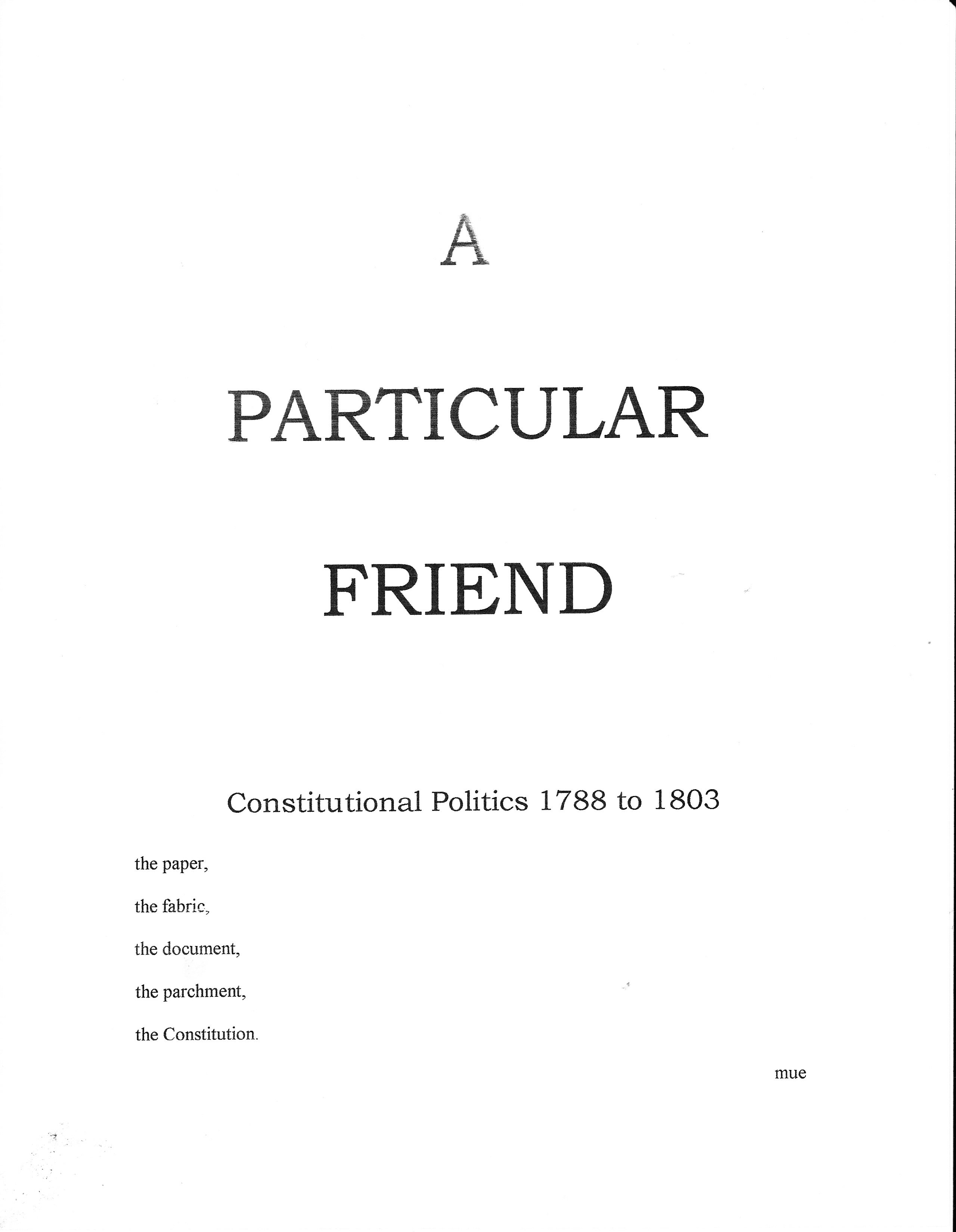
Within the last ten years I bought a computer but didn’t write with it for two years. I wrote a history, non-fiction, A PARTICULAR FRIEND, Constitutional Politics 1788-1803, James Madison’s activities to get the government and the American people accustomed to the Constitutional after 1789. A PARTICULAR FRIEND is on the iBookstore, michael ulin edwards. I put my notes on the computer and realized I needed no complicated outline or involved index to the sources: I only needed keywords to take me from source to source, and to reference related sources. The writing of A PARTICULAR FRIEND was quick.

Image


I submitted the book to New York agents and surprisingly I found many points, unique to this history, were obliquely and sometimes directly made in histories and biographies of Madison and the early “Federalist” period, published after 2008. One reference is important and related to the stature of “common law,” an important issue in the 1790s, and finally disposed of in 1938 by the United States Supreme Court. A PARTICULAR FRIEND was never cited by that historian writing a large survey book for academic courses. I call this a New York Taking.

How do I know someone borrow points from A PARTICULAR FRIEND? To know about this case, the historian has to have Civil Procedure in law school, a first year class. Next, the historian has to make an association from the issue in Civil Procedure to the 10th Amendment of the US Constitution; it is helpful to have Constitutional Law in the Second Year of law school. I note in law school no one make that association between the Civil Procedure case and Constitutional Law. The third step is realizing that the issue in 1938 before the Supreme Court was the same issue, Madison was attacking, in the United States in the 1790s. Finally, out of the blue in 2010(?) a publisher contacted me and asked for my manuscript. I supplied it. I never heard from them again.

What I wrote in A PARTICULAR FRIEND is better and more insightful than that historian, who for his history digested, summarized and regurgitated published histories of those times. 

No credit, adopting stories and taking outlines of existing stories to be rewritten by a commercial writer happens. It is not fair. I am used to it, because in law where I was primarily a legal researcher, stealing happens all the time.

HOWEVER, the writing of A PARTICULAR FRIEND broke me of the typing, make copies, edit process. I had a manuscript on a computer where I could work it and get it into shape without making a copy. Printer ink is an expense to avoid if the same result can be achieved by  changing the way the mind thinks and works.

Now a manuscript of mine has come out so confused, I need a hardcopy to rewrite or make any other sense to it. If it is on the computer I’ll realize the writing is a mess and no rereading, cutting and pasting, no added passages will carry me toward a future produce. I suspect I may have started one book and written 10,000 words, and begun a second of 25,000 words. A hard copy will give me distance and allow me to work with the writing and present a story.

WHAT TO DO ABOUT AGENTS AND NEW YORK? Trust can not be extended only by writers. I am trying to get manuscripts like A PARTICULAR FRIEND read electronically, rather than pay for the bureaucracy filtering and censoring everything.

So here’s the blog.

READ IT!

VERONICA – Mary Gaitskill

Some snippets on the cover say this story is about beauty. There is much more: A realistic painting of life in the big city, and characters who cannot escape the whirl: Death, life, growing and maturing and love round the novel. 

The story is told by a young model for ten years of survival. She is beautiful but doesn’t know how to comprehend it, work with it and protect herself. Innocent and unaware she lets herself be abused, and that is the life in the big city, Paris and New York: One insult after another ending in terror and horror. The reader senses what happens in Paris is originally decadent whereas New York only produces simulation and derivation.

Beauty goes beyond a physical appearance, until the model feels ugly. As her boyfriend hits her trying to force her to admit she is beautiful, she sinks into the experience appearance has given her: living life can make a person, who is conscious, ugly. The reader understands that discouragements, insults and crudities started the abasement before the violence.  

The model remembers everything. Her memory is supported by literary devices. Gaitskill conceives motifs which she carries through the novel: Rigoletto, The worm goes in... These motifs suggest analogies, metaphors and allegories. Gaitskill tells the tale in lustrous language – the turn of the phrase, similes, metaphors or an unexpected noun. The language gains momentum as the reader creeps into the fright of life in New York. Life with her family is real. Having returned from Paris, the model staying with her parents, returns home for the evening: 

“I kissed Ed on the cheek and got out of the car. In the house sat my father, drinking beer and waiting for dinner. La Traviata was on the record player: I said hi and walked through the room. Sara was in the dining room, crouching an inch away from the TV straining the hear over the music. My mother was in the kitchen, stirring a fragrant pot. How I loved her. How I didn’t know…”(97)

An event in New York seem more fanciful: 

“When we came out, Nadia had moved on and the air of the room had changed like the sea in the wake of a great wave. All the little creatures and shells still stirred, fitful and chaotic. An oyster sweating in his cream-colored shell was talking into a microphone about something nobody could hear. A laughing blond bit of seaweed rolled against a scudding black-haired pebble and they slid down the wall, laughing. Patrick said, ‘Honey, let’s go…'” (175)

Readers might wish Gaitskill would jot down more sentences, but she doesn’t need them. She knows the rule about constructing imagery – economy, efficiency and less is more.

The language allows Gaitskill to shift the voice. The story becomes less of a telling of the model’s experience, struggles and growing. It slides to the model’s impressions of those things: The model stumbles and never finds love; Veronica lingers and dies of AIDS. But love and illness are combined: Veronica’s bi-sexual lover gave her AIDS, and yet Veronica describes the relationship with him, which would make any couple in marriage happy.

Because the model doesn’t see Veronica fade everyday, the reader can believe the model cannot relay the on-coming doom. Gaitskill chooses an easy foil to produce a crushing literary impression and an entertainment disapproval. The model goes to a club and hears a rock band. She realizes:  

“I drank and bit the rim of my plastic cup and lost myself in the music on the sound system. I had succeeded. I had become like this music. My face had been a note in a piece of continuous music that rolled over people while they talked and drank…No one remembers a particular note. No one remembers a piece of grass. But it does its part. I had done my part….    The band came on stage.” (209)

“The room was full of life that wanted forms to hold it [dandified feelings], and it wasn’t picky. Neither were we. We watched as if we were witnessing the preservation of a place in our collective heart – a place that had once been primary that we no longer knew what it was or where it was. And now we felt it: secret and tender, and with so many chambers…   There was Veronica alone in her apartment, locked in full engagement with forces the musicians lightly referred to. The song said nothing about any of them, but they were part of it anyway.” (210)

“…I wanted to tell her [Veronica] this. I wanted her to know that even though she was dying, she was still included in the story told by the music.” (211)

From her distended thinking, the model is returned to reality. Hearing the delight and sensations, Veronica says, “This isn’t a rock song, hon.” (211) 

Growing and maturing by experience is the most pitiful way of life. Throughout Veronica the model goes to jobs, goes out to eat, goes to clubs, drinks, does drugs and meets the wrong, unsavory people engaging in the same or similar activities. There is sex but no love anywhere, beyond a rock song and its collectivity. The model has seen much and lived the sad life of Benjamin Franklin’s aphorism: “Experience keeps a dear school, yet Fools will learn in no other.” Poor Richard’s Alamack. In the end the model has hepatitis. 

There need be no explanation why the model never avoids the desultory lifestyle. That is not the story. But within the story one senses that New Yorkers have pets, small dogs and cats, not only to have an animal to love, but also as an excuse to stay home and avoid the scene.

Parents may not like Veronica, but if they are conscious and aware, they know it represents reality. That world has only become more intense and detached. Veronica is a book for every teenage girl in America, filled with nothing in mind but dreams – marvels, glitter, beauty, wonders – to  read: In a few years the hounds of hell will be upon you – your body, your mind, your mental well being, your financial well being, your health. LIFE – Get ready for it. Beauty doesn’t protect you. Beauty makes you a target. Youth is gone with the first life experience.

An attempt to write about New York failed, yet it is assigned in most American high schools: The Great Gatsby which I previous reviewed, “Loathing Gatsby.” On literary merit, as a depiction of New York and as a reflection of society, Veronica should replace Gatsby as the book to read in high school. There is no character as weak and unreal in Veronica as Gatsby and Daisy are in Gatsby. Yes, Veronica is frank, detailed, obnoxious and objectionable. But what sort of literature do Americans want their children to read? Do Americans want their children to be educated to the world? Should American children know they can read, anticipate and be prepared? Literature can do that. Or should Americans take their dreaming daughters to the water and toss them in and watch them drown?

Veronica is a distaff book. The model activities and thoughts return her to her family. There is realization, understanding and reconciliation. The book ends with “I will call my father and tell him I finally heard him. I will be full of gratitude and joy.” But in the book the exploration for love by the model and by anyone else is incomplete, in the society reflected by the ersatz entertainments tearing participants and the audience apart.

There is no great explanation of what love is and how it should survive – perhaps living in New York with pets. What are men supposed to do? That answer seems carry an ample supply of condoms. Veronica presents a hopelessness about the state of love in society. Love needs a platform protected from the whirl. This is an issue that Americans can resolve.


RISKY EDITING

THE LITTLE FRIEND by Donna Tartt

I heard much about this author and decided to give her a try. Tartt likes long and longer sentences. When I experience authors using long sentences, I am inclined to send each a bag of periods.

In History of Florence, Ferdinand Schevill, Ungar, NY, 1961, has many long beautiful sentences conveying a paragraph’s worth of information before the period arrives:

“If we now remind ourselves that Boniface VIII belonged to a lesser clan of the Roman Campagna, the Caetani, and that throughout his early life he had been exposed to the slights of the greater lords, we have no difficulty in understanding that from the moment he commanded the unbounded resources of the papacy he resolved to raise the Caetani to a level with the oldest and most powerful barons of the capital.”(page 168)

This sentence states a longstanding motivation of Boniface VIII and supports inferences why other Roman and Italian families did not like and back the upstart Caetani clan. It also explains why in 1308 (ten years later) when the French sacked Rome Boniface VIII had no friends.

That sentence has its own motors. The reader goes from facts to more facts defining further the subject and other nouns all without a dependent clause following the verb. There are no semi-colons; colons and parentheses. The author has set up the motivation, ability to use power and the projected results of using power.

In The Little Friend Harriet, girl growing up, tells the story of the family. It is the South of the 1950s and 1960s. Every scene in the book may have happened, but readers don’t need a chronicle of a family’s life. The sense that events are similar makes them indistinguishable; family members dwell on nonsense – what-ifs and what-might-have-happened is conveyed. Here’s a sentence about Harriet’s and the family’s outlook: 

“She possessed, to a singular and uncomfortable degree, the narrowness of vision which enabled all the Cleves to forget what they didn’t want to remember, and to exaggerate or otherwise alter what they couldn’t forget; and in restringing the skeleton of the extinct monstrosity which had been her family’s fortune, she was unaware that some of the bones had been tampered with; that others belonged to different animals entirely; that a great many of the most massive and spectacular bones were not bones at all, but plaster-of-paris forgeries. (The famous Bohemian chandelier for instance, had not come from Bohemia at all; it was not even made of crystal; the Judge’s mother had ordered it from Montgomery Ward.) (page 40)

There are oblivious problems, the first being this is a summing up, which runs on. It is better if a novelist tells the story and allows the reader to sum up – reach the conclusion the author wants the reader to make. This sentence sits in the novel like it was an outline point, which should not stand out in the text.

I added the sentence in parentheses because the words or sentences in the parentheses inferentially relate to something that came before. However, it seems improbable any sentence should start with “the narrowness of vision” and link it up with the great family lie, the Montgomery Ward chandelier.

I have been around long enough to know “the narrowness of vision” and “restringing the skeleton.” The secrets and the “dirt” about families are not about whether something is gold or brass, something easily discovered on “The Antiques Roadshow.” Family secrets are about conduct, behavior and thoughts. I would know more about my family not from the filtered fables about favorite souvenirs, but how family members procured their liquor during Prohibition, from whom and how far behind was Elliot Ness.  

There is a lot of parentheses use in A Little Friend. It is irritating. I decided to look it up. Perrin, Smith, Corder, Handbook of Current English, Scott, Foreman & Company, 3rd Edition, 1968, tells, “Parentheses are curved marks used chiefly to enclose incidental or explanatory remarks.” (173) “Parentheses are used to enclose remarks and asides that are not essential to the meaning of a passage.” (174) In essence parentheses are notes or footnotes in another form. A Little Friend uses parentheses correctly but does that use make it a novel?

It is still Harriet’s tale later on:

“Pemberton Hull was driving home from the Country Club in his baby-blue ’62 open-top Cadillac ( the chassis needed realigning, the radiator leaked and its was hell to find parts, he had to send off to some warehouse in Texas and wait two weeks before they arrived but still the car was his darling, his baby, his one true love and every cent he made at the Country Club went either to putting gas in it or to fixing it up when it broke down) and when he swept around the corner of George Street his headlights swung over little Allison Dufresnes sitting out on her front steps all by herself.” (page 104)

I don’t need to know the state of repair of a character’s tuna boat. What is amazing is the car made no noise as it came up the street, and Harriet was upstairs on her bed near an open window and didn’t hear it. When Harriet talks to a boy from town, he mimics the car by sound. (108)

The realization readers have after plowing through The Little Friend (more than 200,000 words) is, how many extra words will I read by the end on page 540? After reading the first 50,000 words, I figure I had read an extra 15,000 words – 75,000 words possible total which is another novel. I refuse.

These words exist in The Little Friend because someone failed to edit it and next blue pencil the text. Long sentences, semi-colons, colons and parentheses return me to my days when I wrote law. I know legal writing when I see it, and The Little Friend is written like a lawyer wrote it. It is informative and mostly clear with a caveat: Legal writing is better organized. A Little Friend is lawyerly not literary.

The types of writing to pass information or to tell a story in a novel is a grand canyon. Each presents opinions; each should present a consistent point of view; each presents the entire opinion in steps. But informational writing follows those guides in every document in order: A, B, C, D. Opinions and their arguments in literature can bounce around: A, L, Z, Q.

In literature an author communicates her imagination; she does not communicate information. Authors shift the order of presentation of opinion: A, L Z, Q may be it. But other devices give structure and order to the story: Voices. There can be more than one. All voices must be distinct from the standpoint of the character: education, biases, prejudices, age, status. These voices pass into dialogue.  In The Little Friend Harriet’s voice seems similar to those of other characters and their dialogue. The drawback is compounded by a united style [or presentation] of writing. For the reader all the characters become the same.

The paragraph about repairs needed on Pembarton’s car would have been better placed earlier when Harriet talks to him: She had introduced him before and knows his “one-true love.” He likely would have mentioned the car, if given the chance because he talked about the car with everyone who would listen. Pembarton also talks about Harriet’s sister. The car arrives but Harriet doesn’t describe any sound, or its effect on her. (104) The sound comes from the boy on page 108. In a novel the characters and the car, obtaining character-like traits, should relay a vignette. Weave the facts into the story about the people rather than data dump: (1)Pembarton’s car, (2) Harriet’s sister, (3) who is Pembarton.  

I tired of reading informational clumps, and stopped when family members began talking about the son, ten years dead, who would now be at college in a fraternity… I realize there is a story in The Little Friend, but it is not well put together. I don’t want to read it.

P.S. I glanced at Donna Tartt’s new book, The Goldfinch (700 plus pages) and was disillusioned. There are words in parentheses on the first page! What type of author has a writing style using parentheses?

HISTORY AND FICTION

bitch. cover

When I went to write Bitch. (iBookstore, michael ulin edwards), I was determined to make it autobiographical. I learned after three major drafts and a long process of 20 years, that autobiography was impossible. It would make a bad book. Some of the reasons can be found in Twentieth Century Journey, William L Shirer, vol. i, Preface; Autobiography of Mark Twain, U.C. Press, Berkeley, 2011, vol. 1, on writing memoirs/autobiography.

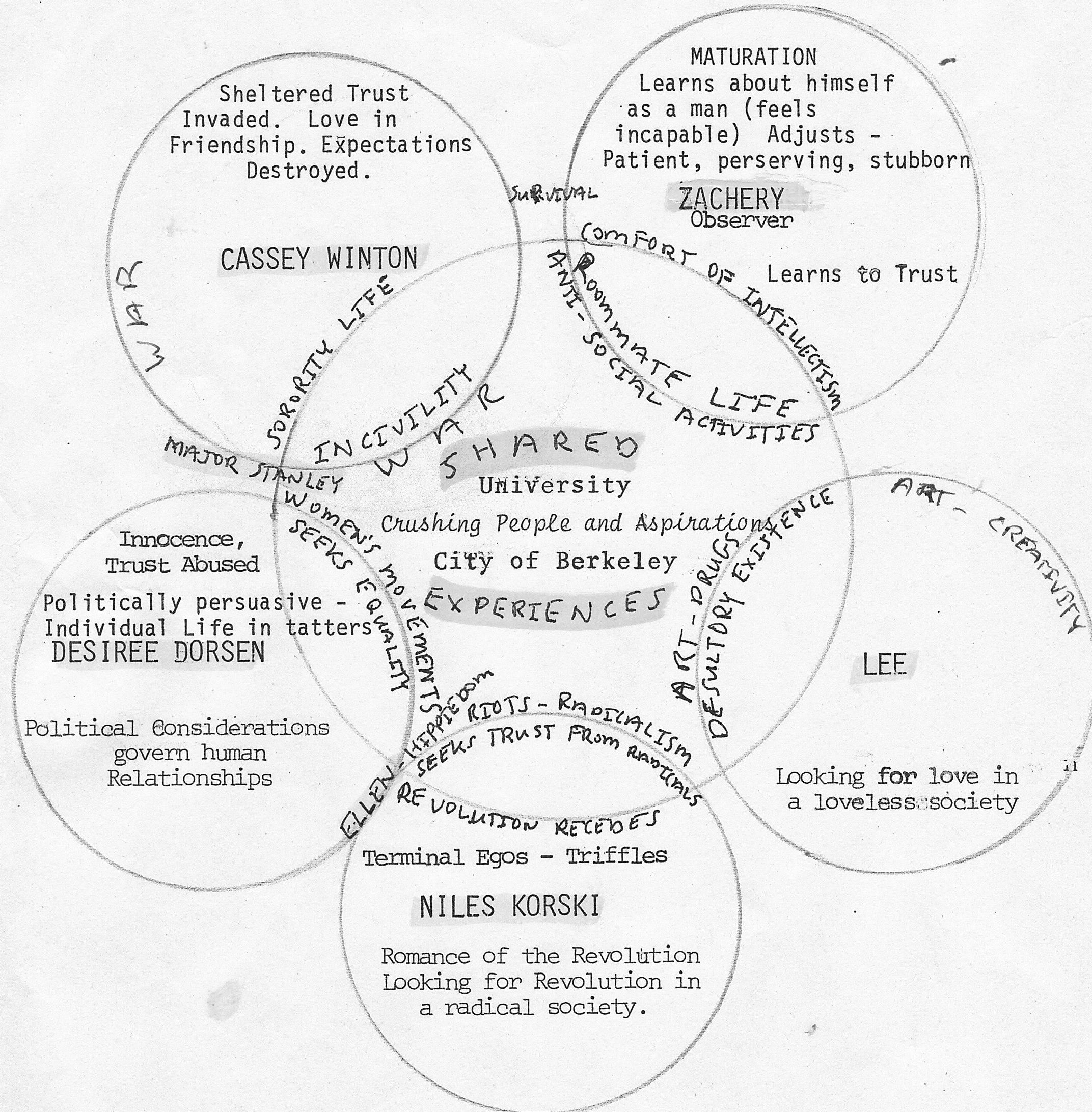
I was motivated to write the life and times of Berkeley, 1968-1973. While there I had forces coming at me. I determined they would best be represented by FIVE major characters, plus subsidiary characters folded into the stories of the FIVE. At that point the book could not be autobiographical; it could not be biographical. It could be history. Recount events as truthfully and accurately as I could, but the characters had to be representations. [Readers have commented that they know these characters.]

As much as I ran from place to place in Berkeley, observing and stuffing everything into my memory (which is not entirely why I almost flunked out my first year – I was also taking the wrong classes and my perspective on learning was horribly distorted), I could not tell the story of Berkeley with one character being everywhere at once: Peoples Park Riot Day, May 15, 1969 – in class on the north side of campus; in the riot itself; at the swimming pools in Strawberry Canyon; wandering around Dwinelle Hall. The FIVE characters and others were useful to convey what had to be said.

It is also impossible for a individual to tell his story when hormones, urges, the environment, economics are exerting influences affecting the person. What is the order? What is the priority? What is important? Those day to day, sometimes hour to hour or minute to minute considerations which may or do change affected human being senses – hear, see, smell, feel, taste – will shift the ground and upend any story.

If the reaction to life under those circumstances is the same, that makes for a dull human being. If the reaction to life under those circumstances whipsaws the human being into incapacity, he becomes confused and worthless. If the reaction causes the human being to take the brunt of it and react intelligently, predictably or making-do, that is the easier story to tell.

IMG

In 200,000 words I came up with the FIVE characters, two guys and three women, living and telling their lives (some aspects of my life) in Berkeley from September 1968 through the summer of 1973. They lived through riots, demonstrations, classes, drugs, life, city and academic events and state and national actions, all told within this novel. [There are 450 notes and a bibliography.]

Also, I could not tell my own story for a personal reason. Who could be truthful about being psychological creepy and sociology awkward then, (probably eccentric today) in a terrifying place. That doesn’t describe the discomfort, the violence and the shock of watching crap on the streets being played out and the acceptance of it by everyone in Berkeley. About 20 years ago I talked to someone I knew as a student. He tried to fit in and spoke the language as a student. His evaluation of those times upon meeting him again was reduced to one word: “Strange.” He didn’t want to talk about what he thought or was doing as a student, which was likely “creepy” and “weird.”

It seemed I was the only person who considered everything going on was strange, weird and ill for society. I may have been suited for a college campus in the 1920s, but I was stuck at Berkeley. I did not want to be a statistic and a loser: Someone told me when I entered that the average stay of a student at Berkeley was four quarters. (The University is much more mellow today which is why it is not a place of excellence.)

While a student at Berkeley, I didn’t like and actually detested loud music, drugs, and the recklessness of students, their lives a step from the street. Everything seemed reenforced by the citizens of Berkeley. Condemning this gross, communal lifestyle is a theme of Bitch.. Indeed, I dislike any communal styles, community standards, something my generation embraced and never let go of, and something which has been passed onto to their children and grandchildren: The collective.

We are not raising children today to be individuals, to think on their own. They are accepting, too much of collective action, group-think, the so-called common good. They have been taught, It Takes a Village – Collective actions are the bases of all advancement. Those are  wet dreams rolling from the Left of the Sixties and from Radical Feminism. (See Shulamith Firestone, The Dialectic of Sex.)

Finally, I did not want to be like any of the FIVE. I put a lot of distance between myself and Berkeley. Not in the novel is: at the end of my Berkeley studies, I wanted to be a composer, but I had injured my left hand and couldn’t play the piano. I was lost to the activities I was prepared for. Law school intervened, but within ten years I had turned to writing.

This post is the second using the cover and the diagram (outline) that I have made. The subject is different because the text differs.

Mind the Mud

The sensational, the gruesome, the weird and the curios are in the papers, on the news, crossing the Internet and everywhere in entertainment. I suppose it is human nature to seek out what or the how-did-that-happen stories and know that it did happen. It is a guilty pleasure to read the details of a law school classmate who embezzled client funds again, again and again. So much for professional responsibilities and legal ethics. Americans put distance between themselves and the act. Americans are acquainted with Michael Jackson’s death, but what about a STRANGE, VIOLENT EVENT: The psychological evaluation of the Sandy Hook elementary school killer and an accompanying evaluation of his enabling mother: She frequented the local bar and talked about gardening, guns and target shooting and  her brilliant sons. One son was home making his reality shoot-em-up computer games.

American interest in acts of perversion, terror, violence, illness and crime is limited. Our understanding of why, what and when is superficial: X killed seven pedestrians while fleeing the cops in a car-jacked Porsche with a baby in back. Forget the trial. Wow, someone can write a book and make a movie, which will obliterate the actual events and make new reality. Perhaps Americans know; perhaps they don’t: There is a wide, deep morass of procedure, time and law consuming every single criminal act before trial and before society’s resolution comes.

Americans simply lose interest [except those concerned and those victimized]. They hear the outcome two, five years later and believe there is an ending. If behaviors, actions and society must change, Americans have to know more than the beginning (the act in the news) and the end years later. Americans must follow the whole process. We cannot rely on a cadre of interested attorneys, doctors, politicians, lobbyists, Warren Buffett, businessmen, accountants and journalists to represent and do good for the country.

My reaction to the current blitz as a writer, is to organize my mind before writing a story. Usually I sit and observe everything. I lose track of steps C -X. I’m diverted trying to be sure what I spend the most time on has merit and quality. I watch movies of quality; I visit museums; I read good books of fiction and non-fiction; I hear great music. I collect as many facts, words and impressions into my mind until I’m frustrated and need a release – filter through the garbage, selecting, and put something on the page. That logjam is released slowly. With luck I’ll organize it well as it comes onto the page, but frequently reordering is necessary many times afterward.

Likewise Americans hear of these horrible events and occurrences; they are exposed to loads of trivia, minutae, tripe and are pestered for long periods of time with nonsense. It is no wonder they hear of the act, shameful, violent, outrageous, an enormity, and let it go, perhaps hearing the end if they ever make the connection. Those Americans don’t have the release I have. I write. Everything within them is bundled tighter and tighter. It is further no wonder that Americans seek all diversion from the terribles and the troubles of this country. I can not blame them.

Americans go so far in their entertainments that they only become aware when a big shock hits the news, an act mindless and futile as the death of any child killed in a crosswalk, frequently a non-news incident. What is happening in this country is THIS: Our imaginations are not as active and adventurous as the stimuli we receive. Human beings have not evolved that much. For instance, October 9, 2013 was a non-news day: No assassinations, no wars, no terrorist attacks. Consider items I found on the Internet that day:

Teen shot while having sex

Eight year old pleads with 911 dispatcher while Mom dies

40 year old mom found nude in teenage boy’s closet

Montana Fishbourne says Twitter hacked – she didn’t out Jamie Foxx

28 men may be charged in 11-year old’s rape

16-month old dies after being dropped in boiling water

The news hasn’t gotten better. On the last weekend of the year cross-racial adoptions senselessly became an issue.

Nobody in America wants to watch this movie or TV program. It is easier to ignore it to our detriment. Ignorance and silence suggest consent – do your own thing; let it be; there is nothing anyone can do; don’t be judgmental; these are trifles. This is the tripe Americans now accept. It is wrong.

In 2014 Americans can do better

DEATH IN THE FAMILY

I should say Merry Christmas and Happy New Year before I note that this is the time of year we notice there aren’t as many people in the family, or young people in the family are suddenly sending cards.

I’ve never been good at expressing condolences to a spouse or to a family member, yet I this year two relatives – fathers with wives, children and grandchildren, good providers looking after their own family but not looking after their own health, in their early seventies. They are gone. I’ve known each man almost my entire life. I’ve seen each infrequently. I feel close to each family, each unrelated to the other and neither is aware of the loss of the other.

The first man was a second cousin whom I saw when young at family gatherings. I was at his marriage. He moved away; he was an excellent businessman. I was ten years young than he; his kids were 10-15 years younger than I. There were family stories which we rumbled about or clipped through, depending upon the time we had to talk. As a teenager I attended his brother’s wedding, and the men in the bridal party wanted me to drink beer with them. Instead of being “corrupted” by them, I mistakingly said, “You’re trying to corrode me.” I was known thereafter by that part of the family as “Old Corroded.” The last time I saw this cousin I told him “corrode” not “corrupt” was the right verb. “How do you know?” “My liver told me.”

The other man lived farther away; I saw him less. He was married to a warm, wonderful first cousin. He was a man of definite opinions and strong feelings. I did not agree with him, but I always listened. One must listen to people who disagree with you, to test yourself, to know about other people in society, and to be able to learn not only for the limited confines of the human intellect and sentiments, but also to be a better person: Learn, listen, courtesy and politeness. See the world through the eyes of another [we may not always like the view]. And if necessary fall back to toleration: I have opinions and know better, but I tolerate you. I did not see this man enough to have that full engagement and experience.

I wrote the families rather than called. I don’t have all the words in me. How many ways can anyone say “a good man,” and not sound facetious? Equally so: “A sad loss.” “Everyone will miss him.” Those would be egotistical and presumptuous of me. I can imagine the thinking of the wives while listening: Hell, you hadn’t see him for 20 years! Do you believe anything you’re saying is true? He was in a lot of pain; that is gone! What makes you think I want to revisit any of this? 

The letters imparted my sentiments and let the families mix their impressions and mine.

LARRY

“The logic of Michelangelo’s David, Beethoven’s Ninth Symphony and Einstein’s Physics [has] been replaced but that of the Stock Exchange Year Book and Hitler’s Mein Kampf.” Eric Ambler, A Coffin for Dimitros

The naked guy was a student who used to walk onto the Berkeley campus wearing only shoes and a day pack. He went to class. I saw him once or twice. He wasn’t bothering anyone, but he eventually was disciplined and left the campus.

Thereafter, the University of California at Berkeley had nothing cultural or artistic to offer the world. Nothing was engagingly odd, alluring entertaining or unique. The campus needed something to contribute to American culture. One day in the mid-1990s a black guy named Larry showed up with his drums and a stool. Larry sat in the middle of Sproul Plaza from 10 a.m. to 4 p.m. and pounded his drums. Some passer-bus claimed that Larry varied his beats and rhythms, but most knew Larry had one routine and it was very annoying and loud. University employees in the west facing offices of Sproul Hall, in the Student Union and in the nearby cafeteria were crushed: Pounding every academic day of the semester, day after day, hour after hour, second after second.

Larry would talk to people and acknowledge others as the parade went by. He claimed to be a drum teacher and was in Sproul Plaza drumming up business. The pun was intended. From the campus police station in the basement of Sproul Hall came authority, after about a year. An arrangement was reached. Larry would move 150 feet sound to the intersection of Bancroft and Telegraph. He could pound his drums all he wanted on City of Berkeley property.

If the University of California had known and correctly realized where City of Berkeley property started in 1964, there would have been no Free Speech Movement.

Larry moved south and changed his hours, 11:30 a.m. into the evening. Same drumming, same parade and a different audience hearing the pounding, heart rendering thunder now across the street from second story apartments. Larry could be heard two blocks away, over traffic, voices and the business of the city. 

Larry was there a long time, a new students wondered why the noisemaker was tolerated and allowed to disrupt the peace near the campus. There were complaints, but the University cops laughed, and the City police had more important matters than objectionable art to fuzz.

I had my car near the University a few years later. I was driving a friend from Boalt on the east side of campus to BART near the west side of campus. It was a warm and pleasant fall evening as we drove west on Bancroft Avenue. As usual I had to stop at the traffic light at Telegraph.

To our right about 30 yards ahead on the sidewalk was Larry pounding his drums. My friend has a voice that can carry a quarter mile. I said, “Tell Larry he sucks.” Down came with window.

As I peeled out, my friend boomed, “LARRY, YOU SUCK!” 

We had driven a half block when we heard the drumming stop.

Shortly thereafter Larry stopped drumming at Telegraph and Bancroft, period. It was the end of any contribution from the University of California at Berkeley to American culture. Imagine an artist stopping all effort because a complete stranger yells, “YOU SUCK! It happened, and that is the only possible result when the artistic effort and cultural contribution is ephemeral, for the moment, temporary and offensive. It’s foundation was based on public indifference backed by the worst of all human attitudes: Let him do his thing.

Americans are unwilling to draw distinctions; they don’t want to be judgmental. But all art and surviving culture is judgmental; What exists and survives is excellence, not something that people have ignored it. Yet Americans usually will pay to witness mediocrity. The choreography by cheerleading squads at most high school football games exceeds that of dancing by song-singing rock stars. Yet people pay big bucks to see the two-stepping lip-syncing robots on stage. There is one feature not available from the high school units. If the dancing and songs are not catchy in music performance, perhaps removing clothes, using drugs or being arrested for beating up someone will attract fans..

And what of the great talent from the music world. Some of it isn’t much better than Larry’s drumming. In a writing by a blogger this month, he wrote that classic music should just die. He correctly pointed out that concert halls were expensive and musicians were always asking for money. He omitted a egregious, parallel comparison: The money spent to build stadiums for professional athletics to benefit owners and athletes. The money spent there dwarfs the money spent on concert halls and symphony orchestras, and no one, if ever, tears down or stop using a music hall. Whether professional athletics is a worthwhile cultural activity is an issue I will not deal with here.

But to the doubting blogger, does he know how long it takes today’s musicians to put together an album of 75-90 minutes? It took George Frederick Handel 25 days to compose Messiah, including the orchestration, about 150 minutes of the arguably best choral music ever composed. Or try being blind and old and compose arguably the best choral music ever composed: Bach did it in the B Minor Mass. Or be DEAF for eight years and compose music that became the best symphony, and perhaps the best music ever conceived and composed: Beethoven did that in the Ninth Symphony. PLUS Beethoven may have been unhappy with the fourth movement of that symphony and considered writing a movement without a chorus. Listen to the whole symphony and wonder why Beethoven may have been unhappy.

In the field of human achievement Messiah, the B Minor Mass and the Ninth Symphony surpass artist achievements in most media. Americans could learn and appreciate much if they knew these works – if Americans replaced and oriented themselves to them rather than let themselves languish and linger, YOU SUCK in the bogs of professional sports and their rock concert fore-times, half-times and after-times.

I would rather spend money on fitful classical musicians than waste money on fitless professional athletes. 

SILLY CULTURE

“The logic of Michelangelo’s David, Beethoven’s Ninth Symphony and Einstein’s Physics [has] been replaced by that of the Stock Exchange Year Book and Hitler’s Mein Kampf.” I like this sentence from Eric Ambler’s A Coffin for Dimitros. 

What does it mean? It can be stated as a sinking bottom line i.e. when there is no foundation there is no building and no edifice. The meaning can be found in other ways. I must paraphrase H.L. Mencken: No one ever went broke underestimating the intelligence of the American public. A third way of saying the sentence comes from Georges Clemenceau covering the American Civil War for French newspapers and in World War One French Prime Minister: (paraphrased) America went from barbarism to decadence without the usual intervening period of civilization.

A question always arises is the relative importance of culture and its excellence to society, the economy and to a nation’s well being. Until 1870 France was becoming a stilted, static place. After a crushing military defeat in 1870 and a harsh peace of 1871 France transformed itself initially by culture. In the fine arts French painting, music and sculpture excelled and pushed the envelope in those media. France became the place to write, paint, sculpt and compose, a reputation it maintains. France is the most obvious example telling the importance of excellent culture and artistic output and those significant influences they have on the people of the country. In short excellent culture allowed France to rebound quickly and strive ahead.

When culture and art become idleness, slight entertainments, annoying diversions or amusing ephemera, it represents nothing more important than something produced on an assembly line – pieces of throw away stuff. How often do Americans hear about a one-time “priceless” work of modern sculpture sold for its scrap-metal value, like a Pentagon weapon system gone bad or an awry government computer program? Art is supposed to entire forever, not be dismissed because it has served its purpose: The artist [creator, originator or mechanic] has been paid and has garnered more commissions off the recognition of the sale. Yet Americans continue to treat music, painting, writing as something thrown against a wall, and if it sticks it will be there offending until it the environment forces it to fall off.

Culture allows a people to backstop problems, issues, events and potential solutions. It lets people retreat to what is good about the society, perhaps live a fantasy or a dream, while the pile emits its bad or good seeps from it. What has a solid footing and does not seem obviously derivative, inordinately temporary, brazenly artificial may survive, be accepted and become part of the lives of the people. But that seldom happens. Today what remains of art produced 10 years ago? About artists I know of, musicians, which pieces of music introduced in 2004 are played today other than franchise themes? Music to TV shows, ads, ditties on computers. The best anyone can say about America is that it is in a rut; it is at sea without an anchor. The backstop supposedly holding American culture is actually a canyon into which we empty more and more stuff. 

Alarmingly, Americans seek solice not in the excellence of human activity and production, but in religion, faith or secularized philosophy. No one can disagree with those individual choices, but they provide and afford few, if any, comprehensive solutions. Religion, faith and philosophy are terrific means to provide comfort to individual means and to guide individuals, but extending those belief systems are not conducive to acceptance or they are offensive to persons with contrary religions, faiths and philosophies. Imposing laws are to force compliance is coercive and debilitating. It results in less respect for law. Because law seems not to work, Americans attempt to rectify imperfections by voting solely for representatives who believe in their religion, faith or philosophical systems.

The so-called Right has justly been accused of voting this way. The so-called Left also votes this way. The commonality of Left and Right is the means of obtaining money and power, but no community remains – Right or Left. And there is no culture except a buzz, a ring, static, a din. And Americans are left to accept the meager entertainments coming to them cheaply and engaging them momentarily. None of it feeds the spirit, the enlightens the soul and fills the essence. None of it braces an individual for the uncertainly of tomorrow.


A COFFIN FOR DIMITROS – Eric Ambler

“The logic of Michelangelo’s David, Beethoven’s Ninth Symphony, Einstein’s Physics [has] been replaced by that of the Stock Exchange Year Book and Hitler’s Mein Kampf.” The author sets out a story – the “special conditions which exist” – to develop this theme. As I view the world, Ambler may as well be writing about the Clinton, Bush and Obama years in the United States of America.

Protagonist, Latimer, is a writer of detective stories. In Istanbul he meets a Colonel of Turkish intelligence who has outlined a detective story but can’t write it. He gives it to Latimer to write. He also offers to show Latimer the body of an international criminal, Dimitros. Latimer sees the man and learns what the Turks know of his activities – spotty before 1924 and a blank after 1924. Latimer decides to learn about Dimitros’ political, criminal and financial activities in those missing 14 years. 

For 100 pages the story is an obligation to read. It could be improved by Ambler telling of Latimer’s curiosity to investigate as a writer. Otherwise, Latimer seems flat and a gadfly. Also when faced with dead time in a story, an author can improve the tale in one of two ways: Tell a better story, OR improve the language used in the telling of the story. Ambler finally ponies up with the second method:

       1. Who is the mastermind becomes “who paid for the bullet?”

       2. Darkness of human existence became “baroque of human affairs.”

       3. “wrinkled flesh” is “raddled flesh”

       4. A sentence “People were dying faster than if you had machine-gunned them.”

       5. An adversary learns that Latimer’s passport says he is a writer, and he says, “…writer is a very elastic term.”

If some of these phrases and sentence offend, the time of this novel is Europe between the Wars. There is a chapter on white slavery and drug dealing in Paris, circa 1930. Many of the victimized prostitutes were from Eastern Europe. I thought this novel was a prequel to the movie, “Taken.”

Tomorrow I shall blog more about the gross statement of the theme of A Coffin, but this book demonstrates with little effort and few additions to the text that something of substance can be included in a tale of international crime. Ambler makes his book a statement of his times, a mirror of society. 

What does the first sentence of this post have to do with crime and A Coffin? When one person or hundred of persons are allowed to shirk the law, step over its lines repeatedly, make fortunes, become prominent and be protected, that makes for a very different society than the one popular in political mythology: Everyone plays by the same rules, has the same opportunities, can pursue happiness, can contribute to the general weal and gain the esteem due a member of society. In the first described society, select people abuse and take advantage and rob. Under the political myth, it is assumed there is organic growth to the betterment of everyone.

Most Americans prefer the political myth, but they don’t always know how to achieve it. They neglect standards, criteria and values. One area where Americans have abandoned all caution: Countless American entertainers and artists, purporting to be part of the community, are abusing the system: They don’t entertain; they aren’t artistic. But why denounce easy targets in the United States?

Look overseas to Russia and the band Pussy Riot. In a church that band decided to perform a desecrating concert and publicize it. The performance was devoid of art and was bad entertainment. If Pussy Riot does not shock with the band’s name, it shouldn’t perform in a church for “more shock value.”

They were prosecuted and imprisoned, which only enhanced their name in the West. Pussy Riot became a cause celebre. Rock and roll musicians asked they be released. I do know if Pussy Riot committed the crimes like trespass or malicious mischief, but years in prison seem long. Although devoid of art and being poor entertainment, the West is ready to bestow awards, riches, fame and adulation on Pussy Riot. That is a mistake. There are no standards, no values, no excellence, just publicity. The West, especially America, cannot give Pussy Riot a big- welcome, you’ve-held-up-our-values, you’re-important-to-human-existence. The West, America and the remainder of the World have done that justly and recently. Who out there has the gall to compare the comparative worth of Pussy Riot to Nelson Mandela?

What does Eric Ambler say? If society does not abide by its heroes like Nelson Mandela and conduct, respect and uphold supporting values and standards, society will end with the standards, values and excellence of Pussy Riot, “the Stock Exchange Year Book and Hitler’s Mein Kampf.”