HUE

Frank Bowden

This excellent telling of the battle of Hue (Vietnam, February 1968) needs to be read.

(1) What happened? (2) Lies the American government and military told itself and Americans about the Tet Offensive (February 1968) and Hue. (3) The gallant, unselfish, courageous fighting of United States Marines against forces more than three or four times their number. (4) The lies the North Vietnamese told themselves to pursue fighting in Hue. (5) The military mistakes made by the Vietnamese, South and North, and Communist Part during the offensive in Hue. (6) Mistakes of the North Vietnamese were not capitalized on by the Americans. (7) The effect on the residents of Hue during the four weeks of fighting. (8) The small forces the South Vietnamese had and went through the daily grind of fighting for four weeks.

Somehow Bowden tells of combat, of wounds and of deaths (mostly Americans): Marines, where they came from, their training, their units, companies and a few battalions, where Marines were supposed to go – target, eliminate the opposition, and whom Marines were fighting against. Suddenly, a wound or a death of a Marine, introduced and ended that story. It was combat in a small city, not in the jungle. Everyone was crammed together, ill-supported except for weapons and ammunition, no washing, no hygiene, no clean clothes. Marines asked for tanks and sometimes never had any or enough; they fought with hand-held delivery of artillery, beginning with hand grenades.

There were no drones, no surveillance devices, no way of looking and locating the enemy. There’s no GPS. Hue was an old-time battle.

This book is well-written. Reading it at once takes the reader to the year 1968 and gives readers the sense of what Hue Marines went through, as well as the North Vietnamese, during those four weeks.

The book lacks comprehensive maps, on which every location mentioned, is on a map. There is no listing of maps in the Table of Contents, and what each map represents. NOTE, these omissions help tell of the battle. Every combatant, Marine, U.S. Army, North Vietnamese and Viet Cong were strangers to Hue, and truly did not know where they were: Where was one landmark or building in relation to any other landmark. Indeed, a Marine Lt. Col. took off the wall of a gasoline station, a map of the City (large distances per millimeter) to help orient him and organize his advance to eliminate the opposition.

Bitch. – Third Edition

IMG_0002-1

The purpose of my novel, Bitch., a period not a dot, a verb not a noun, puts the reader on the ground as a student at the University of California at Berkeley in September 1968 and carries through June 1973. It is 200,000 words.

There are loads of details – historical, fictional, contrived. First Edition, First printing was in 2000 – footnotes, bibliography, index and lexicon (words of the Sixties plus sources) e.g. “bummers” came from neither the Hells Angels nor the hippies. In 1864 the scavengers of Sherman’s Army on the March to the Sea through Georgia were known as bummers.

First Edtion, Second Printing is a reediting of the First Printing. Corrected are typos, less “majestically lawless.” In the First Printing one page has one word on it. The Second Printing has fewer obstacles to get to the purpose of the novel than the First Printing.

Before writing and during writing I did extensive research. I was dismayed when bookstores around the University closed in Berkeley: Seven in ten years. Some libraries closed and deprived me of sources. The Undergraduate Library was remodeled and its collection was reduced at least 50 percent. When I arrived to write, the campus had not changed much. I was able to write from memory, research and setting as they had been for decades.

The primary change between the First Printing and the Second was to the name of a character. I was using a pseudonym, Karl Rauh. In German “rauh” means abrupt, rude, sharp, and there was nothing about my writing that was polite, gentle or soft. Bitch. retains the edge of the attack. But I had named a character in the story, Karl Rauh, and a reader who believed she knew characters in the book, observed there was a problem with voices: author/character. I considered that point and took the quickest remedy: I changed the character’s name.

After the Second Printing was published, I was in the City of Berkeley Library Book Store. Someone had brought in loads of boxes filled with Sociology from the Sixties and Seventies. I realized I had a large source of books I had not seen. I bought and began reading, and more out of bookstores and from libraries, perhaps 1000 books. I had 50-100 pages of notes and additions to the text of Bitch.. For instance a little item: I met a woman who would only date on a Dutch treat basis. In a source I found a teenage girl who would only go Dutch treat because she didn’t like the feeling of being “rented” for the evening. That source is end-noted in the Third Edition.

Unprompted by me in 2009 the publisher of the Second Printing relinquished all rights to Bitch.. I was unhappy with the Second Printing because of the errors and its incomplete research and the many references I had overlooked and now made. Scanning the book into word processing would be a complete disservice to me as a writer and to the text which wasn’t perfect. The idea of retyping a manuscript of that length raises NOT the question, Do I want to read this again? Instead, the question becomes, Do I want to type this again? There were words, sentences and paragraphs to insert or move someplace else. Text to add and stuff to delete, and it was all possible because I read the text at 15-20 words a minute, my typing speed. Along the way I was able to reenter the book into my memory, and was able to play with it. I rounded out characters; I made paragraphs complete thoughts; I made the story full, inserting another 10-15,000 words. I added to endnote texts, and I added 90 note references.

[When one is writing about the Sixties and early Seventies, it is good to get facts, thoughts and impressions correct. Many memoirs and recountings are so highly edited to make the representations of those texts farcical and those texts wholly dishonest. Inserting the notes to sources and newspapers of those times at least tell the facts as they occurred. It is difficult for a once famous “personage” of those times to support his fantasies as he likes to remember them today and not as they happened. Many of those people like to write about their feelings. Hence the endnotes and the bibliography in Bitch..]

Under my name, michael ulin edwards, [I jettisoned the pseudonym],I received a copyright for the Third Edition of Bitch., iBookstore. It is the ghost edition. There are no graphics. There is an improved lexicon and bibliography but no index. Epublishing would not support the index. Unfortunately, there is no search function in Epublishing.

Editing a manuscript I believed once perfect was daunting and annoying, and in the end I was grateful. The text needed a sever reading. I learned how to do that. It is a much different mindset than writing, and different from proofreading. When a writer proofs, he accepts the text and makes small changes. But reediting – sentences, phrases, clauses, paragraphs – does not accept the text as it is. The mindset is to deconstruct. Reediting reinvents the text so words do their best work.
IMG

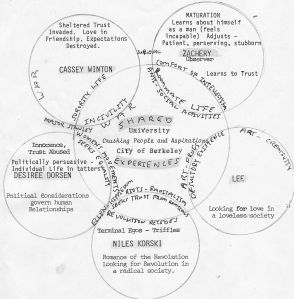
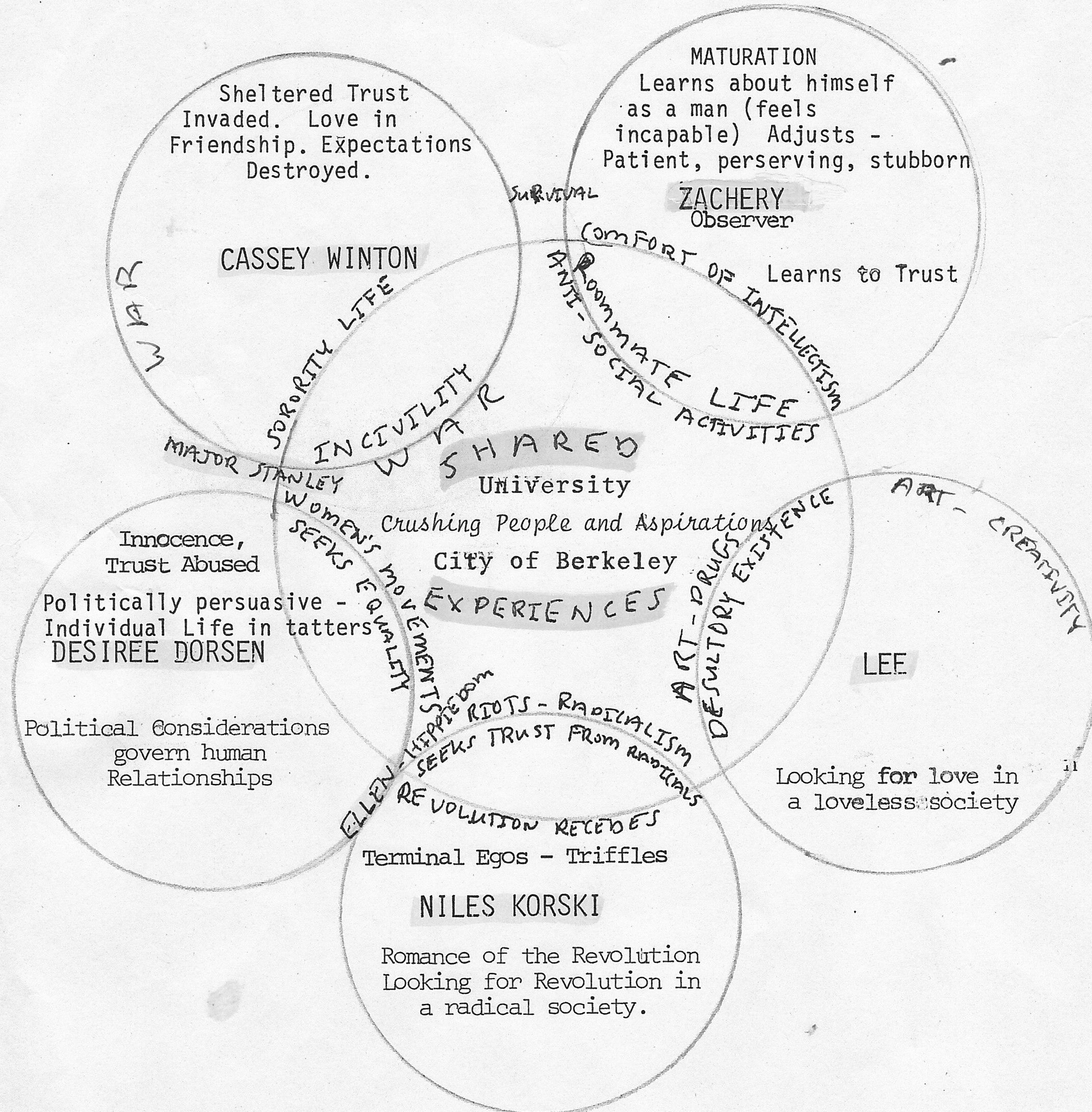
Just a note about writing Bitch.. The more words the more complicated the writing, the organization and the interactions and interface of stories, characters and settings. Before writing I determined there would be five major characters, the names are capitalized in each circle. One subsidiary character, “Ellen,” is mentioned. Not all the characters would have the same experiences, but like many young people during the Sixties and early Seventies, they had shared experiences. Those experiences were by direct participation or vicarious knowledge, because many occurrences during those years had a lot of fallout [unlike today where experiences tend to shut and tie-off]. Once I accepted this organization, the only diagram (“outline”) I made, the text was a matter of writing the stories of each character and how they mixed.

Always paramount was a driving theme found in Lee’s circle: Characters were looking for love in a loveless society.
EXPERIMENTS OVERSEAS

AMERICANS should be careful when spending money and men overseas, especially actively engaging in the Twentieth Century malarkey carried into this millennium. 

There are books – because that is why books are written, to inform and influence – every policy maker and every American should read to access and evaluate plans and policies, and influence action.

In Face of Empire, Frank Golay, tells about the American take over, missteps, gross missteps and high wire acts during its “colonial” relationship with the Philippines (1898-1946). The American perception has been confounded by World War Two: Americans and Philippinos fought the Japanese together. It is not entirely clear whether the Japanese would have invaded the Philippines in 1941, if that land were Philippine ruled and a neutral country. Before the during the War Golay gives many, substantial reasons why MacArthur earned well, the sobriquet of “Dugout Doug.” 

For 40 years Americans tried to teach the Philippine people to support a home-based democracy, and Americans failed: Missing were the infrastructure, institutions and bureaucracy Americans believed the Philippines needed. For instance one American Governor tried to get the Philippine people to accept a summer capital, which was less hot than Manila. None of the insular peoples needed a “cool” capital. He spent millions constructing roads and building edifices. Face of Empire tells of more failures. It is the experience American has throughout the Twentieth Century until today. For decades the Colonial administration was filled with sycophants, toadies, eggheads, do-gooders, pinheads and chuckleheads wanting to try out theories, conceived in academia, on a whim in Washington DC, or the fantasy of Three Cups of Tea, while all were being overpaid at home, in an exotic land or selling books and appearing on radio [and later on TV].

Additionally came the presence and input of the U.S. Military expensively delivering its two-cents worth. Early on the military boasted: “We conquered this land” [under a Republican administration]. “It’s our blood and treasure.” During the Hoover administration (1932) Republicans would only grant independence after an American overlordship of 25 or 30 years. Independence in 1960? How ridiculous is that? Unsure but aware it was stuck to the United States, the Philippines accepted MacArthur during the Thirties, who was to make every wrong military decision before December 11, 1941.

Colonialism and lingering in a country like Afghanistan, is something the United States of America is no good at doing. It is best not to be there formally. Note that The Face of Empire, as reading material, is heavy lumber.

The Quiet American, Graham Greene, mostly famously details the American involvement and experience in Vietnam, a decade before Lyndon Baines Jerk-Creep committed America to enter a Civil War on the losing side. The Quiet American does not just tell the experience of Americans who were in Vietnam, but also for Americans who was aware of that War (60,000 dead over 11 years to failing TV ratings) experienced what Graham Greene wrote about.

Garrison Tales from Tonquin, James O’Neil, Charles Royster, Ed., were written by an American who was in the French Foreign Legion (circa 1890) serving in Vietnam. He tells of the passive resistance and stubbornness of the Vietnam people bypassing French offers to “help” become colonial subjects. The Tales go beyond Vietnam. The experience of an occupied people, whose culture and society extend almost as far back as French society did, crosses borders. Any country with a settled religion, an on-going culture, a long-standing society will not be penetrated by an outside, invading force. Note after World War Two Germany and Japan surrendered “unconditionally.” Each changed its government, but the culture and the societal strictures remained mostly in tact. The changes in Labor Laws in those two countries fed into and supported the political changes.

In Burmese Days, George Orwell presents a remarkable analysis of the colonial experience: For the colonizer and the colonial it is belittling and dehumanizing to lord over the native peoples. Orwell thereby questions the conventional wisdom of The White Man’s Burden.