AFTER AQUARIUS DAWNED

JUDY KUTULAS

This short, selective presentation of cultural phenomena of the Seventies America fails to meet the promise of the title: After Aquarius Dawned, meaning the Sixties, what was that influence? Not all started of that in the Sixties. The Chapter subjects are 1) Music, 2) Style and Manhood, 3) Feminism, 4) Race, 5) Gay/Family Values and 6) Jonestown. Two issues come to the fore: What was the situation in each area during the Sixties, and what was the situation of each during the Seventies?

To access the effects of the Sixties on the Seventies (carry-overs), (ideas) (hangers-on), is an ambitious, detailed project. The historian looks at words and actions backward and forward, and the historian must convey standards by which that process of looking is done.

Aquarius give no starting/ending point for any chapter. The end of the Sixties began with events in 1968: Tet; the Assassinations; Janis Joplin, Jim Morrison, Jimi Hendrix deaths; Woodstock; Altamont; Nixon election; the end of the Beatles and other groups; fractionalization of the Left – S.D.S./Weathermen – within African-American groups and leadership – discord among Women – leftists, Women’s Libbers/Feminists; Santa Barbara; Cambodia; Kent State; University of Wisconsin bombing; attack on academia (mostly by white leftists); cross-over attacks in the South – shooting African-American students by police maintaining law and order; men and women separated from families and friends go missing; advent of surplus people choosing to live on the street.

The chapters in Aquarius advance arguments using the improbable. Carole King and Joni Mitchell at the forefront of 1970s music: each may have represented small segments of music. James Taylor had an audience but wasn’t the missing link between the Sixties and Seventies. Policy fears generated by Sputnik are unaddressed, although men and women were hooked into that business math/science sub-culture. Did the Mary Tyler Moore Show represent feminism during the Seventies? Aquarius does not mention the Equal Rights Amendment of 1972. Stonewall happened in 1969 but its issues did not become a political movement for years; one episode of All in the Family hardly represents a grand advance. At the end of the decade, AIDS separated and next became a public health issue. Race in America during the Seventies was mostly black and white, and despite his unspeakable transgressions, Bill Cosby, by using cartoons, was a leader moving the goals of civil rights expressed by social/political groups to entertainment. Meanwhile, African-American communities were beset by government programs of benign neglect, a term coined by Daniel Patrick Moynihan.

The commune – hippies with disaffected, alienated lives – finishes Aquarius with Jonestown. 900 dead is emblematic of the Sixties influences into the Seventies: The inability to learn and to establish one’s own identify: Become an individual, apart from social, political and cultural norms and expectations. That revolution preached accept, don’t judge other human beings, don’t

criticize. For example, dancing: Partner dancing in the early-mid Sixties; becoming chaotic (feel, reflect the vibrations) in the late Sixties and Seventies; disco awkwardly ebbed and easily flowed. The Eighties brought in raves – human beings jump up and down to pounding sound – in the end there are no couples.

The common thread of the Sixties and Seventies was the survival of a cultural revolution, an attack on individuality: Join the group, accept everyone; let people [not individuals] do their own things; Americans were easily swayed or led. Let people do victimless crimes involving drugs. During the Sixties to this day, individual Americans learned they have liberties, freedoms, rights and privileges, yet how many individual Americans learned that each of them has also duties, responsibilities and obligations to America, to fellow Americans and to the common weal? And Americans also learned government has responsibilities, duties and obligations: Tell no lies about Vietnam and the Vietnam War! Tell no lies about Watergate! Americans learned, don’t trust government.

Ronald Reagan returned some individuality to Americans, and some Americans complain he did it wrong and his efforts were incomplete. His policies reloaded and renewed greed and self- interest into the American psyche, laying those traits over the disorder and undefined social and cultural influences beginning in the Sixties.

Jonestown loaded the hallmarks of Aquarius into the Seventies: A commune, an appeal to communism as was shown by Jim Jones himself, a strong man telling followers how to live, taking their money and property, isolating commune members, using forced labor, always lying, making life and death decisions about commune members, on and on and on. On a sliding scale how many Americans in the Seventies were willing to sacrifice or let go of their status, as individual human beings, and submit to the whims of a goon? The Beatles had disciples but never this. How many Americans follow today? Jonestown should be the first chapter of the book – Americans lost and looking for anchorage. Jonestown manifested a time when little in life seemed certain and life itself was worthless.

Yet, Aquarius uses a subtitle to better tell what the book is about: How the Revolutions of the Sixties Became the Popular Culture of the Seventies. Was the Popular Culture of the Seventies reflected by run-of-the-mill television shows, a few of which have sequels made into movies e.g. Charlie’s Angels. Some of those shows will never go into syndication. Missing from the Seventies Popular Culture but certainly prominent are eye-candy fashion and sports magazine covers, and super-models rising from commonality to become the image of boomer womanhood, (and feminism?).

As a book and as an argument Aquarius is not convincing.
THE YEARS AT OCCIDENTAL COLLEGE IN THE LATE SIXTIES CHARLES E. ROUSE

Events in this book are about the author. The college setting is an accidental backdrop.

The book does not tell about the effect of significant, outside events on the Occidental College campus or among the students: Were there anti-War protests, demonstrations and writings on campus by teachers or students? What were the effects of rioting elsewhere? The author did not see Martin Luther King speak at Occidental College in 1967, but in less than a year Doctor King had been assassinated. Where there reactions about assassinations at Occidental? What did the administration do?

An odd fact out: I doubt if the yippies organized the 1967 Pentagon demonstration, as the author reports. This demonstration was inserted like other significant events: Tet, student riots, student politics campus to campus. Merely mentioning events does not tell what happened to anyone or to anything at Occidental College.

The author is loyal and devoted to Occidental. He identifies every class he had and every professor. But little is told about the teaching, the learning or the students action and growth of the author, or of other students. Everyone at Occidental was smart. They liked to drop names and supply authorities, venturing into German philosophy or onto someone’s newly discovered poem. The author’s favorite authorities were Thomas Wolfe – Electric Kool Air, etc – and Ayn Rand.

The author was awkward around girls, but the psychological diagnosis is incomplete. The reader does not learn if the trouble with women is the root cause of psychological disabilities, or merely one manifestation of other problems. Lots of pages are given to girlfriends (ambiguous suggestions of sex: Everyone was chaste at Occidental?), to mental issues, to eastern religions and to meaningless comments from persons or others in quotes.

For IRONY, try. On the back cover squirb, the author mentions that Barack Obama spent two years at Occidental College during the 1980s. Not mentioned is a state legislator, decades later always trying to please Obama, had a stretch of the 134 Freeway named after Obama. Those four miles, east of the 2-Freeway to Figueroa Avenue, is the route to the Scholl’s Canyon Dump.

Avoid this book.

HONESTY AND TRUTH FOR ONCE

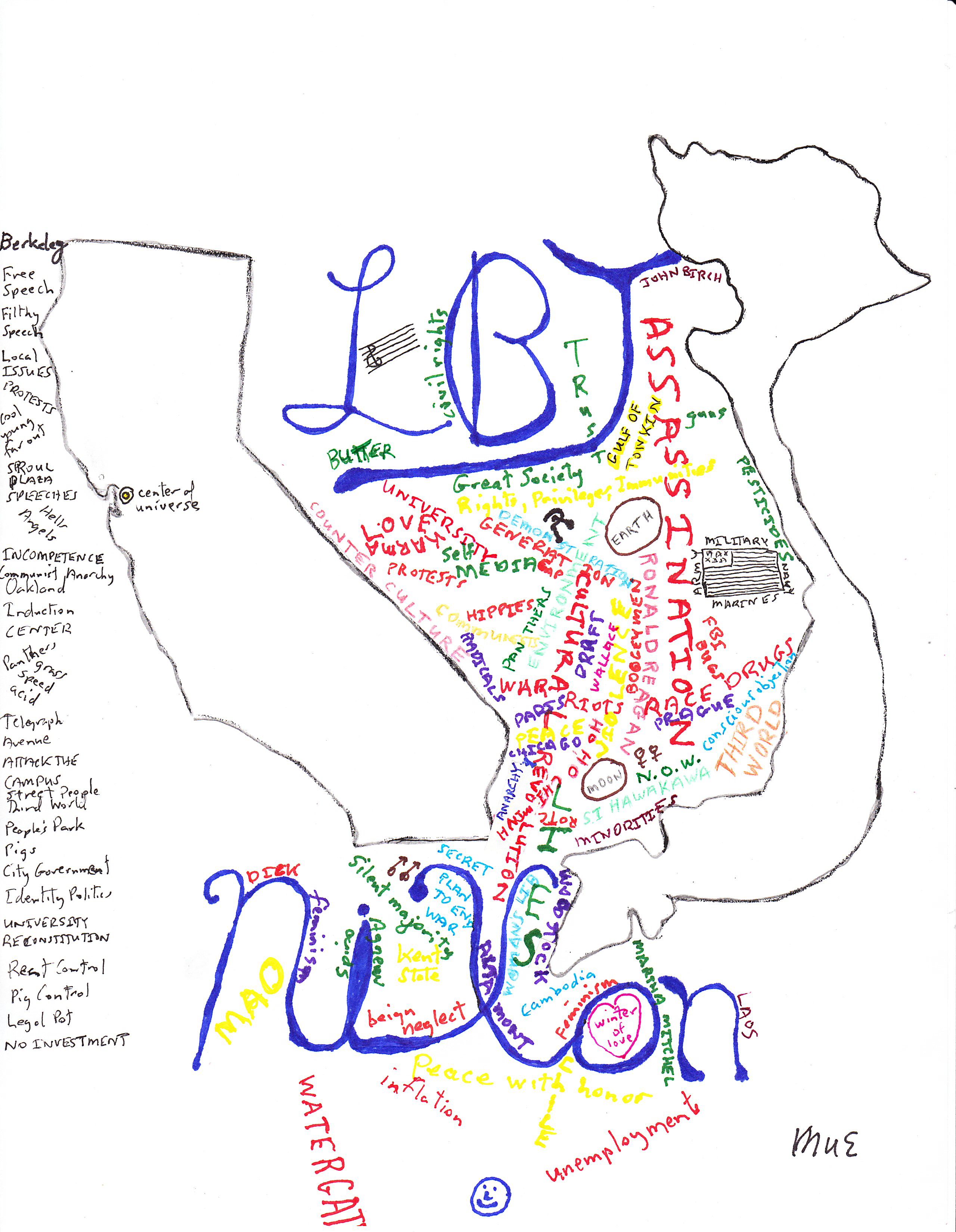
This blog is both promotion of my own novel, Bitch., of which I’ll write more in other posts, and criticism of Radical Son by David Horowitz. Bitch. ($10) is published on the iBookstore. It is about events in Berkeley during the Nixon years (1968-1974) from the standpoint of five first year students.

Horowitz attempts to soft-pedal those years in Berkeley; he lives on Northside, the safest part of town. He is reasonable; he did everything reasonably; he made rational decisions; he understood everything; he was noteworthy enough to write a memoir. Reading his book, Horowitz sounds so plausible and sometimes reasonable, 30 years old, innocent, working for good against evil, using the purest motives while striving for justice and never being critical or judgmental of a thought, an act or plan. Everyone liked David Horowitz. He’s oblivious to dates, short on details, unaware of events, and unwilling to be honest. Horowitz and others of his ilk were phonies, or perhaps they were mentally ill.

Horowitz was part of the Berkeley radical circus, in a coterie of radicalness, a radical party cadre – the people who were responsible for ripping up Berkeley for five years. How do I know this? Bitch., 215,000 words, reading more than 3,000 books including Horowitz’s, years of writing, and having lived through it.

After reading Horowitz’s book, Radical Son, the public will understand why I entitled my book, Bitch., a period not a dot, a verb not a noun. Other than running a magazine called, Ramparts, Horowitz and his buddies colluded with “people” in Berkeley. Throughout Bitch.I call Horowitz and his pals “white radical shits.” The public can understand that term, too – mentally deranged dumb shits who constructed idiot scenarios for “street people” to perform street theater [riots].

Horowitz returns to Berkeley in January 1968 and tells of his Road to Damascus Conversion to the radical cause and its revolutionary ways. He took his son to a local elementary school, where they heard a rock band (Purple Earthquake) perform. Horowitz “felt: A new world is possible.”

Why is that is bull shit and an outright lie? Horowitz has told the reader how smart he is, and that he is well-connected with the left-people in Berkeley. He has come from London, where there is no shortage of electronic instruments and excellent rock music; he has undoubtedly heard the best rock music there. Has anyone ever hear of the Purple Earthquake ever again? [They didn’t become Creedence Clearwater, did they?] Did the band play so loudly that Horowitz broke a blood vessel in his head? Horowitz’s son, a youngster, did not have the same epiphany as his father. Horowitz did not say that he was sober or straight at the performance.

There is another explanation, somewhat goofy but with Horowitz one never knows. It comes from Charles Reich, The Greening of America, p. 260: “Music has become the deepest means of communication…When someone puts a dime in the jukebox…there is a moment of community. [P]eople begin to move, some nod heads, some drum fingers, others tap feet, others move their whole bodies…many sing…” This explanation is improbable because it suggests creativity and art, yet there is nothing in Radical Son which is creative or artistic.

Horowitz was well-connected with the left-people in Berkeley. His manner was agreeable; he was calm and voluble. Throughout Radical Son Horowitz tells about meeting wealthy people, outsiders to Berkeley, and getting money. Horowitz was the “money guy,” for that Berkeley clique as well as for Ramparts. In another book (The Destructive Generation), Horowitz tells about picking up Jane Fonda at the San Francisco Airport and getting her to Alcatraz Island. Why did Horowitz drive? Money beyond taxi fare.

Horowitz rightly criticizes Todd Gitlin’s book, The Sixties, but at least Gitlin tried. He observed the pervasive, on-coming influences from the street and hippie, youth culture including drugs. The Leftists, New Left, Weathermen and others couldn’t manage all that, and Gitlin couldn’t describe it. Horowitz avoided those agency-setting effects completely and disregarded the influences: He lived a normal middle class family life, doing middle class stuff in an upper class neighborhood. His job was a plaything; his ideals and principles – did one need ideals and principles? He was so remote and detached he never understood revolution was not possible and one could not write about it well, if loaded on drugs, blasted by iron-rock, trashed by women and among people whose business acumen didn’t extend beyond the street mantra: “grass, speed, acid.”

But if an author recognizes “a new world is possible,” shouldn’t the author develop the point – observe, do, influence, watch? On which bases was “a new world possible?” Horowitz raised the point and let it rot, in intellectual venality. He didn’t bother to wonder how people, culture and society were divorced from the narrow confines of selective, opportunist Leftist politics whose financial supporters were deceived with every check. Toward the end of his “radical” days, Horowitz met a backer who asked, “Is the revolution possible?” Radical Son proves that Horowitz is the last person in the world to know whether the revolution was possible. Strangely enough, Horowitz does not have the self-reflection and the wherewithal to phrase the setting of that meeting and the question as a joke.

Supposedly, Horowitz had a defining moment in his life when a friend with a job at a Black Panther run school in Oakland was murdered. Throughout the first half of the book Horowitz was chummy with the Panthers, visiting the Party big-wigs. He accepted Huey Newton’s statement that Eldridge Cleaver was too violent for the Party. Horowitz lied about Bobby Seale fleeing Oakland to get away from Huey Newton. Before and after the murder Horowitz casts allegations and theories about who did what, when, where and how. When he tries to talk to the pigs [police], they don’t believe him.

Horowitz was the money man. He liked talking to the top people, but everyone else wasn’t worth a shit and was a trifle. Horowitz initially recommended his murdered friend work at the Panther school. Why? He doesn’t say, but probably so he could have input, influence and control over things there, and the money. The Panthers didn’t need him; they didn’t need the woman who could have been fired and sent packing, not murdered. There is no answer, but it is a scenario which arises from circumstances. It is entirely possible that Horowitz pressed his case too hard, revealed too much and made threats. Horowitz didn’t say this in the book, but he may as well have written he was responsible for the woman’s murder, a personal message to him. [This assumes the Panthers were as irrational as Horowitz claims. They knew if he broke with them, there would be no more money, but they also knew he couldn’t prove anything. Why murder the woman?]

The murder and Horowitz’s role in pre-killing activities were a final revelation for Horowitz after being deaf, blind and mute for a decade. The Panthers had an unsavory side, and everyone but Horowitz knew it. The cops saw the street activities, gang style. Indeed the son of the murdered woman, not a cop, warned his mother. Apparently Horowitz had greater influence, and she worked for the Panthers. In books Black leaders wrote with distrust about the Panthers; Horowitz was illiterate. Black student groups kept their distance from the Panthers who were so entwined with white radical shits to become self-destructive. While Chancellor at San Francisco State, S.I. Hayakawa said, publicly, “The black radicals want a better America. And they may use revolutionary methods at moments, but they are willing to give them up as soon as it’s clear that the administration is willing to do something to improve the quality of their education and their opportunities within the system. White radicals, like the SDS, don’t want to improve America. They just want to destroy it and louse it up in every way possible. So I have nothing to offer them.” (Orrick, William, Shut It Down! A College in Crisis, Washington DC, 1969, p. 147.)

It is obvious that Horowitz would not change from his Mommy-and-Daddy brainwashing to get away from white radical shitism. And he wouldn’t support Black organizations which were trying to improve circumstances in 1968-1969. Instead, he liked the Panthers, isolated friends so long as they could be useful. He liked and likely laughed at their jiving – Martin Luther King was Martin Luther Coon. Radical Son, p. 161.

Essentially, Radical Son, is about Horowitz’s retarded progression from Pinko-Commie to Fascist. He was raised by educated Communist parents, and he believed their crap like it was Gospel. The book does not admit whether he kept his Communist rooting from parental love, or whether he was just an idiot. I’ll go with the latter. Unlike many kids of the Sixties, Horowitz never told his parents they were full of shit, which they were. A reviewer’s comment on the outside of the book says, “A courageous book, full of self-revelation.” That is erroneous. It is more accurate to say, A cowardly book, full of slow-revelation. More accurately, the book should be entitled, Memoirs of a Moron. Horowitz chooses not to be honest, to tell the truth and give a fair portrayal of himself. Instead, he displays an imbecilic rigor, revealing a lack of intellectual discipline and an idleness when seeking the truth.

Image