MIND OF A PEOPLE

A life’s worth of reading had led me onto an issue separating Western thought from most of the world. The issue comes down to the individual and society. It is not every individual doing what he wants; every person must conform to minimum standards and behavior. The issue becomes one of a law and order country enforcing its society on individuals pursuing rights, freedoms and liberties. Vladmir Putin and the Chinese cherish society on terms only whimsically understood by the leaders in power. Individuals in those countries have lost liberties and freedoms to think, believe or communicate anything beyond the party line.

In history Germany had a choice to accept individual freedoms or accept the state security of law and order, as defined by persons in power. In each century, eighteenth to the twentieth, the Germans failed to enlighten themselves. The Germans and their historians know of this failing, but authors fail to understand why the country and its people could not reform: Those Germans today rely on long-established, intellectual philosophical bases which are admired worldwide for their intellectualism. The Germans have believed reliance on tradition and indigenous custom gave any person all the freedom any human being could desire. Reading that history much of it by German authors, I’ve never had the mindset better presented than by Howard Morley Sacher, The Course of Modern Jewish History.

Sacher provides a term for the German mindset: Germany’s Christian Romantic Tradition. The Germans have never had a Christian Romantic Tradition. They’ve had separation and war. Indeed, from 1618-1648 the Germans fought one another, aided by the French, Spanish, Dutch, Swedes and anyone else who wanted to join in. One-third of the German population perished during the Thirty Years War.

Yet the Germans persisted, allowing localities to follow accepted traditions and customs which frequently excluded anyone who was different: Protestants, Catholics, Jews, the educated, businessmen, etc. Local societies became stultified, yet the Germans persisted in the fairy-tale beliefs of their Christian Romantic Tradition.

No one quoted James Madison to support extending rights, liberties and freedoms. They relied on custom and tradition: What German leaders imagined that happened in the Ninth Century was good for the German people in the Twentieth Century. What the ancients said; what the church said; a brilliant man, a German who lived 500 years ago said this or that, telling Germans exactly how to live lives in 1933.

Sacher writes,

As material prosperity declined with the tapering-off of war expenditures, the harassed German Mittelstand relapsed

briefly – but significantly -into impotence. The nationalist secret societies,…, struggled fitfully for a while, and then

were throttled to death by the Carlsbad Decrees of 1819. Constitutionalism vanished like a wraith, while romantic

conservatism burgeoned forth in the works of political theorists, artists, musicians, and writers, who harked back to

the dear dead days of Gothic medievalism, and who endowed very tangible feudal and class interests with the

magic of an ideology. Immanuel Fichte and Georg Hegel deduced from the past that the welfare of the State-

Leviathan took precedence over the happiness of individuals. The theological Schleiermacher sanctified the state

on the level of theology. German prose and poetry conjured up the past in fairy tales, legends, epics; music was

rewoven about the themes of minnesingers. Law, too, was visualized by Savigny as the result of inexorable

historical circumstances. The sustained emphasis upon tradition, the past, and the state augured ill for the

liberals, the reformers, the emancipators – and especially for the Jews. (p. 103)

Thus as decades passed and society changed, the human beings did not abide realism and history. They learned the historical fantasies concocted and promoted by each generation of leaders. Inhibitions became more traditional, customary and accepted.

For in Germany conservatism worked; it created the State; it created prosperity; it created power. For sixty years

before the emergence of the empire, Kant, Fichte, Herder and Hegel had argued that the needs of the Christian

German state took precedence over the needs of the individual. Droysen and Ranke delved deep into Germany

history to support this contention. Now, in one massive coup de main, Bismarck validated all the theorizing that

had gone before. If conservative nationalism had been a respectable philosophy in pre-Bismarckian days, it

seemed positively irrefutable after 1870. (p. 222)

If it remains part of Germany today, and historical fantasies and good times in the past is a large part of the lore of many countries [those readily accepting totalitarianism, tyranny, the despotism],only bad can come from that mindset:

World War I was not simply a product of rival economic imperialisms. We know now – indeed, World War II has

helped to teach us – that Germany’s foreign policy, her decision to resort to hostilities, were the ultimate result

of the myth of the German folk destiny, of militant pan-Germanism, and of the idealization of the Leviathan-State.(p. 419)

Supported by philosophical fantasies no where near reflecting rational human behaviors, digging up historical legends many of which came from England [Tristan, Holy Grail, Tristan and Isolde were Welsh and Irish lovers] and constructing a sociology which was completely detached from ethics and morals, the Germans next concocted a very primitive political system to allow themselves to put their wonderings into practice.
OIL AND ITS PRICE

On Thanksgiving Day OPEC declined to cut its production of oil. That means Saudi Arabia refused to cut its production whilst all other producers would maintain their production of oil and oil sales. The price of oil has declined since that decision.

One talking point, utterly stupid revealing a complete lack of understanding and knowledge about oil and production in the United States, is the Saudi Arabian move will affect oil production from fracking. These commentators are ignorant.

Most tracked oil is produced at the current market price. More wells are drilled to maintain pressure within a field, not always to produce. Wells must be drilled to maintain production. Many of the wells drilled in 2010 – 2012 produce oils at a lower cost per barrel than the current market price. Much of the expense in drilling involves the drilling rig and specialized employees. Costs of frack-drilling have declined since 2007.

As Americans have demonstrated this oil can be got at quickly, within a year or two. We have railroads to bring in heavy equipment and trucks to move it on site. Warren Buffet, Obama’s friend, owns the primary railroad.

It is a losing proposition for any country to believe it can diminish or stop American oil production through fracking. The UAE attempted to diminish tracking for natural gas by producing a misleading movie starring Matt Damon released in 2012. The UAE has loads of natural gas which it would like to deliver in liquified form to American harbors. Instead, that market is gone.

Who wants big liquified natural gas facilities in America’s harbors? All Americans should raise their hands.

The Saudi Arabians are much smarter than the TV and print people give them credit. They have a product, oil. They have a global market to get the product to. First question, will Saudi Arabia be around as a country?

The Saudis look at Iran, nuclear research and reactors leading to bomb making. Before the bomb became an issue there was a century of mistrust between the Arabs, largely of the Sunni sect of Islam, and the Irans, mostly of the Shiia sect of Islam. What are the Americans doing? Nothing. They just gave the Irans six or eight more months to negotiate a deal, which was supposed to be completed by 2014. A bomb may be forthcoming by the time Obama leaves office.

If Iran does not have money from oil, its nuclear program may slow a lot.

The Russians are the real target of the Saudi move. The Russians produce more than 9,000,000 barrels of oil a day. Much of that oil is produced of the large area of Siberia. It is ordinary oil.

Last month the Russians and Chinese agreed to build an oil pipeline from Russia to China. Who’s going to finance the pipeline? Who’s building it? Will it be built if there is not enough oil to transport? Will it be built if the price of oil is low?

A chunk of Siberian oil has been going west. Sanctions affect those sales. Sanctions affect that production: Maintenance cannot be effectively and efficiently performed on the wells in wide spread fields. The price of oil affects those wells. If it costs $80-90 a barrel to lift and transport Siberian oil, why do it if the oil can be delivered in a harbor with a refinery close by in China for $70?

Production of high priced Russian oil will decline. There will be no drilling and no maintenance. How long will the Russians lose money? The Russians can shut-in the wells, but that means restarting them after maintenance. Sanctions eliminates that possibility. Within a few years Russian production might fall 3,000,000 barrels, not to come back for decades.

Giving the Chinese access to Siberia by way of building a pipeline is a great danger for Russia. In the nineteenth century the Russians Czar compelled the Chinese emperor to hand over a million square miles of Asia. The Chinese want that land returned; to my knowledge Mao was the last Chinese leader to make that claim public. Of course, the Russian Far East is lightly populated, not much opposition for hundreds of millions of Chinese.

Putin is not much of a chess player. He does everything for a minimal gain tomorrow or sometimes next week. He’s becoming buddies with the Chinese much like Stalin got cozy with Hitler in August 1939. That did not turn out well for the Russians.

The Saudi Arabians are not acting maliciously or from hatred or contempt. They are acting according to their national interests, and because they are most affected, the Russians are affected most.


Background

I read a lot of history; I read it in sprees. For a year twentieth century history has been my nut, primarily the two European wars and Germany and the Soviet Union. There are times I’ll find an author, and buy books from Amazon or Bookfinder (and others), but most of my reading comes from used books, stuff bought at library bookstores or library sales.

Why read history? To understand more completely. In Barrons today, Jack A. Ablin of BMO Private Bank, is quoted (M16): “It is hard to conceptualize from our Western point of view, but roughly 80% of Russians surveyed believe that economic growth and jobs are more important than their form of government.” I agree. That has been an issue many books I’ve read over the last year, decade, scores of years.

However, I went to read three volumes by Richard J. Evans, the first being, The Coming of the Third Reich (borrowed from the library). In total the three volumes are about 1500 pages. I read the Preface, and Evans discusses other survey books telling of the Third Reich. He notes William L. Shirer’s books, The Rise and Fall and says it is weak, but he fails to mention it is the first. It is unusual for a historian to criticize, outside critical literature, books. He is complimentary to everyone he mentions, English and German historians. He finally, and has to mention Gordon Craig, an American, but only one of Craig’s books: The Politics of the Germany Army 1640-1945.

I finished the Preface and wondered why it was incomplete: Gordon Craig has a book, Germany: 1866-1945 (1978). It seemed spot onto Richard Evans’ topic, but it wasn’t referenced. A German who became an American wrote three volumes, the last covering 1840-1945. Hojo Holborn was a brilliant historian; he died in 1967. Reading about the Weimar Republic (1919-1933) and its culture, one finds Hajo Holborn mentioned. He was part of German academia and participated in the culture before the Nazis came to power. He left Germany in 1933 after losing his university position.

I wondered why Hajo Holborn and Gordon Craig’s other books were not in the Preface. I looked at the bibliography where they were also absent, saving Craig’s German Army book.

I turned the page to Chapter 1, page 1, line 1 or Evans’ The Coming of the Third Reich:

       “Is it wrong to begin with Bismarck?”

Richard Evans book was published in 2003, almost forty years after Gordon Craig’s book. I realized I had read this book before. I stopped reading. Indeed, Germany: 1866-1945 by Gordon Craig, Chapter 1, Page 1, line 1 reads: 

       “Is it a mistake to begin with Bismarck?”

WRITING TRIALS ARE OVER

Think of the social and psychological pressures over the last two months hitting a writer.

Thanksgiving: A sleeper event. Usually this is the last time most Americans visit grandma’s house [or house of a relative living in a distant place] – over the hill, through the vale, along the Interstates, aboard an airline with the whole family: Kids, dog, goldfish. And Americans usually make the effort, something they will never recover from: Too much food, cholesterol, and fat. Loads a disagreeable conversation and too much familiarity. Too little sleep, relaxation and escape from the terrors of normal life.

Americans do Thanksgiving because it leaves the year end holidays, a true family event without the many annoying relatives. For a writer there are three dreadful, situational questions: What are you writing now? For the unpublished writer: When are you getting published? For the published writer: I saw your book [at the library], [in a bookstore] or [borrowed it]. I read a few pages and didn’t like it. I put it down. [Inference is: Why don’t you give it to me?]

Americans like to tell themselves about Thanksgiving, It’s only one day a year.

Religious Holidays in December. If each religion stuck to one day and kept it itself, everything would be fine. But, SHARE. We all live in the same world. The writer has less control over his life. Some persons like myself send Christmas [Season’s Greetings] cards and get a 20 percent return, which is pretty good these days. Older people get better returns, but my parents are considering paring the number of cards sent by 50 percent.

The mixing of the holidays means a relentless round of open houses, dinners, spiked punches, egg nog, cookies of all shapes and tastes, and other odd looking offerings which are undistinguishable except they are sweet. [How about fruit cake soaked for five months in 190 proof rum? That’s aging for the glutton.] There are also gifts guests and invitees bring. The appropriate response to these December “gifts” [including the liquor] should be a Congressional Act: The last Saturday of the year shall be known as NGSD – National Garage Sales Day.

There is a movement afoot to put Christ back into Christmas. Those proponents have one great obstacle. They believe Christmas has become too commercial, too festive and too irreverent. I mostly agree, hence I’m writing this post. BUT can anyone propose cutting back on Christmas giving and festivities: The American economy would grind to a halt. Certain proposed measures would discourage Americans from giving and spending. It is an unAmerican movement to broadly propose such a path.

New Years Day: This was once a period when unhappy people would cash out – drink and drive recklessly and kill themselves. Whereupon state legislatures realized that big money was to be made in drunk driving most of them raised fines and penalties. And law enforcement has commendably improved tactics to prevent many drunk drivers from killing themselves and hurting or killing others.

Americans use this day to make Resolutions – gone by Day’s end. Look back and rid themselves of memories. Face the unknown bravely. The flaw – Americans party with like-thinking friends, acquaintances and strangers. The reflection comes from a mirror of the past  – the restart of the football season after Christmas. Betting and pools. I’ve seen surveys about the drop in business productivity because employees are research and choosing terms, watching, arguing and moping about poor performances. It is egregiously perplexing when someone’s mother-in-law concerned about the grandkids, the family and who volunteers at the local library wins the loot. Everyone can speculate how she picked her teams. I tried to pay no attention to the games, except to observe that Stanford sucked in the Rose Bowl.

January. This was once a month when lives crashed. Nothing has happening. The January blues. People could reflect, meditate, take an inventory, and move on.

    Martin Luther King. Celebrations are no longer on his birthday, January 15, but whenever it will create a three day weekend. The day has become part of the January celebration rather than supporting the historical January tradition. President Obama started out well by defining the day as one of service – a message less apparent this year. Because the day is on a weekend now, it has become intertwined and lost along the Professional Football playoffs. No local parade will save it.

   Professional Football. This sport has overtaken January as its own. Note this occupation is in the middle of the Professional Basketball Season.

   Entertainment. There was once only the Oscars [Academy Award] ceremony in the late winter. It is passé and meaningless. Now January has become award-event month. Every week is a ceremony offering somebody, something: music, special effects, acting. Not only do movie ads tell how many Academy Award nominations have been received, but also they give a litany of previous awards – Golden Globes, Director’s Guild, Writer’s Guild, Janitor’s Guild [top trophy goes to best use of used condom].

   State of the Union. It was too long. If President Obama has wanted anyone to remember the speech and what he said, he would have spoken for 15 minutes rather than 65 minutes. Even that is too long to get noticed. Better yet the President could have put it to music and given us a rap song in 3 minutes. Best yet, the President could have devised an aphorism, no longer than 20 words, something everyone would want to carve onto stone. 

Super Bowl. This is the true end of social and psychological confrontations disturbing writers. It’s the big game which will go on much too long. Americans will attend parties, overeat, over drink, talk about golf, and look forward to a time for rest and relaxation.

I will watch none of the game because (1) it is only a football game. I only need to know the result, not how someone won. (2) There are too many ads. (3) This it not a football game which should last only 2 1/2 hours. That game has its own pulse. The teams can get into a rhythm. One can go into a slump. (4) The whole spectacle is too commercial, apart from the ads. (5) There are too many ads disrupting the game.I don’t want to watch babies selling diapers or a stock brokerage firm. (6) Also, let’s watch men beat one another up. Perhaps a player will die; they’ll drive him off the field in a golf-cart [Hence the natural golf-football crossover.] A few players will get injured. Too many will suffer permanent physical injuries which will increase Workers Compensation costs. An unknown number will suffer head injuries aggravating previous injuries and leaving them unable to live productive lives after their playing days. (7) I’ve decided against watching gladiator sports only a month after the religious holidays. Why watch the carnage? 

I know I shall be culturally deprived. I will miss the Super Bowl Ads. I could record the whole show and run through, watching the ads. But I’ll leave advertising where it is [last year’s ads were mediocre]. I hope to do something useful for myself or for others.

February: The end of the season.

I know the Winter Olympics are coming up. They seem a let down after the rip-roaring action of the previous two months.

I know that Valentines Day is coming up. Love, hearts and dripping sentiments seem a let down after the rip-roaring actions of the last two months.

AMERICA’S FARMS

No one can devise a farm policy today. Eighty (80) years ago the New Deal began farm programs, and for those four score years Congress has dumped money into farming to support the small family farm.

How many small family farms are there? In California families run agricultural lands, but they aren’t farms – pigs, cows, chickens, vegetable gardens, money crop. Indeed, many or all of those family members get their food in grocery stores in Beverly Hills, in California coastal towns and cities and in Bay Area cities. No one lives on the agricultural lands in the Central Valley.

Americans should not confuse farming with home ownership. There are houses on farms, but mortgaging the homestead is not reason for losing the farm. Otherwise, it would be best to bail out every delinquent homeowner in America.

It is not likely a problem this year, but it was reported late last year if Congress did not renew the Farm Bill, that milk would be $6-8 a gallon. A formula devised in the 1940s would determine milk prices nationally in 2014, now 2015. Note the 1940s was before most Americans were born. Did the lawmakers concocting that price formula figure they were writing a Constitutional Amendment called Milk Prices Forever Sacred?

There have been many changes to farms and agriculture. Machinery and automation have increase productivity a lot. Not many human beings milk cows. They’d rather milk the government for money. Not every family wants to live on the Old McDonald’s farm, where pigs no longer oink, oink here and there. Bill Clinton taught us, It’s “suie, pig!” No one makes money planting a few acres of corn and wheat. Subsistence farming happens, but I don’t believe farm programs are designed for those people. The problems extant in the 1930s are no longer around – certainly not in the same places. Congress should start anew and write Farm Programs suited for 2015.

I began this writing to react to a solicitation in the mail from the American Farmland Trust. HEADLINE: AMERICAN FARMLAND IS DISAPPEARING at x acres per day.

Losing farmland has been a problem in America for a long time. There are many reasons for it. Water: In California water is not delivered or is deemed undeliverable, and land goes dry, groves and orchards dry up and land returns to what nature can make it. Some farm communities in California have unemployment rates exceeding 40 percent because there is no work because no water is delivered.

The example given in the Farmland Trust solicitation is from Arkansas where a family lost its dairy farm – herd, land and equipment. Initially, this is a victory for persons who believe milk is bad for human beings. [They get their opinions and facts from the Internet which is always a trustworthy source.] Another group of diary opponents believe cows create more methane gas than they should; they also believe diary [chicken, pig] farms create too much waste. Finally, there are people who believe dairy farmers might receive too many subsidies than they should. The general humanity of these detractors is to sacrifice cows, land, equipment and the human beings trying to make things work.

I am suspicious that American Farmland Trust is an organization to allow its officers and employees to solicit money and pay themselves the bulk of those dollars, all to solicit more money. The solicitation presents the emotion tug: “beauty and bounty as far as the eye can see,” but no where is mentioned cows and buffalo roaming. The Farmland Trust sends notecards: “a beautiful peach blossom in perfect bloom.” It is obviously not in California where orchards and groves are being desiccated, and trees are cut down for firewood. Another notecard: “a canine farmhand ‘driving’ a tractor.” I’ve never seen a dog drive a tractor, a truck or a car. I have seen dogs playing poker. I note further that American Farmland Trust offered to send a FREE deluxe toy calf: “Milkshake,” “with a gift of $25 or more.” Milkshake is a stuff toy which I suppose is not made in America.

I cannot repeat or summarize much of the solicitation. It is too long. But I can react:

First, I don’t want any class of Americans to benefit from any government program or preference forever!  If a family is farming, that is the business. There should be no absolute guarantee that that farming business should last until Judgment Day. In business is the ever present risk of nature – weather, infestations and crummy growing conditions – and Acts of God. 

Just like an attorney must know and specialize in an area of the law, a farmer ought to watch The Weather Channel or look at the NOAA website and prepare. Farming is not always an environmentally clean activity, and the government gets involved. Smart, profitable farmers know this: Air quality, soil preservation, water contamination, chemical/fertilizer run off, wildlife destruction are all possible. Farms know about these rules and laws because violating them will result in fines and penalties.

To what extent have the owners of that Arkansas farm been prudent? I don’t know, but I know people in the milk business, small suppliers or large chains, make money. They may not be his constituents, but Patrick Leahy of Vermont voiced concern about small dairy producers in his state if milk subsidies were changed. Senator Leahy is the type of guy who would like to spend the last federal dollar on milk price supports.

Second, the complete problem with small farmers and farms is unsolvable by organizations like American Farmland Trust. Donations will waste money while misdirecting attention and misstating the problem. Most small farmers resort to alternative methods of farming – organic farms, speciality crops – or they make products from their farms – cheeses, wines, vinegars and cooking oils. This inventiveness is lost on American Farmland Trust. It’s motto appears to be: Once a Farm, Always a Farm. Manhattan was once farmland. Orange County, California was once tens of miles of orange groves. Washington DC where American Farmland Trust is located was once a swamp. 

HISTORY AND FICTION

bitch. cover

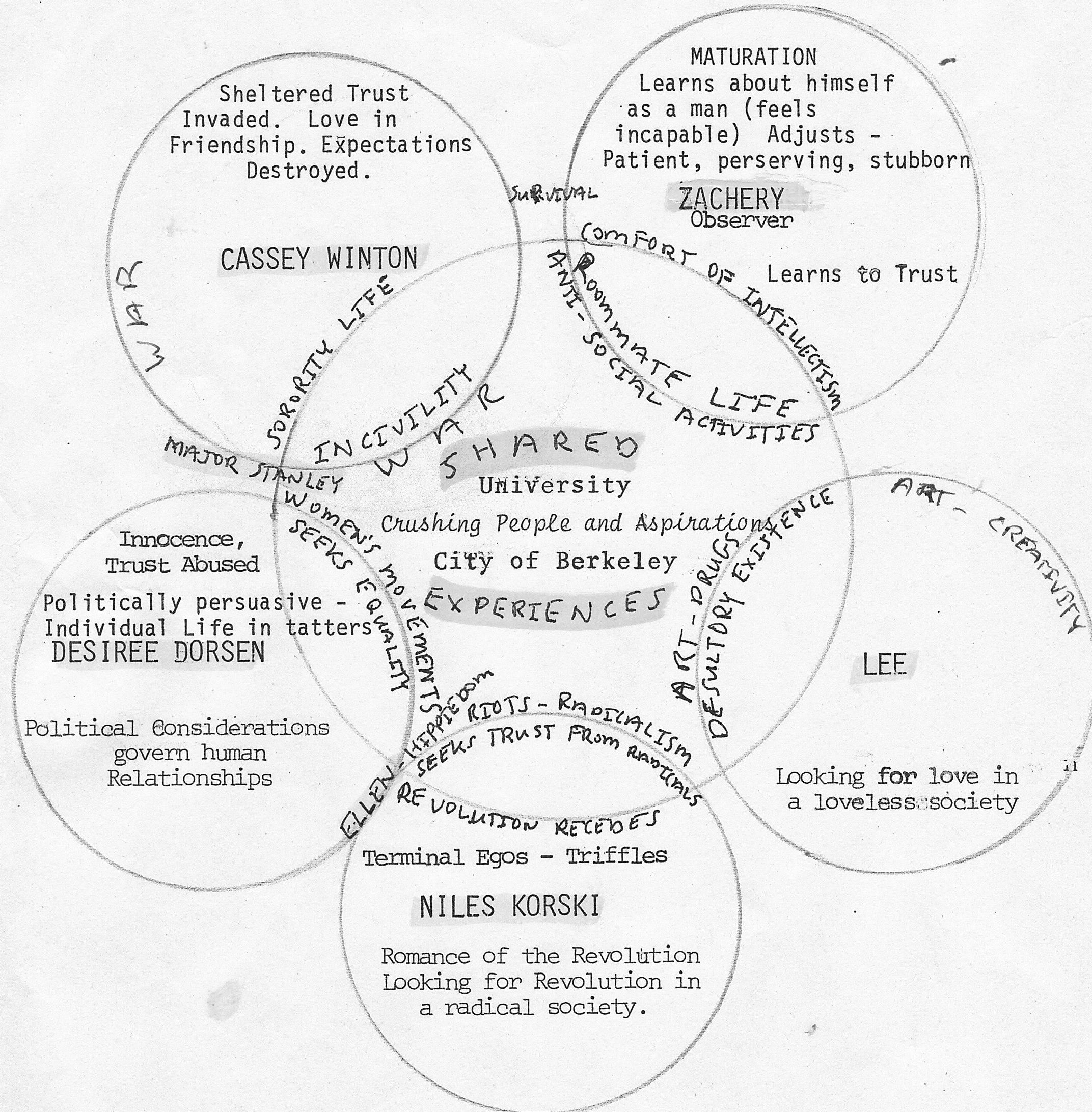
When I went to write Bitch. (iBookstore, michael ulin edwards), I was determined to make it autobiographical. I learned after three major drafts and a long process of 20 years, that autobiography was impossible. It would make a bad book. Some of the reasons can be found in Twentieth Century Journey, William L Shirer, vol. i, Preface; Autobiography of Mark Twain, U.C. Press, Berkeley, 2011, vol. 1, on writing memoirs/autobiography.

I was motivated to write the life and times of Berkeley, 1968-1973. While there I had forces coming at me. I determined they would best be represented by FIVE major characters, plus subsidiary characters folded into the stories of the FIVE. At that point the book could not be autobiographical; it could not be biographical. It could be history. Recount events as truthfully and accurately as I could, but the characters had to be representations. [Readers have commented that they know these characters.]

As much as I ran from place to place in Berkeley, observing and stuffing everything into my memory (which is not entirely why I almost flunked out my first year – I was also taking the wrong classes and my perspective on learning was horribly distorted), I could not tell the story of Berkeley with one character being everywhere at once: Peoples Park Riot Day, May 15, 1969 – in class on the north side of campus; in the riot itself; at the swimming pools in Strawberry Canyon; wandering around Dwinelle Hall. The FIVE characters and others were useful to convey what had to be said.

It is also impossible for a individual to tell his story when hormones, urges, the environment, economics are exerting influences affecting the person. What is the order? What is the priority? What is important? Those day to day, sometimes hour to hour or minute to minute considerations which may or do change affected human being senses – hear, see, smell, feel, taste – will shift the ground and upend any story.

If the reaction to life under those circumstances is the same, that makes for a dull human being. If the reaction to life under those circumstances whipsaws the human being into incapacity, he becomes confused and worthless. If the reaction causes the human being to take the brunt of it and react intelligently, predictably or making-do, that is the easier story to tell.

IMG

In 200,000 words I came up with the FIVE characters, two guys and three women, living and telling their lives (some aspects of my life) in Berkeley from September 1968 through the summer of 1973. They lived through riots, demonstrations, classes, drugs, life, city and academic events and state and national actions, all told within this novel. [There are 450 notes and a bibliography.]

Also, I could not tell my own story for a personal reason. Who could be truthful about being psychological creepy and sociology awkward then, (probably eccentric today) in a terrifying place. That doesn’t describe the discomfort, the violence and the shock of watching crap on the streets being played out and the acceptance of it by everyone in Berkeley. About 20 years ago I talked to someone I knew as a student. He tried to fit in and spoke the language as a student. His evaluation of those times upon meeting him again was reduced to one word: “Strange.” He didn’t want to talk about what he thought or was doing as a student, which was likely “creepy” and “weird.”

It seemed I was the only person who considered everything going on was strange, weird and ill for society. I may have been suited for a college campus in the 1920s, but I was stuck at Berkeley. I did not want to be a statistic and a loser: Someone told me when I entered that the average stay of a student at Berkeley was four quarters. (The University is much more mellow today which is why it is not a place of excellence.)

While a student at Berkeley, I didn’t like and actually detested loud music, drugs, and the recklessness of students, their lives a step from the street. Everything seemed reenforced by the citizens of Berkeley. Condemning this gross, communal lifestyle is a theme of Bitch.. Indeed, I dislike any communal styles, community standards, something my generation embraced and never let go of, and something which has been passed onto to their children and grandchildren: The collective.

We are not raising children today to be individuals, to think on their own. They are accepting, too much of collective action, group-think, the so-called common good. They have been taught, It Takes a Village – Collective actions are the bases of all advancement. Those are  wet dreams rolling from the Left of the Sixties and from Radical Feminism. (See Shulamith Firestone, The Dialectic of Sex.)

Finally, I did not want to be like any of the FIVE. I put a lot of distance between myself and Berkeley. Not in the novel is: at the end of my Berkeley studies, I wanted to be a composer, but I had injured my left hand and couldn’t play the piano. I was lost to the activities I was prepared for. Law school intervened, but within ten years I had turned to writing.

This post is the second using the cover and the diagram (outline) that I have made. The subject is different because the text differs.

LAUGH ABOUT A BLACK KID

MSNBC, leaning forward like Hitler’s Army in World War II, got its chuckles.

Mitt Romney is the grandfather of a black child. The New York Citiers on MSNBC are laughing about it and making loads of politically incorrect comments about this adoption.

Fortunately, the Romney family can protect the child from these vile, scornful, hateful remarks and give the child love, hope and security.

But MSNBC: Other than ridding itself of everyone on this show or news program – producers, hosts, guests – and never showing their mugs on TV again as well as shutting them out forever, the host of every MSNBC show/program/news hour and every NBC newsperson should apologize publicly to the Romney family and to the American people.  

A COFFIN FOR DIMITROS – Eric Ambler

“The logic of Michelangelo’s David, Beethoven’s Ninth Symphony, Einstein’s Physics [has] been replaced by that of the Stock Exchange Year Book and Hitler’s Mein Kampf.” The author sets out a story – the “special conditions which exist” – to develop this theme. As I view the world, Ambler may as well be writing about the Clinton, Bush and Obama years in the United States of America.

Protagonist, Latimer, is a writer of detective stories. In Istanbul he meets a Colonel of Turkish intelligence who has outlined a detective story but can’t write it. He gives it to Latimer to write. He also offers to show Latimer the body of an international criminal, Dimitros. Latimer sees the man and learns what the Turks know of his activities – spotty before 1924 and a blank after 1924. Latimer decides to learn about Dimitros’ political, criminal and financial activities in those missing 14 years. 

For 100 pages the story is an obligation to read. It could be improved by Ambler telling of Latimer’s curiosity to investigate as a writer. Otherwise, Latimer seems flat and a gadfly. Also when faced with dead time in a story, an author can improve the tale in one of two ways: Tell a better story, OR improve the language used in the telling of the story. Ambler finally ponies up with the second method:

       1. Who is the mastermind becomes “who paid for the bullet?”

       2. Darkness of human existence became “baroque of human affairs.”

       3. “wrinkled flesh” is “raddled flesh”

       4. A sentence “People were dying faster than if you had machine-gunned them.”

       5. An adversary learns that Latimer’s passport says he is a writer, and he says, “…writer is a very elastic term.”

If some of these phrases and sentence offend, the time of this novel is Europe between the Wars. There is a chapter on white slavery and drug dealing in Paris, circa 1930. Many of the victimized prostitutes were from Eastern Europe. I thought this novel was a prequel to the movie, “Taken.”

Tomorrow I shall blog more about the gross statement of the theme of A Coffin, but this book demonstrates with little effort and few additions to the text that something of substance can be included in a tale of international crime. Ambler makes his book a statement of his times, a mirror of society. 

What does the first sentence of this post have to do with crime and A Coffin? When one person or hundred of persons are allowed to shirk the law, step over its lines repeatedly, make fortunes, become prominent and be protected, that makes for a very different society than the one popular in political mythology: Everyone plays by the same rules, has the same opportunities, can pursue happiness, can contribute to the general weal and gain the esteem due a member of society. In the first described society, select people abuse and take advantage and rob. Under the political myth, it is assumed there is organic growth to the betterment of everyone.

Most Americans prefer the political myth, but they don’t always know how to achieve it. They neglect standards, criteria and values. One area where Americans have abandoned all caution: Countless American entertainers and artists, purporting to be part of the community, are abusing the system: They don’t entertain; they aren’t artistic. But why denounce easy targets in the United States?

Look overseas to Russia and the band Pussy Riot. In a church that band decided to perform a desecrating concert and publicize it. The performance was devoid of art and was bad entertainment. If Pussy Riot does not shock with the band’s name, it shouldn’t perform in a church for “more shock value.”

They were prosecuted and imprisoned, which only enhanced their name in the West. Pussy Riot became a cause celebre. Rock and roll musicians asked they be released. I do know if Pussy Riot committed the crimes like trespass or malicious mischief, but years in prison seem long. Although devoid of art and being poor entertainment, the West is ready to bestow awards, riches, fame and adulation on Pussy Riot. That is a mistake. There are no standards, no values, no excellence, just publicity. The West, especially America, cannot give Pussy Riot a big- welcome, you’ve-held-up-our-values, you’re-important-to-human-existence. The West, America and the remainder of the World have done that justly and recently. Who out there has the gall to compare the comparative worth of Pussy Riot to Nelson Mandela?

What does Eric Ambler say? If society does not abide by its heroes like Nelson Mandela and conduct, respect and uphold supporting values and standards, society will end with the standards, values and excellence of Pussy Riot, “the Stock Exchange Year Book and Hitler’s Mein Kampf.”


EXPERIMENTS OVERSEAS

AMERICANS should be careful when spending money and men overseas, especially actively engaging in the Twentieth Century malarkey carried into this millennium. 

There are books – because that is why books are written, to inform and influence – every policy maker and every American should read to access and evaluate plans and policies, and influence action.

In Face of Empire, Frank Golay, tells about the American take over, missteps, gross missteps and high wire acts during its “colonial” relationship with the Philippines (1898-1946). The American perception has been confounded by World War Two: Americans and Philippinos fought the Japanese together. It is not entirely clear whether the Japanese would have invaded the Philippines in 1941, if that land were Philippine ruled and a neutral country. Before the during the War Golay gives many, substantial reasons why MacArthur earned well, the sobriquet of “Dugout Doug.” 

For 40 years Americans tried to teach the Philippine people to support a home-based democracy, and Americans failed: Missing were the infrastructure, institutions and bureaucracy Americans believed the Philippines needed. For instance one American Governor tried to get the Philippine people to accept a summer capital, which was less hot than Manila. None of the insular peoples needed a “cool” capital. He spent millions constructing roads and building edifices. Face of Empire tells of more failures. It is the experience American has throughout the Twentieth Century until today. For decades the Colonial administration was filled with sycophants, toadies, eggheads, do-gooders, pinheads and chuckleheads wanting to try out theories, conceived in academia, on a whim in Washington DC, or the fantasy of Three Cups of Tea, while all were being overpaid at home, in an exotic land or selling books and appearing on radio [and later on TV].

Additionally came the presence and input of the U.S. Military expensively delivering its two-cents worth. Early on the military boasted: “We conquered this land” [under a Republican administration]. “It’s our blood and treasure.” During the Hoover administration (1932) Republicans would only grant independence after an American overlordship of 25 or 30 years. Independence in 1960? How ridiculous is that? Unsure but aware it was stuck to the United States, the Philippines accepted MacArthur during the Thirties, who was to make every wrong military decision before December 11, 1941.

Colonialism and lingering in a country like Afghanistan, is something the United States of America is no good at doing. It is best not to be there formally. Note that The Face of Empire, as reading material, is heavy lumber.

The Quiet American, Graham Greene, mostly famously details the American involvement and experience in Vietnam, a decade before Lyndon Baines Jerk-Creep committed America to enter a Civil War on the losing side. The Quiet American does not just tell the experience of Americans who were in Vietnam, but also for Americans who was aware of that War (60,000 dead over 11 years to failing TV ratings) experienced what Graham Greene wrote about.

Garrison Tales from Tonquin, James O’Neil, Charles Royster, Ed., were written by an American who was in the French Foreign Legion (circa 1890) serving in Vietnam. He tells of the passive resistance and stubbornness of the Vietnam people bypassing French offers to “help” become colonial subjects. The Tales go beyond Vietnam. The experience of an occupied people, whose culture and society extend almost as far back as French society did, crosses borders. Any country with a settled religion, an on-going culture, a long-standing society will not be penetrated by an outside, invading force. Note after World War Two Germany and Japan surrendered “unconditionally.” Each changed its government, but the culture and the societal strictures remained mostly in tact. The changes in Labor Laws in those two countries fed into and supported the political changes.

In Burmese Days, George Orwell presents a remarkable analysis of the colonial experience: For the colonizer and the colonial it is belittling and dehumanizing to lord over the native peoples. Orwell thereby questions the conventional wisdom of The White Man’s Burden.