HONESTY AND TRUTH FOR ONCE

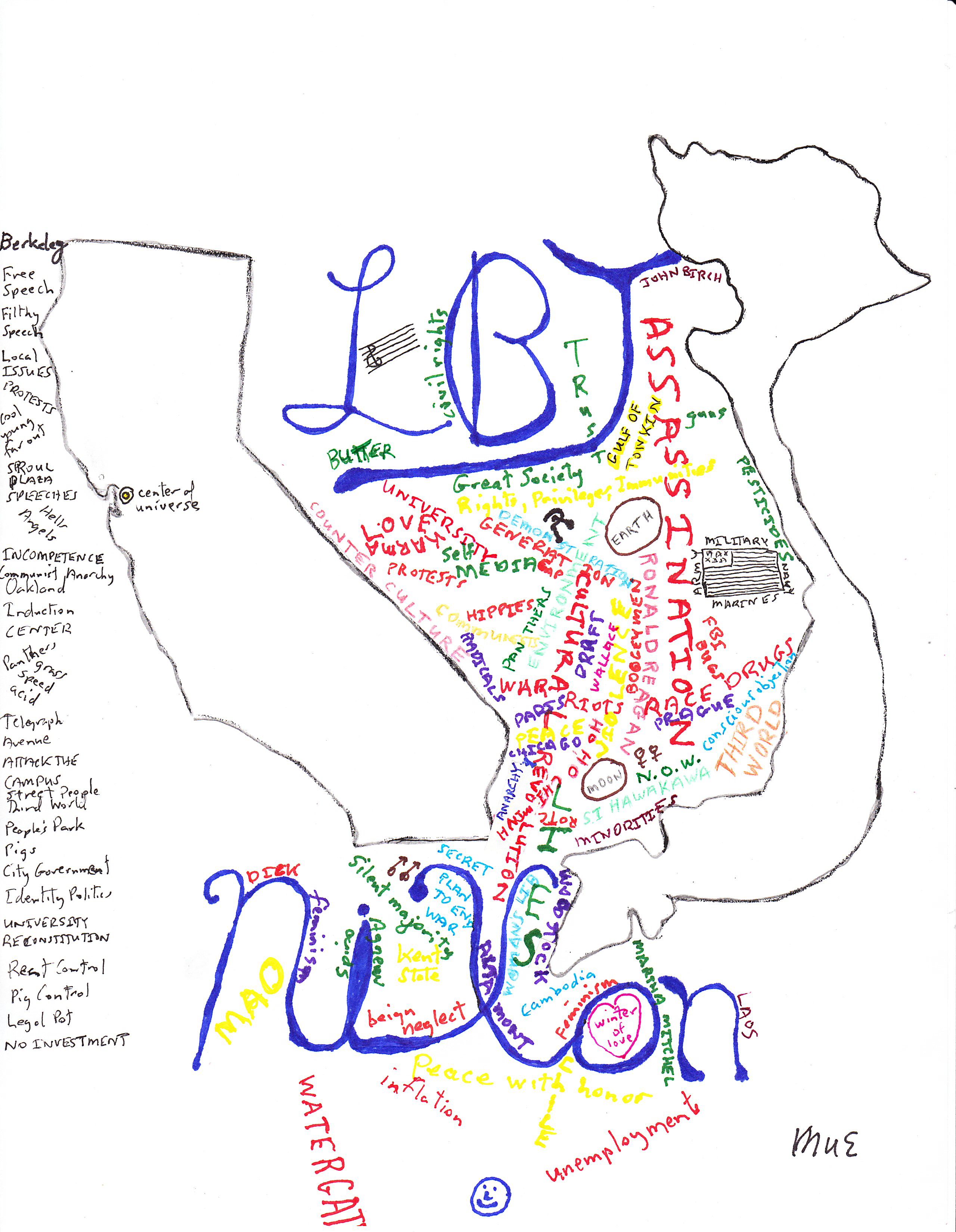
This blog is both promotion of my own novel, Bitch., of which I’ll write more in other posts, and criticism of Radical Son by David Horowitz. Bitch. ($10) is published on the iBookstore. It is about events in Berkeley during the Nixon years (1968-1974) from the standpoint of five first year students.

Horowitz attempts to soft-pedal those years in Berkeley; he lives on Northside, the safest part of town. He is reasonable; he did everything reasonably; he made rational decisions; he understood everything; he was noteworthy enough to write a memoir. Reading his book, Horowitz sounds so plausible and sometimes reasonable, 30 years old, innocent, working for good against evil, using the purest motives while striving for justice and never being critical or judgmental of a thought, an act or plan. Everyone liked David Horowitz. He’s oblivious to dates, short on details, unaware of events, and unwilling to be honest. Horowitz and others of his ilk were phonies, or perhaps they were mentally ill.

Horowitz was part of the Berkeley radical circus, in a coterie of radicalness, a radical party cadre – the people who were responsible for ripping up Berkeley for five years. How do I know this? Bitch., 215,000 words, reading more than 3,000 books including Horowitz’s, years of writing, and having lived through it.

After reading Horowitz’s book, Radical Son, the public will understand why I entitled my book, Bitch., a period not a dot, a verb not a noun. Other than running a magazine called, Ramparts, Horowitz and his buddies colluded with “people” in Berkeley. Throughout Bitch.I call Horowitz and his pals “white radical shits.” The public can understand that term, too – mentally deranged dumb shits who constructed idiot scenarios for “street people” to perform street theater [riots].

Horowitz returns to Berkeley in January 1968 and tells of his Road to Damascus Conversion to the radical cause and its revolutionary ways. He took his son to a local elementary school, where they heard a rock band (Purple Earthquake) perform. Horowitz “felt: A new world is possible.”

Why is that is bull shit and an outright lie? Horowitz has told the reader how smart he is, and that he is well-connected with the left-people in Berkeley. He has come from London, where there is no shortage of electronic instruments and excellent rock music; he has undoubtedly heard the best rock music there. Has anyone ever hear of the Purple Earthquake ever again? [They didn’t become Creedence Clearwater, did they?] Did the band play so loudly that Horowitz broke a blood vessel in his head? Horowitz’s son, a youngster, did not have the same epiphany as his father. Horowitz did not say that he was sober or straight at the performance.

There is another explanation, somewhat goofy but with Horowitz one never knows. It comes from Charles Reich, The Greening of America, p. 260: “Music has become the deepest means of communication…When someone puts a dime in the jukebox…there is a moment of community. [P]eople begin to move, some nod heads, some drum fingers, others tap feet, others move their whole bodies…many sing…” This explanation is improbable because it suggests creativity and art, yet there is nothing in Radical Son which is creative or artistic.

Horowitz was well-connected with the left-people in Berkeley. His manner was agreeable; he was calm and voluble. Throughout Radical Son Horowitz tells about meeting wealthy people, outsiders to Berkeley, and getting money. Horowitz was the “money guy,” for that Berkeley clique as well as for Ramparts. In another book (The Destructive Generation), Horowitz tells about picking up Jane Fonda at the San Francisco Airport and getting her to Alcatraz Island. Why did Horowitz drive? Money beyond taxi fare.

Horowitz rightly criticizes Todd Gitlin’s book, The Sixties, but at least Gitlin tried. He observed the pervasive, on-coming influences from the street and hippie, youth culture including drugs. The Leftists, New Left, Weathermen and others couldn’t manage all that, and Gitlin couldn’t describe it. Horowitz avoided those agency-setting effects completely and disregarded the influences: He lived a normal middle class family life, doing middle class stuff in an upper class neighborhood. His job was a plaything; his ideals and principles – did one need ideals and principles? He was so remote and detached he never understood revolution was not possible and one could not write about it well, if loaded on drugs, blasted by iron-rock, trashed by women and among people whose business acumen didn’t extend beyond the street mantra: “grass, speed, acid.”

But if an author recognizes “a new world is possible,” shouldn’t the author develop the point – observe, do, influence, watch? On which bases was “a new world possible?” Horowitz raised the point and let it rot, in intellectual venality. He didn’t bother to wonder how people, culture and society were divorced from the narrow confines of selective, opportunist Leftist politics whose financial supporters were deceived with every check. Toward the end of his “radical” days, Horowitz met a backer who asked, “Is the revolution possible?” Radical Son proves that Horowitz is the last person in the world to know whether the revolution was possible. Strangely enough, Horowitz does not have the self-reflection and the wherewithal to phrase the setting of that meeting and the question as a joke.

Supposedly, Horowitz had a defining moment in his life when a friend with a job at a Black Panther run school in Oakland was murdered. Throughout the first half of the book Horowitz was chummy with the Panthers, visiting the Party big-wigs. He accepted Huey Newton’s statement that Eldridge Cleaver was too violent for the Party. Horowitz lied about Bobby Seale fleeing Oakland to get away from Huey Newton. Before and after the murder Horowitz casts allegations and theories about who did what, when, where and how. When he tries to talk to the pigs [police], they don’t believe him.

Horowitz was the money man. He liked talking to the top people, but everyone else wasn’t worth a shit and was a trifle. Horowitz initially recommended his murdered friend work at the Panther school. Why? He doesn’t say, but probably so he could have input, influence and control over things there, and the money. The Panthers didn’t need him; they didn’t need the woman who could have been fired and sent packing, not murdered. There is no answer, but it is a scenario which arises from circumstances. It is entirely possible that Horowitz pressed his case too hard, revealed too much and made threats. Horowitz didn’t say this in the book, but he may as well have written he was responsible for the woman’s murder, a personal message to him. [This assumes the Panthers were as irrational as Horowitz claims. They knew if he broke with them, there would be no more money, but they also knew he couldn’t prove anything. Why murder the woman?]

The murder and Horowitz’s role in pre-killing activities were a final revelation for Horowitz after being deaf, blind and mute for a decade. The Panthers had an unsavory side, and everyone but Horowitz knew it. The cops saw the street activities, gang style. Indeed the son of the murdered woman, not a cop, warned his mother. Apparently Horowitz had greater influence, and she worked for the Panthers. In books Black leaders wrote with distrust about the Panthers; Horowitz was illiterate. Black student groups kept their distance from the Panthers who were so entwined with white radical shits to become self-destructive. While Chancellor at San Francisco State, S.I. Hayakawa said, publicly, “The black radicals want a better America. And they may use revolutionary methods at moments, but they are willing to give them up as soon as it’s clear that the administration is willing to do something to improve the quality of their education and their opportunities within the system. White radicals, like the SDS, don’t want to improve America. They just want to destroy it and louse it up in every way possible. So I have nothing to offer them.” (Orrick, William, Shut It Down! A College in Crisis, Washington DC, 1969, p. 147.)

It is obvious that Horowitz would not change from his Mommy-and-Daddy brainwashing to get away from white radical shitism. And he wouldn’t support Black organizations which were trying to improve circumstances in 1968-1969. Instead, he liked the Panthers, isolated friends so long as they could be useful. He liked and likely laughed at their jiving – Martin Luther King was Martin Luther Coon. Radical Son, p. 161.

Essentially, Radical Son, is about Horowitz’s retarded progression from Pinko-Commie to Fascist. He was raised by educated Communist parents, and he believed their crap like it was Gospel. The book does not admit whether he kept his Communist rooting from parental love, or whether he was just an idiot. I’ll go with the latter. Unlike many kids of the Sixties, Horowitz never told his parents they were full of shit, which they were. A reviewer’s comment on the outside of the book says, “A courageous book, full of self-revelation.” That is erroneous. It is more accurate to say, A cowardly book, full of slow-revelation. More accurately, the book should be entitled, Memoirs of a Moron. Horowitz chooses not to be honest, to tell the truth and give a fair portrayal of himself. Instead, he displays an imbecilic rigor, revealing a lack of intellectual discipline and an idleness when seeking the truth.
Image

READ ORWELL – I

I’ve mentioned that George Orwell is the best writer of the twentieth century, and most people never get past thinking, ANIMAL FARM(condemning Stalin) and 1984(condemning shrinking communications in a tri-polar world). Those are excellent books, each driving in demonic ways their points.

But Orwell wrote novels and books before World War II, and most of those make excellent reading. I recommend those. Where Orwell excelled was in preparation for the novels: essays. He wrote about almost everything with certainty and accuracy. He touched psychological and sociological issues beyond those found in novels and essays. Essays also discuss writing, business and politics. I wish I could write as well today, as topically, forcefully, completely and truthfully.

“The Prevention of Literature,” January 1946 is about the forces affecting writers and publishing. I’ll give background and a smattering. It’s the 300th anniversary of John Milton’s Areopagitica pamphlet in defense of freedom of the press celebrated by the group of British writers called PEN. Orwell is disappointed that this group of leftists are so far removed from reality they are dishonest. He’s a leftist himself but believes in personal liberty. The speeches at the PEN gathering include: Freedom of the Press in India; general comments on the goodness of liberty; no obscenity laws; and defending the Russian purges (1936-1939).

Orwell writes, “Of…several hundred people, perhaps half of whom were directly connected with the writing trade, there was not a single one who could point out that freedom of the press, if it means anything at all, means the freedom to criticize and oppose.”… “There was nothing particularly surprising in this.”

The writing trade “is under attack from two directions…it’s theoretical enemies, the apologists of totalitarianism, and…it’s immediate practical enemies, monopoly and bureaucracy…”

Orwell goes on to define and tell why writers are the most exposed artists – not painters, musicians, poets, sculpturers. He has choice words or criticism about poets and poetry, which go beyond Mark Twain’s, “Poets are too lazy to write complete sentences.”

About the monopolies and bureaucracies affecting writers, in 1946 Orwell writes,

“…apart from newspapers it is doubtful…whether the great mass of people in the industrial countries feel the need for any kind of literature…Probably novels and stories will be completely superseded by film and radio production. Or perhaps some kind of low-grade sensational fiction will survive, produced by a sort of conveyer-belt process that reduces human initiative to the minimum.

“It would probably not be beyond human ingenuity to write books by machinery. But a sort of mechanizing process can already be seen at work in the film and radio, in publicity and propaganda, and in the lower reaches of journalism. The Disney films…are produced by what is essentially a factory process, the work being done partly mechanically and partly by teams of artists who have to subordinate their individual style. Radio features are….So also with the innumerable books and pamphlets commissioned by government…Even more machine-like is the production of short stories…Papers such as the WRITER abound with advertisements of Literary Schools, all of them offering…ready-made plots….algebraical formula…packs of cards marked with characters and situations…to be shuffled…”

Orwell wrote this in 1946, and for the most part the world has seen literary production fall off since World War II. A friend of mine wrote read the first Best Seller of well-known author a few decades ago. She read the second book, and stopped a third of the way through. It was the first book rewritten; that author was writing FORMULA: This happens on page 24; that happens on page 67; crisis by page 189.

Has anyone ever gone to a film class or tried writing a screenplay. First advice: Read this book which is complete nonsense, unreadable by anyone with any ability to understand this language and any readingcomprehension. All the screenplay books are poorly written and full of crap. FORMULA for film is everywhere; there’s even a preferred word processing “format.” Yet, FORMULA is killing film. Every year Entertainment puts out the same films, different titles, different actors, different production people. Advertisements and promotion rely on the people involved in the production, not on the quality of the production, an expensive experiment. Entertainment is also trying to mine TV programs for films which fortunately has been unsuccessful. They’re going after the comic books. Except for characters in costume on Hollywood Boulevard I want everyone to know that Superman, Spider Man, Batman, Iron Man, and others I don’t want to know of, are NOT REAL. No one will fly through the air and save you, not Matt Damon playing Jason Bourne in Tangiers, not James Bond, not the next sequel hero. 

Orwell talks about totalitarianism and shrinking liberty of thought and action, and in his day the Soviet Union was a target just as been Nazi Germany. Today the Russians are flirting with that type of government and certainly the Chinese are living with it. But people of other nations are  confined within limits or norms whether it be from a strict religions doctrine, from social controls, from ignorance, from commercial controls and financial limits. Many of the latter countries are obscurantist, which will put back human beings there 1000 years. The tragedy is the rulers of those latter countries, sometimes aided and abetted by the totalitarian regimes, have no concern for their own people of their futures.

I want to know whether someone among the powers that be, dropped George Orwell into the Twenty-First Century, let him look around and take all the notes he wanted. He was to return to his time to warn people: This is not the best use of human and physical resources to produce what’s coming (in society called civilization). Orwell is focused on the tradition he came from – Western Culture. He uses it as an example. In another essay he identifies obscurantist forces affecting us in “Pleasure Spots.” It is a short essay, January 1946. I’ll quote,

“The music…is the most important ingredient…The radio is already consciously used for this purpose by innumerable people. In very many English homes the radio is literally never turned off, though it is manipulated from time to time so as to make sure that only light music will come out…I know people who will keep the radio playing all through a meal and at the same time continue talking just loudly enough for the voices and the music to cancel out. This is done with a definite purpose. The music prevents the conversation from becoming serious or even coherent, while the chatter of voices stops one from listening attentively to the music and thus prevents the onset of that dreaded thing, thought….It is difficult not to feel that the unconscious aim…is a return to the womb…

“The question…arises because in exploring the physical universe man has made no attempt to explore himself. Much of what goes by the name of pleasure is simply an effort to destroy consciousness…” 

Orwell describes more than half the people I know – whether they have the radio turned, whether it is DVD, whether it is a TV, whether it is at home, in the car, at the office or on the sidewalk.

Read Orwell.


MY OUTLOOK

I watch the world daily, and sometimes doubt whether the sun will rise tomorrow. If it didn’t, it wouldn’t be so bad. Each day world wide seems a catastrophe. The reasons are primarily – too many people live on Earth – with much better communications so we learn everything immediately – we see indicators of disaster in our own society.

About 200 years ago in 1815 Mt. Tambora in Indonesia erupted, and in 1816 the United States had a year without summer. It snowed in New England in July; no one knew why. Today that eruption would be on the news and INSTANT CONCERN! Prices for agricultural prices would rise; other commodities would rise or fall. Vacation plans would change – no surf, no sun, no sand. Humans would lose a season of bikini fashions. More fabric would be used go ward off the cold.

Academians, journalists and analysts, chattering away, would make projections, forecasts and predications. Some might blame man for the geological disaster, like the actor who blamed the Haitian earthquake on global warming. Other people would say it’s God’s punishment. Many would say or imply this is a new situation – it has never happened before. All those people are WRONG – talk is frequently WRONG. Those people make livings from WRONGNESS.

Disasters have happened before, whatever the force or the cause: God, gravity, geology or Gaia. This planet is not stable; the weather is not predictable, for five days let alone temperatures in 100 years. Human beings cannot survive without struggle. Some disasters in the past killed only a few human beings: 1857 quake along the San Andres Fault; the 1809 New Madrid earthquake; the eruption of Mt. St. Helens in 1980. Change the time or the location (a little) and Los Angeles could be devastated by the southern San Andres Fault moving; the Mississippi River Valley would be greatly altered by a 9.0 earthquake. If Mt. Raneir, 150 miles north of Helens, goes, wipe Seattle from the map.

The disaster themselves seem horrible, but worse today everyone in the world would see it and the aftermath on TV or the Internet. We saw the aftermath of the Indonesians 2004 earthquake/tsunami and the 2011 Japan earthquake/tsunami/nuclear disaster. Seeing it in real time is significant, but doesn’t make the reporting better: There are still the questions: “How do you feel?” “What were you thinking?” “Were you scared?”

A neighbor was holding a video camera during a 1994 earthquake, and he yelled, “Holy Shit!” I believe that is a legitimate response to any disaster and as an answer to any of those questions. But the TV stations didn’t want to report it. Newspapers tried to make the news fit.

Man made disasters could have been avoided without misses. No way. There has been the easy reporting of global warming and scores of incidences and thousands of theories coming from scientists seeking government research money. It’s a disaster, theoretically in 100 years, provided the Four Horsemen of the Apocalypse don’t show up. I notice there is little research to prevent that appearance.

Since 1994, Rwanda, Clinton didn’t see it, sorry. Didn’t see Darfur/Sudan, sorry; missed the USS Cole, sorry. Bush 9-11, who’s calling, huh? Why fight in Afghanistan, Duh? WMD, Iraq war, Huh? The corrupt narco state of Afghanistan is no worse than Chicago, Obama, 2009.