ONCE UPON A…

Once upon a manuscript I had to edit. As thoroughly as I could I would mark changes, and next RETYPE. The manuscript was never right. Repeat the process. I had a reliable IBM Selectic with expensive lift-off tape and ribbon cartridges, and use loads of white paper. I became an expert with copy machines and an authority where to get copies done cheaply. Two cents a page was the last cost of my mass copy efforts.

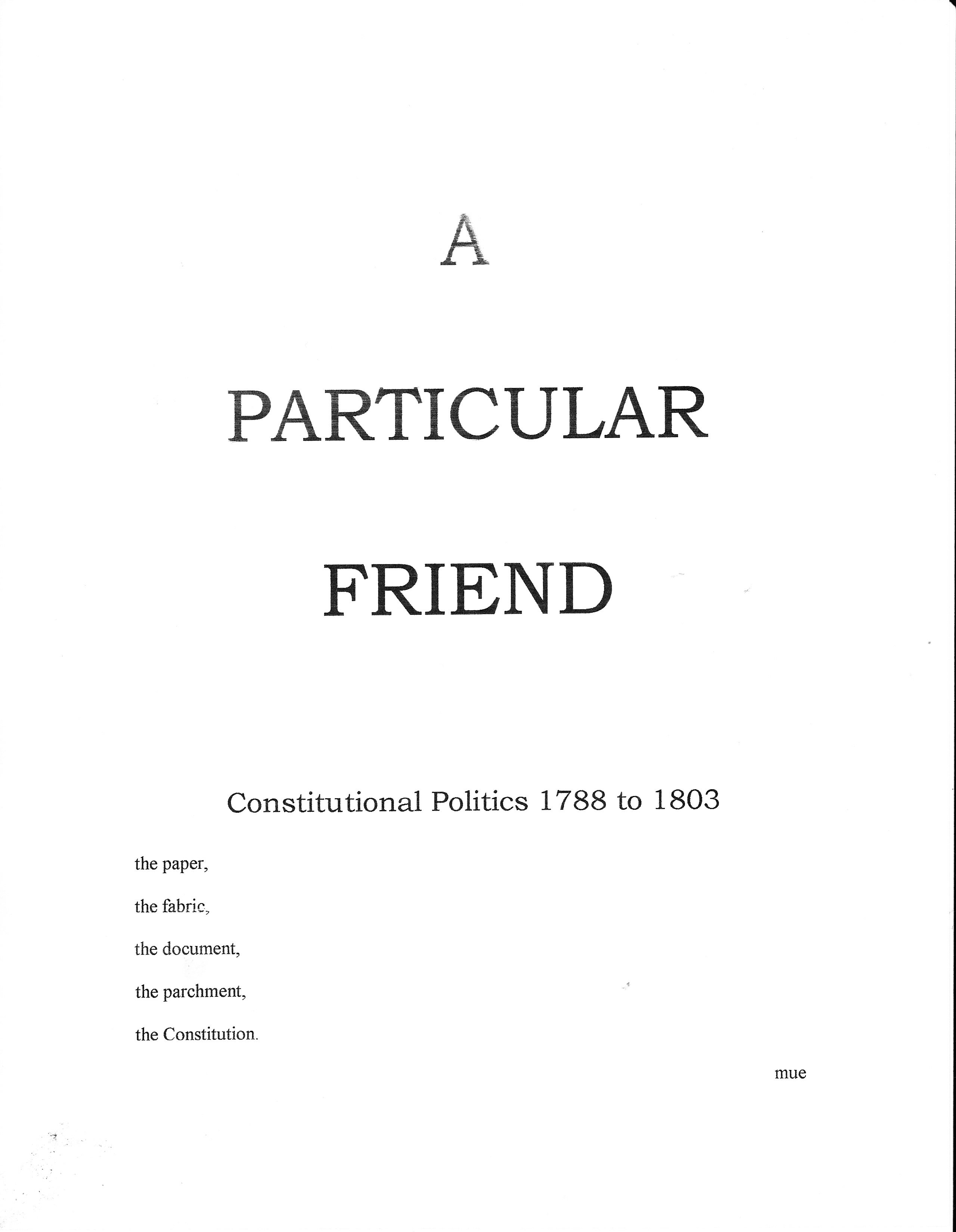
Within the last ten years I bought a computer but didn’t write with it for two years. I wrote a history, non-fiction, A PARTICULAR FRIEND, Constitutional Politics 1788-1803, James Madison’s activities to get the government and the American people accustomed to the Constitutional after 1789. A PARTICULAR FRIEND is on the iBookstore, michael ulin edwards. I put my notes on the computer and realized I needed no complicated outline or involved index to the sources: I only needed keywords to take me from source to source, and to reference related sources. The writing of A PARTICULAR FRIEND was quick.
Image


I submitted the book to New York agents and surprisingly I found many points, unique to this history, were obliquely and sometimes directly made in histories and biographies of Madison and the early “Federalist” period, published after 2008. One reference is important and related to the stature of “common law,” an important issue in the 1790s, and finally disposed of in 1938 by the United States Supreme Court. A PARTICULAR FRIEND was never cited by that historian writing a large survey book for academic courses. I call this a New York Taking.

How do I know someone borrow points from A PARTICULAR FRIEND? To know about this case, the historian has to have Civil Procedure in law school, a first year class. Next, the historian has to make an association from the issue in Civil Procedure to the 10th Amendment of the US Constitution; it is helpful to have Constitutional Law in the Second Year of law school. I note in law school no one make that association between the Civil Procedure case and Constitutional Law. The third step is realizing that the issue in 1938 before the Supreme Court was the same issue, Madison was attacking, in the United States in the 1790s. Finally, out of the blue in 2010(?) a publisher contacted me and asked for my manuscript. I supplied it. I never heard from them again.

What I wrote in A PARTICULAR FRIEND is better and more insightful than that historian, who for his history digested, summarized and regurgitated published histories of those times. 

No credit, adopting stories and taking outlines of existing stories to be rewritten by a commercial writer happens. It is not fair. I am used to it, because in law where I was primarily a legal researcher, stealing happens all the time.

HOWEVER, the writing of A PARTICULAR FRIEND broke me of the typing, make copies, edit process. I had a manuscript on a computer where I could work it and get it into shape without making a copy. Printer ink is an expense to avoid if the same result can be achieved by  changing the way the mind thinks and works.

Now a manuscript of mine has come out so confused, I need a hardcopy to rewrite or make any other sense to it. If it is on the computer I’ll realize the writing is a mess and no rereading, cutting and pasting, no added passages will carry me toward a future produce. I suspect I may have started one book and written 10,000 words, and begun a second of 25,000 words. A hard copy will give me distance and allow me to work with the writing and present a story.

WHAT TO DO ABOUT AGENTS AND NEW YORK? Trust can not be extended only by writers. I am trying to get manuscripts like A PARTICULAR FRIEND read electronically, rather than pay for the bureaucracy filtering and censoring everything.

So here’s the blog.
EXPLORATION

Primarily a writer of fiction, I read a lot of history. One group (area) (field) of books always interests me: Exploration of the earth beginning with the Portuguese and Spanish and finishing in the Twentieth Century. A lot of usual stuff happens: In a sixteenth a guy got parted from a Spanish expedition in Florida, and he walked west to Spanish settlements in Mexico.

Exploration and writing a story are similar. There’s a starting point. The vessel sail in one medium on blue or if it is snow, white. Paper is usually write for the author. Like the author an explorer sort of knows where he’s headed. Neither writer nor explorer know exactly how to get there. A lot of skill is required. Once the writer and explorer believe the destination is reached, they like to call it quits. Success is not always evident. Remember Columbus sailed for India and ended up in North America. Look at the first draft of any story. How close to finishing is the writer? Getting home, completing the story – that’s the rub.

Recently read is L.H. Neatby, The Quest of the Northwest Passage, chock full of facts, names and places with many maps that don’t give all the names of the places mentioned in the text. When reading a book of exploration or discovery, it is good to know where the expedition is: Glendale, Arizona or Glendale, California. Can anyone tell me where the Great Fish River is? Having read the book, I may know. But I may not.

Next, it is not enough to say that Eskimos in the early days (1600 to 1700s) were murderers and thieves without giving a brief background of their society and culture: Life is hard near the Arctic. Did the explorers act this way, or that? I was unaware until late in the book, that a translator who learned to speak the natives’ language in Labrador was understood by Eskimos near the mouth of the Mackenzie River, at least 2000 miles away.

Neatby’s book is otherwise well-presented. It benefits from shortness, 200 pages, no Index. But brevity diminishes the tales. Trapped in ice like Shakleton at the South Pole 60 years later, Captain Collinson secured his ship in the Arctic flow. Morale of the crew was excellent especially after the men built, next to the ship, a billiards table from ice and available materials and played until the ice broke. The reader needs more than 250 words about Captain Collinson.

The text requires an interest in exploration and Canadian history; it is not geared toward the general reader. But the subject matter is compelling with one caveat: Every explorer is cold, frozen, gets frost bitten or ends up frozen to death. This is a welcome book to read during the hot summer months.

The following are exceptionally readable and authoritative books about exploration, the persons involved and the peoples they met:

Carl Sauer: a) Sixteenth Century North America, b) Seventeenth Century North America, c) The Early Spanish Main

JH Parry: a) Discovery of the Sea, b) The Age of Reconnoissance, c) other books

CR Boxer: Histories of the Dutch and Portuguese Empires.

William Goetzmann: a) Exploration and Empire, b) Army Exploration in the American West

Alan Villiers: a) Captain Cook. There are many biographies of Captain Cook. This one is well written. The author is a sailor and has sailed in a ship like the ones Cook piloted, as well as many smaller ships and boats that Cook sailed. There is some technical sailing lingo in it which is not obnoxious. I’m not a sailor and never will be. I will not master the terms or fully understand, always what was happening or why. Although incomprehensible, these sentences and clauses did not get into my general understanding. Despite that, I can only conclude that I like this book because I like to be teased. 

SEE EVERYONE, DO A LOT

SEE EVERYONE, DO A LOT

Over the summer I read four volumes by William L. Shirer: Berlin Diary, and Twentieth Century Journey(three volumes). I liked all four books. I recommend them, especially the ones recounting events before World War Two. Of all four the first, Twentieth Century Journey: A Start (1904-1930) is the most varied. Shirer goes to Paris and gets a job on a newspaper. He mets everyone in Paris and tells.

Shirer is by no means correct or accurate about everything. Who is? Most of his shortcomings can be overlooked. In Berlin Shirer respected and was fond of Ambassador Dodd and daughter Martha, a communist. There Martha dated an agent from the KGB or its predecessor agency; summaries of her Soviet files of 1930 activities make very funny reading, an evaluation of a real spy. Her father, the ambassador, had many screws loose and at best was naive. Most notably, the Ambassador wrote Mission to Moscow about Stalin’s purges (1936-1939). When Stalin and his cronies watched the movie, “Mission to Moscow,” they couldn’t stop laughing.

If Shirer knew nothing, he felt free to criticize it liberally – Ronald Reagan and Star Wars, “a hoax.” I wonder if the Israelis think their Iron Dome is a hoax. Shirer’s naiveté and ignorance cannot be excused. He tells about living in horse and buggy days, watching early air flights, using Trans-Atlantic flights to cross that ocean, seeing men visit the Moon, and benefiting from medical advances to prolong his life on Earth. Yet for Shirer there was no scientific progress. We know nothing is a hoax, if science and math can reduce its mysteries to possibilities, to probabilities and to certainties. However, Shirer is selective with some beliefs.

When Shirer was preparing to go to the Soviet Union (1982), he was asked, “What do you think of the Soviets?” He answered, “I don’t know. I haven’t been there.” Shirer’s response is disingenuous on a number of grounds. First, does anyone like Shirer go to the Soviet Union at the height of the Cold War, and not read about the place, so he has no opinion because he’s never seen the country for himself? Second, without reading did Shirer (former foreign correspondence/hard news addict/historian) form any opinions about the Soviets before he went in 1982? If he didn’t have an opinion, his whole life and life’s work is a lie. Third, did Shirer read only books of popular/non-fiction (friend-Harrison Salisbury) and read nothing from academia; the best writer of many books on the Soviets by 1982 was Adam Ulam.

One cannot answer this third question yes or no, which is a failing of the Memoirs. The idea of preparation before going someplace and knowing is attractive: the tourist knows the history, culture and society, and can understand the social significance of what is seen and what is said. It is an enriching experience, rather than arriving and flying-by-the-seat-of-his-pants, as Shirer would have the reader believe. These latter chapters of volume three of A Native’s Return are incomplete and sketchy. We learn nothing about Shirer, himself, except he wants to avoid subjects and certain embarrassment.

Volume three, A Native’s Return, presents a gross inconsistency, academia and the Ivory Tower. And Shirer was correct in his reaction to that. When The Rise and Fall of the Third Reich was published, many professors disparaged it. One ground was it was a best seller. The book was one of the first on the subject, and overall, it is not as bad nor better than most books on the subject. What most historians, professors and intellectuals didn’t like was Shirer’s familiarity on many subjects and a sense after reading documents about the people and their acts, persons he once knew and observed, he describes results accurately and authentically.

Shirer was invited to participate in a seminar at Harvard. Shirer writes:

I was troubled by the practice of …young academic historians of drawing historical conclusions from their detailed studies of a tiny part of the picture. …too young to have known Nazi Germany at first hand…kept dodging important questions…more interested in their data…

The last day…an elderly man,…, a refugee from Nazi Germany and for many years a distinguished professor of history at the University at Paris. I knew him by reputation, and the day before he had said he admired my own works on Germany.

“This is all so unreal,” he whispered to me. “Let’s ask the chair if we can interrupt the program for a few minutes and tells some of these young historians what it was like to live in Nazi Germany and just what happened to bring a calamity on the German people. We can tell them how the people really behaved, which is quite different from what the dry data tells them. He got at attention of the chair…and explained that much of the talk over the weekend seemed to him to be so lacking in reality…

The presiding academic historian listened patiently, a little bemused,… and said, “Thank you very much,” and promptly without batting an eye, called on the next speaker on the agenda.
(A Native’s Return, p. 402)

Because of academia and the Ivory Tower, the public can now understand why Martin Gilbert, an academician, has written stark, long histories of the Nazis without the fluff of data points or eye-balling this event, or magnifying incidences as revealing a theory or a postulation, all typical Ivory Tower stuff, especially when analyzing great disasters, gross problems or gutteral practices.

It is equally anonymous that professors, critics and intellectuals would complain about the length and authority of The Rise and Fall. Indeed, the whole East Coast intellectual establishment seemed offended:

“Some American reviewers were declaring that they would no longer read books with an array of footnotes. My God, I thought, my book must have at least a thousand. I had tried to document each fact and had noted it in a footnote.” (A Native’s Return, p. 239)

Without notes that can be checked and the source that can be authenticated, it seems the modern practice for historians, intellectuals and others of the scribbling class to write crap, call it the product of vast, deep thinking and sell it to others of their ilk, and the unsuspecting. Having no or few notes is dangerous. Most writings from that scribbling class which have notes merely refer to previously published writings from the scribbling class.

Why have facts at all? Shirer researched and wrote about the fall the France 1940, The Collapse of the Third Republic. The military disaster was accompanied by political ineptitude. Indeed, the last two Presidents of the Third Republic had mistresses who ran things, gave instructions, interfered and/or counseled their masters in 1940. In 900 pages Shirer devoted four (4) pages to the mistresses. The Ivory Tower screamed! Salacious, irrelevant, misleading. Once again the Ivory Tower got it wrong, but it has a lot to defend: Woodrow Wilson, one-time professor and then President of Princeton. In one hundred years have academic researchers given the American people the low-down of Mrs. Wilson’s presidency? NO! It seems entirely appropriate for Shirer to write four pages about mistresses, when France was falling apart, the government was in disorder, the army would not fight, the President of the Republic was wearing pjs and his mistress was cracking the whip.

It is easy to dismiss the flaws. Overall William L Shirer’s Twentieth Century Journey and Berlin Diary are memorable and worth reading. 

HONESTY AND TRUTH FOR ONCE

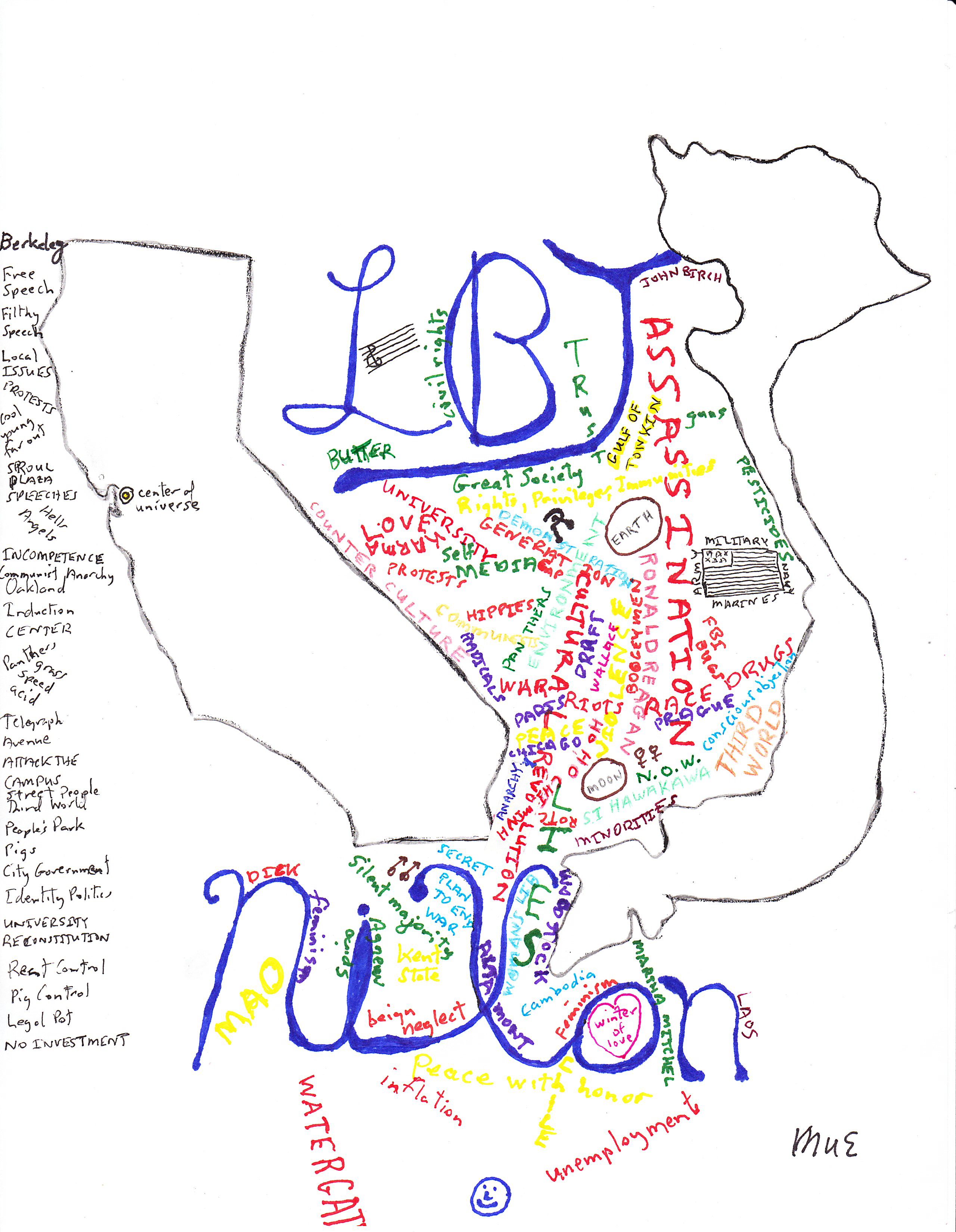
This blog is both promotion of my own novel, Bitch., of which I’ll write more in other posts, and criticism of Radical Son by David Horowitz. Bitch. ($10) is published on the iBookstore. It is about events in Berkeley during the Nixon years (1968-1974) from the standpoint of five first year students.

Horowitz attempts to soft-pedal those years in Berkeley; he lives on Northside, the safest part of town. He is reasonable; he did everything reasonably; he made rational decisions; he understood everything; he was noteworthy enough to write a memoir. Reading his book, Horowitz sounds so plausible and sometimes reasonable, 30 years old, innocent, working for good against evil, using the purest motives while striving for justice and never being critical or judgmental of a thought, an act or plan. Everyone liked David Horowitz. He’s oblivious to dates, short on details, unaware of events, and unwilling to be honest. Horowitz and others of his ilk were phonies, or perhaps they were mentally ill.

Horowitz was part of the Berkeley radical circus, in a coterie of radicalness, a radical party cadre – the people who were responsible for ripping up Berkeley for five years. How do I know this? Bitch., 215,000 words, reading more than 3,000 books including Horowitz’s, years of writing, and having lived through it.

After reading Horowitz’s book, Radical Son, the public will understand why I entitled my book, Bitch., a period not a dot, a verb not a noun. Other than running a magazine called, Ramparts, Horowitz and his buddies colluded with “people” in Berkeley. Throughout Bitch.I call Horowitz and his pals “white radical shits.” The public can understand that term, too – mentally deranged dumb shits who constructed idiot scenarios for “street people” to perform street theater [riots].

Horowitz returns to Berkeley in January 1968 and tells of his Road to Damascus Conversion to the radical cause and its revolutionary ways. He took his son to a local elementary school, where they heard a rock band (Purple Earthquake) perform. Horowitz “felt: A new world is possible.”

Why is that is bull shit and an outright lie? Horowitz has told the reader how smart he is, and that he is well-connected with the left-people in Berkeley. He has come from London, where there is no shortage of electronic instruments and excellent rock music; he has undoubtedly heard the best rock music there. Has anyone ever hear of the Purple Earthquake ever again? [They didn’t become Creedence Clearwater, did they?] Did the band play so loudly that Horowitz broke a blood vessel in his head? Horowitz’s son, a youngster, did not have the same epiphany as his father. Horowitz did not say that he was sober or straight at the performance.

There is another explanation, somewhat goofy but with Horowitz one never knows. It comes from Charles Reich, The Greening of America, p. 260: “Music has become the deepest means of communication…When someone puts a dime in the jukebox…there is a moment of community. [P]eople begin to move, some nod heads, some drum fingers, others tap feet, others move their whole bodies…many sing…” This explanation is improbable because it suggests creativity and art, yet there is nothing in Radical Son which is creative or artistic.

Horowitz was well-connected with the left-people in Berkeley. His manner was agreeable; he was calm and voluble. Throughout Radical Son Horowitz tells about meeting wealthy people, outsiders to Berkeley, and getting money. Horowitz was the “money guy,” for that Berkeley clique as well as for Ramparts. In another book (The Destructive Generation), Horowitz tells about picking up Jane Fonda at the San Francisco Airport and getting her to Alcatraz Island. Why did Horowitz drive? Money beyond taxi fare.

Horowitz rightly criticizes Todd Gitlin’s book, The Sixties, but at least Gitlin tried. He observed the pervasive, on-coming influences from the street and hippie, youth culture including drugs. The Leftists, New Left, Weathermen and others couldn’t manage all that, and Gitlin couldn’t describe it. Horowitz avoided those agency-setting effects completely and disregarded the influences: He lived a normal middle class family life, doing middle class stuff in an upper class neighborhood. His job was a plaything; his ideals and principles – did one need ideals and principles? He was so remote and detached he never understood revolution was not possible and one could not write about it well, if loaded on drugs, blasted by iron-rock, trashed by women and among people whose business acumen didn’t extend beyond the street mantra: “grass, speed, acid.”

But if an author recognizes “a new world is possible,” shouldn’t the author develop the point – observe, do, influence, watch? On which bases was “a new world possible?” Horowitz raised the point and let it rot, in intellectual venality. He didn’t bother to wonder how people, culture and society were divorced from the narrow confines of selective, opportunist Leftist politics whose financial supporters were deceived with every check. Toward the end of his “radical” days, Horowitz met a backer who asked, “Is the revolution possible?” Radical Son proves that Horowitz is the last person in the world to know whether the revolution was possible. Strangely enough, Horowitz does not have the self-reflection and the wherewithal to phrase the setting of that meeting and the question as a joke.

Supposedly, Horowitz had a defining moment in his life when a friend with a job at a Black Panther run school in Oakland was murdered. Throughout the first half of the book Horowitz was chummy with the Panthers, visiting the Party big-wigs. He accepted Huey Newton’s statement that Eldridge Cleaver was too violent for the Party. Horowitz lied about Bobby Seale fleeing Oakland to get away from Huey Newton. Before and after the murder Horowitz casts allegations and theories about who did what, when, where and how. When he tries to talk to the pigs [police], they don’t believe him.

Horowitz was the money man. He liked talking to the top people, but everyone else wasn’t worth a shit and was a trifle. Horowitz initially recommended his murdered friend work at the Panther school. Why? He doesn’t say, but probably so he could have input, influence and control over things there, and the money. The Panthers didn’t need him; they didn’t need the woman who could have been fired and sent packing, not murdered. There is no answer, but it is a scenario which arises from circumstances. It is entirely possible that Horowitz pressed his case too hard, revealed too much and made threats. Horowitz didn’t say this in the book, but he may as well have written he was responsible for the woman’s murder, a personal message to him. [This assumes the Panthers were as irrational as Horowitz claims. They knew if he broke with them, there would be no more money, but they also knew he couldn’t prove anything. Why murder the woman?]

The murder and Horowitz’s role in pre-killing activities were a final revelation for Horowitz after being deaf, blind and mute for a decade. The Panthers had an unsavory side, and everyone but Horowitz knew it. The cops saw the street activities, gang style. Indeed the son of the murdered woman, not a cop, warned his mother. Apparently Horowitz had greater influence, and she worked for the Panthers. In books Black leaders wrote with distrust about the Panthers; Horowitz was illiterate. Black student groups kept their distance from the Panthers who were so entwined with white radical shits to become self-destructive. While Chancellor at San Francisco State, S.I. Hayakawa said, publicly, “The black radicals want a better America. And they may use revolutionary methods at moments, but they are willing to give them up as soon as it’s clear that the administration is willing to do something to improve the quality of their education and their opportunities within the system. White radicals, like the SDS, don’t want to improve America. They just want to destroy it and louse it up in every way possible. So I have nothing to offer them.” (Orrick, William, Shut It Down! A College in Crisis, Washington DC, 1969, p. 147.)

It is obvious that Horowitz would not change from his Mommy-and-Daddy brainwashing to get away from white radical shitism. And he wouldn’t support Black organizations which were trying to improve circumstances in 1968-1969. Instead, he liked the Panthers, isolated friends so long as they could be useful. He liked and likely laughed at their jiving – Martin Luther King was Martin Luther Coon. Radical Son, p. 161.

Essentially, Radical Son, is about Horowitz’s retarded progression from Pinko-Commie to Fascist. He was raised by educated Communist parents, and he believed their crap like it was Gospel. The book does not admit whether he kept his Communist rooting from parental love, or whether he was just an idiot. I’ll go with the latter. Unlike many kids of the Sixties, Horowitz never told his parents they were full of shit, which they were. A reviewer’s comment on the outside of the book says, “A courageous book, full of self-revelation.” That is erroneous. It is more accurate to say, A cowardly book, full of slow-revelation. More accurately, the book should be entitled, Memoirs of a Moron. Horowitz chooses not to be honest, to tell the truth and give a fair portrayal of himself. Instead, he displays an imbecilic rigor, revealing a lack of intellectual discipline and an idleness when seeking the truth.

Image