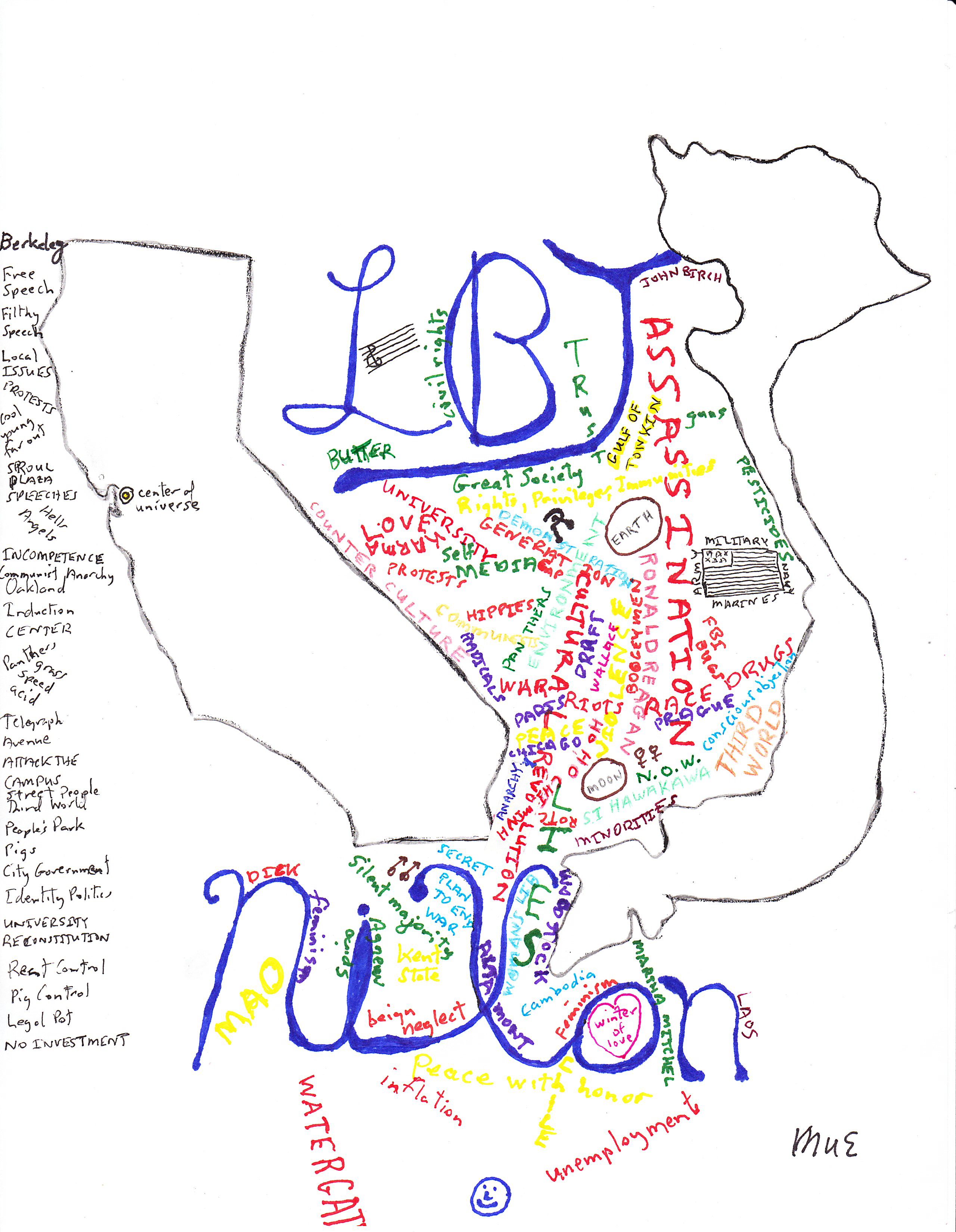
2020 Election Headlines, Last Week

Newt Gingrich should spend all his time in Georgia, where suppressing the votes of African-Americans and other minorities always gave Newt a victory. No suppression, no victory for Don and none for Newt.

Rudy Guiliani complained 450,000 votes were suppressed in Pennsylvania. A later figure said 650,000 votes. The votes suppressed were mail-in ballots which broke for Joe Biden three (3) to five (5). 

The public can understand Guiliani’s confusion. He scheduled a press conference at a Four Seasons [Lawn Care] business. Are they Republicans? The place looked right to Guiliani who walked into the porno shop next door, believing it was Trump’s Headquarters. Not finding the candidate but pictures, perhaps of notable campaign workers, Guiliani left and was comfortable: Outside he saw a crematorium (are they Republicans?) was close-by to incinerate the remainder of the Trump 2020 campaign.

The Georgia Secretary of State said he was sure illegal votes were cast in the Presidential election. The Secretary of State did not identify which ballots were illegal, or where they came from. It was easier in the old days when ballots were marked “W” or “N.” All “N” ballots were illegal. When one considers illegal voting, one thinks of Illinois, and the graveyard voting. The question for the Georgia Secretary of State is how many Confederate honored dead voted for Trump?

Jonathan Turley. Anyone remember Jonathan. On Fox News he urged Americans “to look at the votes.” That’s very nice, Johny boy. Look but don’t count the votes. Of course, Jonathan is a guy people once went to when they had legal problems and needed explanations. Legal questions are always based upon fact, a commodity which Johnathan has in short supply.

How refreshing were some of Richard Nixon’s employees. Caught in a misstatement of fact, an outright lie, Ron Ziegler, Nixon’s Press Secretary identified the false sentence as an “inoperative statement.” There is a trace of honesty, reality and humor in that confession. Kayleigh McEnany has neither the wit or judgment to appreciate Ron Ziegler’s standards. 

Mike Pence, Vice President, leader of the Virus Task-Force, on vacation while more than 10,000 Americans died of Covid-19. Mike Pence is fat, dumb and unhappy and is sulking: On January 20, 2021 he no longer has a job. Who in Washington D.C. wants to talk to him? He’ll have to return to Indiana.

Samuel Alito, Supreme Court Justice gave an advisory opinion: Covid-19, a public health crisis, is creating “unimaginable restrictions on individual liberty.” BOGUS.

Stop being a HIPPIE, Sam, promoting dirt, filth and infection in human society.

Sam sounds like he regrets not going to the first Woodstock festival, where he could swallow a lot of mud. He regrets not going to Altamont where he could see Hells Angels – the security team -209 beat up fans and musicians and kill one of them.

Sam should take a shower, wear a face mask, social distance, and wash his hands. And Sam should stop annoying the women and clerks around the Supreme Court, if that’s what Sam calls individual liberty of a Don Trump fashion.

The Stolen Election: If Democrats stole the 2020 election, why did Republicans pick up 13 seats in the House of Representations? Why is it Republicans managed to keep 50 seats in the Senate, and may keep the Senate majority?

A First! Ted Cruz said nothing stupid this week. 
HIPPIES RULE: OLIVE OIL

The oil comes from the fruit of trees. When ancient man could not make wine, beer or spirits from the liquid of the fruit, a woman came along and learned, this is good for cooking. Now, the Olive Oil world should be investigated.

The Internet says stuff, once cherished but made overseas, is being debased but is still labeled as fabulous Olive Oil. Those Internet writers do not tell what is wrong with premium olive oil from Spain, France, Italy, Greece, Turkey and other countries. They cannot attest to an old, or an odd olive, changing the taste, smoothness or quality of the product. It is inferred that the octane is now 20 rather than 90, but nobody gives any laboratory evidence. Instead, they give their preferred procedures.

Pick up a bottle of speciality olive oil from California, United States of America: “My country tis a vie…” There are all sorts of dates on the bottle: Date Olives were picked; date squashed, date processed, date frozen, date bottled, used by date. Each date has a particular function and adds to the flavor or quality. No one will tell when the THC is added, a well known ingredient like the gasoline additive, Petrox, to put a tiger in the tank. After using California Olive Oil, no one cares what the food tastes like. Any food will do.

Because the product comes from California and results from the finest agricultural techniques, olive oil in the state is funded and hyped by people writing the Internet articles. It is like the old days when hippies argued that brown rice was better than anything else. No one can say what the finest agricultural techniques are, or that the new product of technology is truly better than the oil fashioned stuff, made with millennia of experience, or why an old olive tree is slimier than a new one. Why not have bits of fertilizer in the morning’s milk? That’s better than drinking milk that’s pasteurized. And users of the California olive oil pay super premium prices, at least $70 a gallon.

This olive oil problem arose when giant, greedy corporations without name, honor or reputation began taking over growers, producers and sellers. Specifically Michael Corleone announced, “The Corleone family has sold all its interests in the olive oil business.” The Corleone family had a stake in producing and selling the best product around. They were honorable and maintained their reputation. If they didn’t do so, they knew their goose was cooked. They were also a family and of a people who would like higher prices for their product, but they knew the market. So the Corleone family never charged excessive prices, ($70.00 a gallon) like they were principals of a pharmaceutical company, selling at excessive prices all the while degrading the competition.

HISTORY AND FICTION

bitch. cover

When I went to write Bitch. (iBookstore, michael ulin edwards), I was determined to make it autobiographical. I learned after three major drafts and a long process of 20 years, that autobiography was impossible. It would make a bad book. Some of the reasons can be found in Twentieth Century Journey, William L Shirer, vol. i, Preface; Autobiography of Mark Twain, U.C. Press, Berkeley, 2011, vol. 1, on writing memoirs/autobiography.

I was motivated to write the life and times of Berkeley, 1968-1973. While there I had forces coming at me. I determined they would best be represented by FIVE major characters, plus subsidiary characters folded into the stories of the FIVE. At that point the book could not be autobiographical; it could not be biographical. It could be history. Recount events as truthfully and accurately as I could, but the characters had to be representations. [Readers have commented that they know these characters.]

As much as I ran from place to place in Berkeley, observing and stuffing everything into my memory (which is not entirely why I almost flunked out my first year – I was also taking the wrong classes and my perspective on learning was horribly distorted), I could not tell the story of Berkeley with one character being everywhere at once: Peoples Park Riot Day, May 15, 1969 – in class on the north side of campus; in the riot itself; at the swimming pools in Strawberry Canyon; wandering around Dwinelle Hall. The FIVE characters and others were useful to convey what had to be said.

It is also impossible for a individual to tell his story when hormones, urges, the environment, economics are exerting influences affecting the person. What is the order? What is the priority? What is important? Those day to day, sometimes hour to hour or minute to minute considerations which may or do change affected human being senses – hear, see, smell, feel, taste – will shift the ground and upend any story.

If the reaction to life under those circumstances is the same, that makes for a dull human being. If the reaction to life under those circumstances whipsaws the human being into incapacity, he becomes confused and worthless. If the reaction causes the human being to take the brunt of it and react intelligently, predictably or making-do, that is the easier story to tell.

IMG

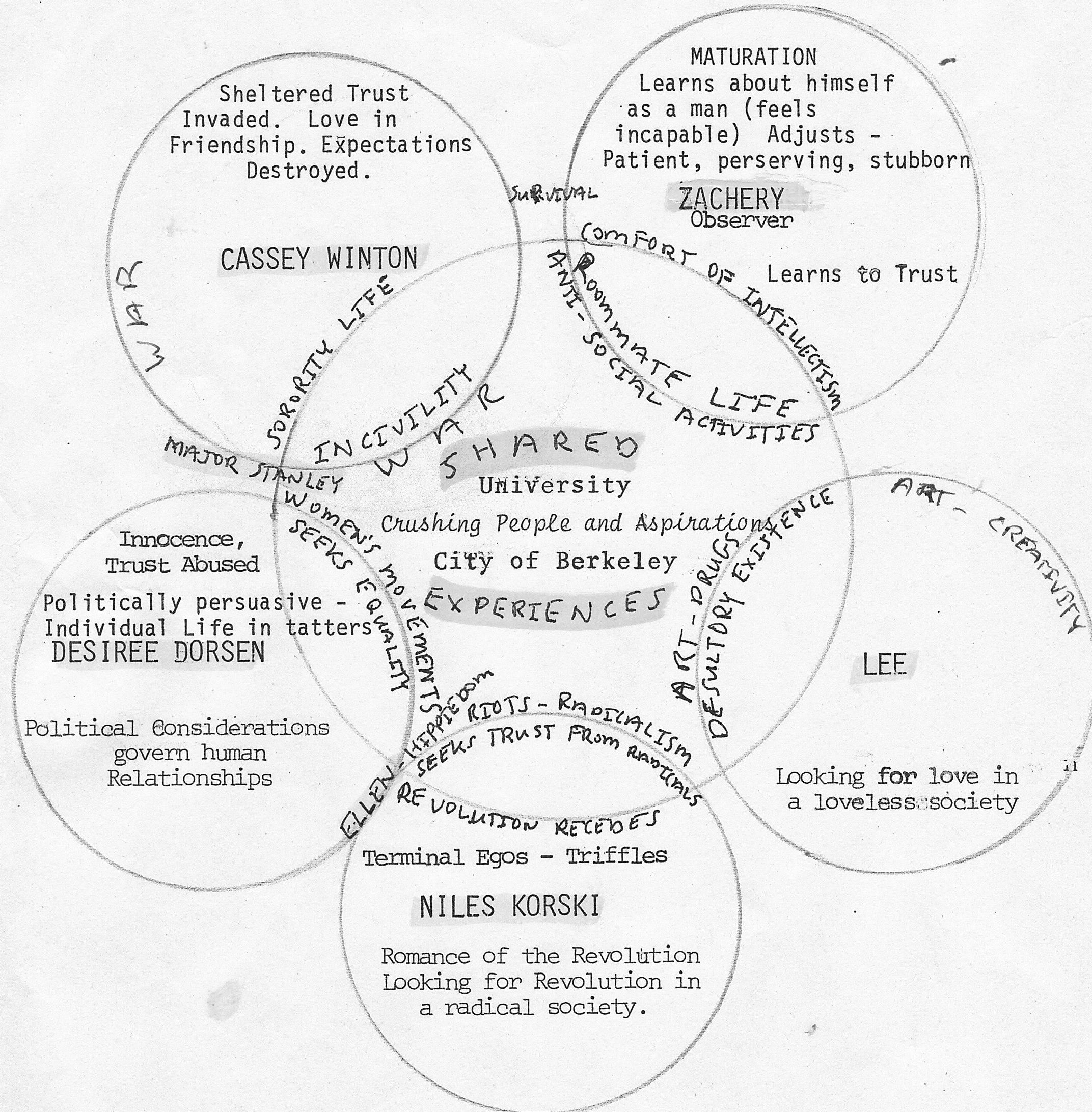
In 200,000 words I came up with the FIVE characters, two guys and three women, living and telling their lives (some aspects of my life) in Berkeley from September 1968 through the summer of 1973. They lived through riots, demonstrations, classes, drugs, life, city and academic events and state and national actions, all told within this novel. [There are 450 notes and a bibliography.]

Also, I could not tell my own story for a personal reason. Who could be truthful about being psychological creepy and sociology awkward then, (probably eccentric today) in a terrifying place. That doesn’t describe the discomfort, the violence and the shock of watching crap on the streets being played out and the acceptance of it by everyone in Berkeley. About 20 years ago I talked to someone I knew as a student. He tried to fit in and spoke the language as a student. His evaluation of those times upon meeting him again was reduced to one word: “Strange.” He didn’t want to talk about what he thought or was doing as a student, which was likely “creepy” and “weird.”

It seemed I was the only person who considered everything going on was strange, weird and ill for society. I may have been suited for a college campus in the 1920s, but I was stuck at Berkeley. I did not want to be a statistic and a loser: Someone told me when I entered that the average stay of a student at Berkeley was four quarters. (The University is much more mellow today which is why it is not a place of excellence.)

While a student at Berkeley, I didn’t like and actually detested loud music, drugs, and the recklessness of students, their lives a step from the street. Everything seemed reenforced by the citizens of Berkeley. Condemning this gross, communal lifestyle is a theme of Bitch.. Indeed, I dislike any communal styles, community standards, something my generation embraced and never let go of, and something which has been passed onto to their children and grandchildren: The collective.

We are not raising children today to be individuals, to think on their own. They are accepting, too much of collective action, group-think, the so-called common good. They have been taught, It Takes a Village – Collective actions are the bases of all advancement. Those are  wet dreams rolling from the Left of the Sixties and from Radical Feminism. (See Shulamith Firestone, The Dialectic of Sex.)

Finally, I did not want to be like any of the FIVE. I put a lot of distance between myself and Berkeley. Not in the novel is: at the end of my Berkeley studies, I wanted to be a composer, but I had injured my left hand and couldn’t play the piano. I was lost to the activities I was prepared for. Law school intervened, but within ten years I had turned to writing.

This post is the second using the cover and the diagram (outline) that I have made. The subject is different because the text differs.

HONESTY AND TRUTH FOR ONCE

This blog is both promotion of my own novel, Bitch., of which I’ll write more in other posts, and criticism of Radical Son by David Horowitz. Bitch. ($10) is published on the iBookstore. It is about events in Berkeley during the Nixon years (1968-1974) from the standpoint of five first year students.

Horowitz attempts to soft-pedal those years in Berkeley; he lives on Northside, the safest part of town. He is reasonable; he did everything reasonably; he made rational decisions; he understood everything; he was noteworthy enough to write a memoir. Reading his book, Horowitz sounds so plausible and sometimes reasonable, 30 years old, innocent, working for good against evil, using the purest motives while striving for justice and never being critical or judgmental of a thought, an act or plan. Everyone liked David Horowitz. He’s oblivious to dates, short on details, unaware of events, and unwilling to be honest. Horowitz and others of his ilk were phonies, or perhaps they were mentally ill.

Horowitz was part of the Berkeley radical circus, in a coterie of radicalness, a radical party cadre – the people who were responsible for ripping up Berkeley for five years. How do I know this? Bitch., 215,000 words, reading more than 3,000 books including Horowitz’s, years of writing, and having lived through it.

After reading Horowitz’s book, Radical Son, the public will understand why I entitled my book, Bitch., a period not a dot, a verb not a noun. Other than running a magazine called, Ramparts, Horowitz and his buddies colluded with “people” in Berkeley. Throughout Bitch.I call Horowitz and his pals “white radical shits.” The public can understand that term, too – mentally deranged dumb shits who constructed idiot scenarios for “street people” to perform street theater [riots].

Horowitz returns to Berkeley in January 1968 and tells of his Road to Damascus Conversion to the radical cause and its revolutionary ways. He took his son to a local elementary school, where they heard a rock band (Purple Earthquake) perform. Horowitz “felt: A new world is possible.”

Why is that is bull shit and an outright lie? Horowitz has told the reader how smart he is, and that he is well-connected with the left-people in Berkeley. He has come from London, where there is no shortage of electronic instruments and excellent rock music; he has undoubtedly heard the best rock music there. Has anyone ever hear of the Purple Earthquake ever again? [They didn’t become Creedence Clearwater, did they?] Did the band play so loudly that Horowitz broke a blood vessel in his head? Horowitz’s son, a youngster, did not have the same epiphany as his father. Horowitz did not say that he was sober or straight at the performance.

There is another explanation, somewhat goofy but with Horowitz one never knows. It comes from Charles Reich, The Greening of America, p. 260: “Music has become the deepest means of communication…When someone puts a dime in the jukebox…there is a moment of community. [P]eople begin to move, some nod heads, some drum fingers, others tap feet, others move their whole bodies…many sing…” This explanation is improbable because it suggests creativity and art, yet there is nothing in Radical Son which is creative or artistic.

Horowitz was well-connected with the left-people in Berkeley. His manner was agreeable; he was calm and voluble. Throughout Radical Son Horowitz tells about meeting wealthy people, outsiders to Berkeley, and getting money. Horowitz was the “money guy,” for that Berkeley clique as well as for Ramparts. In another book (The Destructive Generation), Horowitz tells about picking up Jane Fonda at the San Francisco Airport and getting her to Alcatraz Island. Why did Horowitz drive? Money beyond taxi fare.

Horowitz rightly criticizes Todd Gitlin’s book, The Sixties, but at least Gitlin tried. He observed the pervasive, on-coming influences from the street and hippie, youth culture including drugs. The Leftists, New Left, Weathermen and others couldn’t manage all that, and Gitlin couldn’t describe it. Horowitz avoided those agency-setting effects completely and disregarded the influences: He lived a normal middle class family life, doing middle class stuff in an upper class neighborhood. His job was a plaything; his ideals and principles – did one need ideals and principles? He was so remote and detached he never understood revolution was not possible and one could not write about it well, if loaded on drugs, blasted by iron-rock, trashed by women and among people whose business acumen didn’t extend beyond the street mantra: “grass, speed, acid.”

But if an author recognizes “a new world is possible,” shouldn’t the author develop the point – observe, do, influence, watch? On which bases was “a new world possible?” Horowitz raised the point and let it rot, in intellectual venality. He didn’t bother to wonder how people, culture and society were divorced from the narrow confines of selective, opportunist Leftist politics whose financial supporters were deceived with every check. Toward the end of his “radical” days, Horowitz met a backer who asked, “Is the revolution possible?” Radical Son proves that Horowitz is the last person in the world to know whether the revolution was possible. Strangely enough, Horowitz does not have the self-reflection and the wherewithal to phrase the setting of that meeting and the question as a joke.

Supposedly, Horowitz had a defining moment in his life when a friend with a job at a Black Panther run school in Oakland was murdered. Throughout the first half of the book Horowitz was chummy with the Panthers, visiting the Party big-wigs. He accepted Huey Newton’s statement that Eldridge Cleaver was too violent for the Party. Horowitz lied about Bobby Seale fleeing Oakland to get away from Huey Newton. Before and after the murder Horowitz casts allegations and theories about who did what, when, where and how. When he tries to talk to the pigs [police], they don’t believe him.

Horowitz was the money man. He liked talking to the top people, but everyone else wasn’t worth a shit and was a trifle. Horowitz initially recommended his murdered friend work at the Panther school. Why? He doesn’t say, but probably so he could have input, influence and control over things there, and the money. The Panthers didn’t need him; they didn’t need the woman who could have been fired and sent packing, not murdered. There is no answer, but it is a scenario which arises from circumstances. It is entirely possible that Horowitz pressed his case too hard, revealed too much and made threats. Horowitz didn’t say this in the book, but he may as well have written he was responsible for the woman’s murder, a personal message to him. [This assumes the Panthers were as irrational as Horowitz claims. They knew if he broke with them, there would be no more money, but they also knew he couldn’t prove anything. Why murder the woman?]

The murder and Horowitz’s role in pre-killing activities were a final revelation for Horowitz after being deaf, blind and mute for a decade. The Panthers had an unsavory side, and everyone but Horowitz knew it. The cops saw the street activities, gang style. Indeed the son of the murdered woman, not a cop, warned his mother. Apparently Horowitz had greater influence, and she worked for the Panthers. In books Black leaders wrote with distrust about the Panthers; Horowitz was illiterate. Black student groups kept their distance from the Panthers who were so entwined with white radical shits to become self-destructive. While Chancellor at San Francisco State, S.I. Hayakawa said, publicly, “The black radicals want a better America. And they may use revolutionary methods at moments, but they are willing to give them up as soon as it’s clear that the administration is willing to do something to improve the quality of their education and their opportunities within the system. White radicals, like the SDS, don’t want to improve America. They just want to destroy it and louse it up in every way possible. So I have nothing to offer them.” (Orrick, William, Shut It Down! A College in Crisis, Washington DC, 1969, p. 147.)

It is obvious that Horowitz would not change from his Mommy-and-Daddy brainwashing to get away from white radical shitism. And he wouldn’t support Black organizations which were trying to improve circumstances in 1968-1969. Instead, he liked the Panthers, isolated friends so long as they could be useful. He liked and likely laughed at their jiving – Martin Luther King was Martin Luther Coon. Radical Son, p. 161.

Essentially, Radical Son, is about Horowitz’s retarded progression from Pinko-Commie to Fascist. He was raised by educated Communist parents, and he believed their crap like it was Gospel. The book does not admit whether he kept his Communist rooting from parental love, or whether he was just an idiot. I’ll go with the latter. Unlike many kids of the Sixties, Horowitz never told his parents they were full of shit, which they were. A reviewer’s comment on the outside of the book says, “A courageous book, full of self-revelation.” That is erroneous. It is more accurate to say, A cowardly book, full of slow-revelation. More accurately, the book should be entitled, Memoirs of a Moron. Horowitz chooses not to be honest, to tell the truth and give a fair portrayal of himself. Instead, he displays an imbecilic rigor, revealing a lack of intellectual discipline and an idleness when seeking the truth.

Image