CONSIDERATIONS

1. Being the world’s oldest human being is an achievement, I suppose. It also means you’re next to die.

2. I don’t know whether this makes a restaurant good or bad: There are no free breath mints on the courtesy table at the entrance.

3. We’ve all heard, “My Country right or wrong.” In times when we’re debating whether to bomb another country, it must be noted and reconsidered. George Orwell made the choice less obvious and more personal: “My mother drunk or sober.”

4. Mark Twain observed, Clothes make the man. He explained why: “Naked people have little or no influence in society.” But I believe today it is different for women. It seems the fewer clothes a woman can wear, the more influence she is apt to have.

SEE EVERYONE, DO A LOT

SEE EVERYONE, DO A LOT

Over the summer I read four volumes by William L. Shirer: Berlin Diary, and Twentieth Century Journey(three volumes). I liked all four books. I recommend them, especially the ones recounting events before World War Two. Of all four the first, Twentieth Century Journey: A Start (1904-1930) is the most varied. Shirer goes to Paris and gets a job on a newspaper. He mets everyone in Paris and tells.

Shirer is by no means correct or accurate about everything. Who is? Most of his shortcomings can be overlooked. In Berlin Shirer respected and was fond of Ambassador Dodd and daughter Martha, a communist. There Martha dated an agent from the KGB or its predecessor agency; summaries of her Soviet files of 1930 activities make very funny reading, an evaluation of a real spy. Her father, the ambassador, had many screws loose and at best was naive. Most notably, the Ambassador wrote Mission to Moscow about Stalin’s purges (1936-1939). When Stalin and his cronies watched the movie, “Mission to Moscow,” they couldn’t stop laughing.

If Shirer knew nothing, he felt free to criticize it liberally – Ronald Reagan and Star Wars, “a hoax.” I wonder if the Israelis think their Iron Dome is a hoax. Shirer’s naiveté and ignorance cannot be excused. He tells about living in horse and buggy days, watching early air flights, using Trans-Atlantic flights to cross that ocean, seeing men visit the Moon, and benefiting from medical advances to prolong his life on Earth. Yet for Shirer there was no scientific progress. We know nothing is a hoax, if science and math can reduce its mysteries to possibilities, to probabilities and to certainties. However, Shirer is selective with some beliefs.

When Shirer was preparing to go to the Soviet Union (1982), he was asked, “What do you think of the Soviets?” He answered, “I don’t know. I haven’t been there.” Shirer’s response is disingenuous on a number of grounds. First, does anyone like Shirer go to the Soviet Union at the height of the Cold War, and not read about the place, so he has no opinion because he’s never seen the country for himself? Second, without reading did Shirer (former foreign correspondence/hard news addict/historian) form any opinions about the Soviets before he went in 1982? If he didn’t have an opinion, his whole life and life’s work is a lie. Third, did Shirer read only books of popular/non-fiction (friend-Harrison Salisbury) and read nothing from academia; the best writer of many books on the Soviets by 1982 was Adam Ulam.

One cannot answer this third question yes or no, which is a failing of the Memoirs. The idea of preparation before going someplace and knowing is attractive: the tourist knows the history, culture and society, and can understand the social significance of what is seen and what is said. It is an enriching experience, rather than arriving and flying-by-the-seat-of-his-pants, as Shirer would have the reader believe. These latter chapters of volume three of A Native’s Return are incomplete and sketchy. We learn nothing about Shirer, himself, except he wants to avoid subjects and certain embarrassment.

Volume three, A Native’s Return, presents a gross inconsistency, academia and the Ivory Tower. And Shirer was correct in his reaction to that. When The Rise and Fall of the Third Reich was published, many professors disparaged it. One ground was it was a best seller. The book was one of the first on the subject, and overall, it is not as bad nor better than most books on the subject. What most historians, professors and intellectuals didn’t like was Shirer’s familiarity on many subjects and a sense after reading documents about the people and their acts, persons he once knew and observed, he describes results accurately and authentically.

Shirer was invited to participate in a seminar at Harvard. Shirer writes:

I was troubled by the practice of …young academic historians of drawing historical conclusions from their detailed studies of a tiny part of the picture. …too young to have known Nazi Germany at first hand…kept dodging important questions…more interested in their data…

The last day…an elderly man,…, a refugee from Nazi Germany and for many years a distinguished professor of history at the University at Paris. I knew him by reputation, and the day before he had said he admired my own works on Germany.

“This is all so unreal,” he whispered to me. “Let’s ask the chair if we can interrupt the program for a few minutes and tells some of these young historians what it was like to live in Nazi Germany and just what happened to bring a calamity on the German people. We can tell them how the people really behaved, which is quite different from what the dry data tells them. He got at attention of the chair…and explained that much of the talk over the weekend seemed to him to be so lacking in reality…

The presiding academic historian listened patiently, a little bemused,… and said, “Thank you very much,” and promptly without batting an eye, called on the next speaker on the agenda.
(A Native’s Return, p. 402)

Because of academia and the Ivory Tower, the public can now understand why Martin Gilbert, an academician, has written stark, long histories of the Nazis without the fluff of data points or eye-balling this event, or magnifying incidences as revealing a theory or a postulation, all typical Ivory Tower stuff, especially when analyzing great disasters, gross problems or gutteral practices.

It is equally anonymous that professors, critics and intellectuals would complain about the length and authority of The Rise and Fall. Indeed, the whole East Coast intellectual establishment seemed offended:

“Some American reviewers were declaring that they would no longer read books with an array of footnotes. My God, I thought, my book must have at least a thousand. I had tried to document each fact and had noted it in a footnote.” (A Native’s Return, p. 239)

Without notes that can be checked and the source that can be authenticated, it seems the modern practice for historians, intellectuals and others of the scribbling class to write crap, call it the product of vast, deep thinking and sell it to others of their ilk, and the unsuspecting. Having no or few notes is dangerous. Most writings from that scribbling class which have notes merely refer to previously published writings from the scribbling class.

Why have facts at all? Shirer researched and wrote about the fall the France 1940, The Collapse of the Third Republic. The military disaster was accompanied by political ineptitude. Indeed, the last two Presidents of the Third Republic had mistresses who ran things, gave instructions, interfered and/or counseled their masters in 1940. In 900 pages Shirer devoted four (4) pages to the mistresses. The Ivory Tower screamed! Salacious, irrelevant, misleading. Once again the Ivory Tower got it wrong, but it has a lot to defend: Woodrow Wilson, one-time professor and then President of Princeton. In one hundred years have academic researchers given the American people the low-down of Mrs. Wilson’s presidency? NO! It seems entirely appropriate for Shirer to write four pages about mistresses, when France was falling apart, the government was in disorder, the army would not fight, the President of the Republic was wearing pjs and his mistress was cracking the whip.

It is easy to dismiss the flaws. Overall William L Shirer’s Twentieth Century Journey and Berlin Diary are memorable and worth reading. 

HONESTY AND TRUTH FOR ONCE

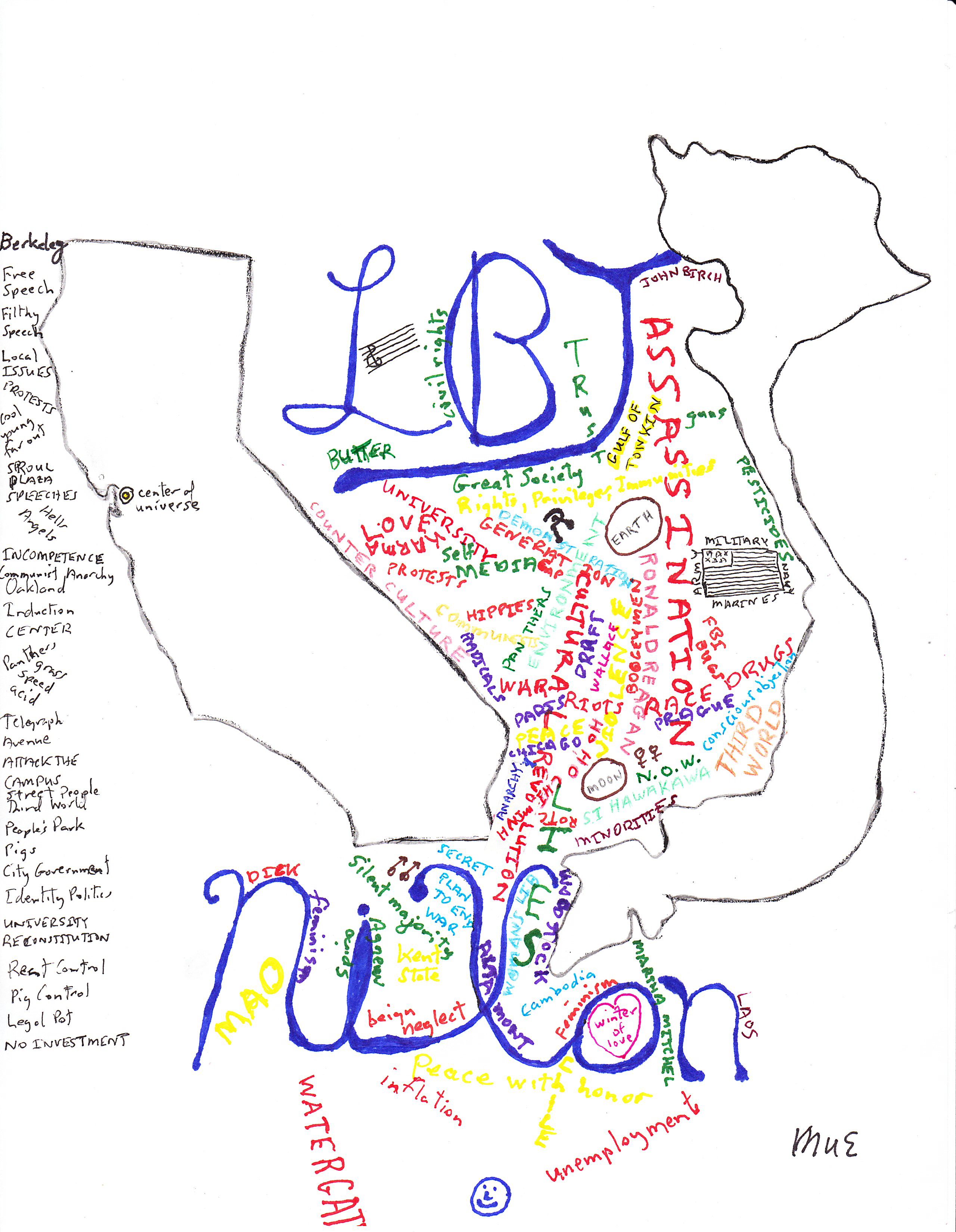
This blog is both promotion of my own novel, Bitch., of which I’ll write more in other posts, and criticism of Radical Son by David Horowitz. Bitch. ($10) is published on the iBookstore. It is about events in Berkeley during the Nixon years (1968-1974) from the standpoint of five first year students.

Horowitz attempts to soft-pedal those years in Berkeley; he lives on Northside, the safest part of town. He is reasonable; he did everything reasonably; he made rational decisions; he understood everything; he was noteworthy enough to write a memoir. Reading his book, Horowitz sounds so plausible and sometimes reasonable, 30 years old, innocent, working for good against evil, using the purest motives while striving for justice and never being critical or judgmental of a thought, an act or plan. Everyone liked David Horowitz. He’s oblivious to dates, short on details, unaware of events, and unwilling to be honest. Horowitz and others of his ilk were phonies, or perhaps they were mentally ill.

Horowitz was part of the Berkeley radical circus, in a coterie of radicalness, a radical party cadre – the people who were responsible for ripping up Berkeley for five years. How do I know this? Bitch., 215,000 words, reading more than 3,000 books including Horowitz’s, years of writing, and having lived through it.

After reading Horowitz’s book, Radical Son, the public will understand why I entitled my book, Bitch., a period not a dot, a verb not a noun. Other than running a magazine called, Ramparts, Horowitz and his buddies colluded with “people” in Berkeley. Throughout Bitch.I call Horowitz and his pals “white radical shits.” The public can understand that term, too – mentally deranged dumb shits who constructed idiot scenarios for “street people” to perform street theater [riots].

Horowitz returns to Berkeley in January 1968 and tells of his Road to Damascus Conversion to the radical cause and its revolutionary ways. He took his son to a local elementary school, where they heard a rock band (Purple Earthquake) perform. Horowitz “felt: A new world is possible.”

Why is that is bull shit and an outright lie? Horowitz has told the reader how smart he is, and that he is well-connected with the left-people in Berkeley. He has come from London, where there is no shortage of electronic instruments and excellent rock music; he has undoubtedly heard the best rock music there. Has anyone ever hear of the Purple Earthquake ever again? [They didn’t become Creedence Clearwater, did they?] Did the band play so loudly that Horowitz broke a blood vessel in his head? Horowitz’s son, a youngster, did not have the same epiphany as his father. Horowitz did not say that he was sober or straight at the performance.

There is another explanation, somewhat goofy but with Horowitz one never knows. It comes from Charles Reich, The Greening of America, p. 260: “Music has become the deepest means of communication…When someone puts a dime in the jukebox…there is a moment of community. [P]eople begin to move, some nod heads, some drum fingers, others tap feet, others move their whole bodies…many sing…” This explanation is improbable because it suggests creativity and art, yet there is nothing in Radical Son which is creative or artistic.

Horowitz was well-connected with the left-people in Berkeley. His manner was agreeable; he was calm and voluble. Throughout Radical Son Horowitz tells about meeting wealthy people, outsiders to Berkeley, and getting money. Horowitz was the “money guy,” for that Berkeley clique as well as for Ramparts. In another book (The Destructive Generation), Horowitz tells about picking up Jane Fonda at the San Francisco Airport and getting her to Alcatraz Island. Why did Horowitz drive? Money beyond taxi fare.

Horowitz rightly criticizes Todd Gitlin’s book, The Sixties, but at least Gitlin tried. He observed the pervasive, on-coming influences from the street and hippie, youth culture including drugs. The Leftists, New Left, Weathermen and others couldn’t manage all that, and Gitlin couldn’t describe it. Horowitz avoided those agency-setting effects completely and disregarded the influences: He lived a normal middle class family life, doing middle class stuff in an upper class neighborhood. His job was a plaything; his ideals and principles – did one need ideals and principles? He was so remote and detached he never understood revolution was not possible and one could not write about it well, if loaded on drugs, blasted by iron-rock, trashed by women and among people whose business acumen didn’t extend beyond the street mantra: “grass, speed, acid.”

But if an author recognizes “a new world is possible,” shouldn’t the author develop the point – observe, do, influence, watch? On which bases was “a new world possible?” Horowitz raised the point and let it rot, in intellectual venality. He didn’t bother to wonder how people, culture and society were divorced from the narrow confines of selective, opportunist Leftist politics whose financial supporters were deceived with every check. Toward the end of his “radical” days, Horowitz met a backer who asked, “Is the revolution possible?” Radical Son proves that Horowitz is the last person in the world to know whether the revolution was possible. Strangely enough, Horowitz does not have the self-reflection and the wherewithal to phrase the setting of that meeting and the question as a joke.

Supposedly, Horowitz had a defining moment in his life when a friend with a job at a Black Panther run school in Oakland was murdered. Throughout the first half of the book Horowitz was chummy with the Panthers, visiting the Party big-wigs. He accepted Huey Newton’s statement that Eldridge Cleaver was too violent for the Party. Horowitz lied about Bobby Seale fleeing Oakland to get away from Huey Newton. Before and after the murder Horowitz casts allegations and theories about who did what, when, where and how. When he tries to talk to the pigs [police], they don’t believe him.

Horowitz was the money man. He liked talking to the top people, but everyone else wasn’t worth a shit and was a trifle. Horowitz initially recommended his murdered friend work at the Panther school. Why? He doesn’t say, but probably so he could have input, influence and control over things there, and the money. The Panthers didn’t need him; they didn’t need the woman who could have been fired and sent packing, not murdered. There is no answer, but it is a scenario which arises from circumstances. It is entirely possible that Horowitz pressed his case too hard, revealed too much and made threats. Horowitz didn’t say this in the book, but he may as well have written he was responsible for the woman’s murder, a personal message to him. [This assumes the Panthers were as irrational as Horowitz claims. They knew if he broke with them, there would be no more money, but they also knew he couldn’t prove anything. Why murder the woman?]

The murder and Horowitz’s role in pre-killing activities were a final revelation for Horowitz after being deaf, blind and mute for a decade. The Panthers had an unsavory side, and everyone but Horowitz knew it. The cops saw the street activities, gang style. Indeed the son of the murdered woman, not a cop, warned his mother. Apparently Horowitz had greater influence, and she worked for the Panthers. In books Black leaders wrote with distrust about the Panthers; Horowitz was illiterate. Black student groups kept their distance from the Panthers who were so entwined with white radical shits to become self-destructive. While Chancellor at San Francisco State, S.I. Hayakawa said, publicly, “The black radicals want a better America. And they may use revolutionary methods at moments, but they are willing to give them up as soon as it’s clear that the administration is willing to do something to improve the quality of their education and their opportunities within the system. White radicals, like the SDS, don’t want to improve America. They just want to destroy it and louse it up in every way possible. So I have nothing to offer them.” (Orrick, William, Shut It Down! A College in Crisis, Washington DC, 1969, p. 147.)

It is obvious that Horowitz would not change from his Mommy-and-Daddy brainwashing to get away from white radical shitism. And he wouldn’t support Black organizations which were trying to improve circumstances in 1968-1969. Instead, he liked the Panthers, isolated friends so long as they could be useful. He liked and likely laughed at their jiving – Martin Luther King was Martin Luther Coon. Radical Son, p. 161.

Essentially, Radical Son, is about Horowitz’s retarded progression from Pinko-Commie to Fascist. He was raised by educated Communist parents, and he believed their crap like it was Gospel. The book does not admit whether he kept his Communist rooting from parental love, or whether he was just an idiot. I’ll go with the latter. Unlike many kids of the Sixties, Horowitz never told his parents they were full of shit, which they were. A reviewer’s comment on the outside of the book says, “A courageous book, full of self-revelation.” That is erroneous. It is more accurate to say, A cowardly book, full of slow-revelation. More accurately, the book should be entitled, Memoirs of a Moron. Horowitz chooses not to be honest, to tell the truth and give a fair portrayal of himself. Instead, he displays an imbecilic rigor, revealing a lack of intellectual discipline and an idleness when seeking the truth.

Image

READ ORWELL – I

I’ve mentioned that George Orwell is the best writer of the twentieth century, and most people never get past thinking, ANIMAL FARM(condemning Stalin) and 1984(condemning shrinking communications in a tri-polar world). Those are excellent books, each driving in demonic ways their points.

But Orwell wrote novels and books before World War II, and most of those make excellent reading. I recommend those. Where Orwell excelled was in preparation for the novels: essays. He wrote about almost everything with certainty and accuracy. He touched psychological and sociological issues beyond those found in novels and essays. Essays also discuss writing, business and politics. I wish I could write as well today, as topically, forcefully, completely and truthfully.

“The Prevention of Literature,” January 1946 is about the forces affecting writers and publishing. I’ll give background and a smattering. It’s the 300th anniversary of John Milton’s Areopagitica pamphlet in defense of freedom of the press celebrated by the group of British writers called PEN. Orwell is disappointed that this group of leftists are so far removed from reality they are dishonest. He’s a leftist himself but believes in personal liberty. The speeches at the PEN gathering include: Freedom of the Press in India; general comments on the goodness of liberty; no obscenity laws; and defending the Russian purges (1936-1939).

Orwell writes, “Of…several hundred people, perhaps half of whom were directly connected with the writing trade, there was not a single one who could point out that freedom of the press, if it means anything at all, means the freedom to criticize and oppose.”… “There was nothing particularly surprising in this.”

The writing trade “is under attack from two directions…it’s theoretical enemies, the apologists of totalitarianism, and…it’s immediate practical enemies, monopoly and bureaucracy…”

Orwell goes on to define and tell why writers are the most exposed artists – not painters, musicians, poets, sculpturers. He has choice words or criticism about poets and poetry, which go beyond Mark Twain’s, “Poets are too lazy to write complete sentences.”

About the monopolies and bureaucracies affecting writers, in 1946 Orwell writes,

“…apart from newspapers it is doubtful…whether the great mass of people in the industrial countries feel the need for any kind of literature…Probably novels and stories will be completely superseded by film and radio production. Or perhaps some kind of low-grade sensational fiction will survive, produced by a sort of conveyer-belt process that reduces human initiative to the minimum.

“It would probably not be beyond human ingenuity to write books by machinery. But a sort of mechanizing process can already be seen at work in the film and radio, in publicity and propaganda, and in the lower reaches of journalism. The Disney films…are produced by what is essentially a factory process, the work being done partly mechanically and partly by teams of artists who have to subordinate their individual style. Radio features are….So also with the innumerable books and pamphlets commissioned by government…Even more machine-like is the production of short stories…Papers such as the WRITER abound with advertisements of Literary Schools, all of them offering…ready-made plots….algebraical formula…packs of cards marked with characters and situations…to be shuffled…”

Orwell wrote this in 1946, and for the most part the world has seen literary production fall off since World War II. A friend of mine wrote read the first Best Seller of well-known author a few decades ago. She read the second book, and stopped a third of the way through. It was the first book rewritten; that author was writing FORMULA: This happens on page 24; that happens on page 67; crisis by page 189.

Has anyone ever gone to a film class or tried writing a screenplay. First advice: Read this book which is complete nonsense, unreadable by anyone with any ability to understand this language and any readingcomprehension. All the screenplay books are poorly written and full of crap. FORMULA for film is everywhere; there’s even a preferred word processing “format.” Yet, FORMULA is killing film. Every year Entertainment puts out the same films, different titles, different actors, different production people. Advertisements and promotion rely on the people involved in the production, not on the quality of the production, an expensive experiment. Entertainment is also trying to mine TV programs for films which fortunately has been unsuccessful. They’re going after the comic books. Except for characters in costume on Hollywood Boulevard I want everyone to know that Superman, Spider Man, Batman, Iron Man, and others I don’t want to know of, are NOT REAL. No one will fly through the air and save you, not Matt Damon playing Jason Bourne in Tangiers, not James Bond, not the next sequel hero. 

Orwell talks about totalitarianism and shrinking liberty of thought and action, and in his day the Soviet Union was a target just as been Nazi Germany. Today the Russians are flirting with that type of government and certainly the Chinese are living with it. But people of other nations are  confined within limits or norms whether it be from a strict religions doctrine, from social controls, from ignorance, from commercial controls and financial limits. Many of the latter countries are obscurantist, which will put back human beings there 1000 years. The tragedy is the rulers of those latter countries, sometimes aided and abetted by the totalitarian regimes, have no concern for their own people of their futures.

I want to know whether someone among the powers that be, dropped George Orwell into the Twenty-First Century, let him look around and take all the notes he wanted. He was to return to his time to warn people: This is not the best use of human and physical resources to produce what’s coming (in society called civilization). Orwell is focused on the tradition he came from – Western Culture. He uses it as an example. In another essay he identifies obscurantist forces affecting us in “Pleasure Spots.” It is a short essay, January 1946. I’ll quote,

“The music…is the most important ingredient…The radio is already consciously used for this purpose by innumerable people. In very many English homes the radio is literally never turned off, though it is manipulated from time to time so as to make sure that only light music will come out…I know people who will keep the radio playing all through a meal and at the same time continue talking just loudly enough for the voices and the music to cancel out. This is done with a definite purpose. The music prevents the conversation from becoming serious or even coherent, while the chatter of voices stops one from listening attentively to the music and thus prevents the onset of that dreaded thing, thought….It is difficult not to feel that the unconscious aim…is a return to the womb…

“The question…arises because in exploring the physical universe man has made no attempt to explore himself. Much of what goes by the name of pleasure is simply an effort to destroy consciousness…” 

Orwell describes more than half the people I know – whether they have the radio turned, whether it is DVD, whether it is a TV, whether it is at home, in the car, at the office or on the sidewalk.

Read Orwell.


GOT THROUGH EPISODE 16, ONLY

I’ve never seen 24, the TV program. I like Kiefer Sutherland and especially his dad, Donald Sutherland. Last week I saw the first season of 24, four DVDs which I got at the library. There may be a fifth DVD, but I won’t watch Number 5. I won’t watch any more of the series.

FIRST SEASON: Black Senator running for President, is in California on primary day. (California is not his home state, but I’m not sure.) INTELLIGENCE comes in: Senator will be assassinated perhaps by people within the Intelligence Agency. Kiefer and his working group is assigned to investigate the assassination and to prevent it. At home is a wife with whom he has resumed life together after a separation, and a teenage daughter whom they learn has just off during the early morning hours on a school day.

In the sixteen episodes I viewed there is no backstory about reasons for the marital separation, the separation or reason to recouple. The wife is presented as uptight, tightly woven, right and righteous. 

Work crisis, home crisis. Wife waits at home until daughter shows up. Kiefer (Jack Bauer) learns from his supervisor that the Agency may kill the Senator: Find the traitor, find the assassin. Everyone who learns or knows of the assassination plan dies except Kiefer (good shot with acceptable high fighting skills) and most of Kiefer’s intelligence team.

While investigating, Kiefer spends a lot of time out of the office, while the team slaves away on computers and fields phone calls.

The Senator and his life are also part of the action. Senator’s son, who once killed someone by tossing him off a building, got a reprieve. That death was called an accident but the truth is emerging. Senator also learns there’s a heightened threat on his life. He refuses to change his schedule one bit, not one whit or an iota. The Senator is a sitting duck for anyone who wants to kill him.

The Senator seems powerfully naive and ignorant for someone running for president, but the American public has been this before. It will take a while before they vote for it again.

Back to the review. The Senator’s political story is predictable, shallow, preposterous and falls to the grade of a soap opera. Ditto the problems of the Senator’s family. The worse role (not the actor’s fault) is that of the Senator’s son, the sneaking murderer. He’s 20 years old, I suppose, but acts 14. He and his father (Senator) have never talked But have a heart to heart where they exchange cliches and thereafter feel better. But Senator doesn’t want son to leave. Son asks why. Senator: “Security” (not “Assassination. We have the faces. They will shoot me and members of the family today.”) Son leaves, sneaking out for a covert meeting with a tongue-happy political advisor.

I realized after 12 hours of episodes, that I didn’t care if the Senator was elected, or if the Son survived, or if the family ever escaped from Peyton Place.

It turned out Kiefer’s daughter [Elisha Cutbert] is being kidnapped; she thinks she’s going to a party. It’s a date gone wrong, a date every girl out to see and brace herself against. It’s the strongest part of the 12 hours. If there are bad dates in the teenage world for a girl, these early episodes show them well. Daughter’s dating-girlfriend gets hit by a car and is murdered later in the hospital. No one every mentions this murder although it is a salient plot and story point. 

Coincidence: Daughter is held by the very people who want to kill the Senator. They will use the daughter and the wife, joining daughter after a few episodes, to coerce Kiefer into position that he will be suspected of assassinating the Senator. Kiefer avoids that evil trap and investigates, using clandestine contacts within his intelligence group to learn where wife and daughter are being held: It’s a type of Charles Manson compound-ranch, 15-20 guys with big guns and with access to bigger guns.

TIME TO UNRAVEL SOME OF THIS BUILD-UP:

Problem 1:  When Kiefer calls in Rescue Mission from the Agency, assigned to take out the compound are three helicopters of early Vietnam days but gaily painted. Five guys get off one Chopper, 15 guys total against an equal number more heavily armed bad guys with evil faces. I hate seeing those guys on the street. This is a Let’s-Send-A-Rescue-Mission-To-Get-Hostages-From-The-American-Embassy-In-Tehran-A-La-Jimmy-Carter. For the TV show it worked.

Problem 2: Daughter wears red top while being chased by bad guys with bigs guns through the property. No one says, “Shoot at anything that’s red. Ask questions later.” Only after the helicopter ride to safety at Headquarters, does Kiefer give her a brown jacket to conceal her whereabouts.

Problem 3: Daughter has had date-from-hell, but she remains thick. (IQ 30 required for this part). One of the kidnappers wants out and helps daughter and wife. He escapes with them. Daughter has taken a shine to him. Daughter decides, I can protect him in the rough and tumble world, where I can’t protect myself. No one straightens her out. Also daughter is upset with mother/wife when she learns mother/wife is pregnant. She says something like, “You didn’t tell me you were getting pregnant!” [I’m sure all parents sit their existing kid down and say…]

Problem 4: Perception, Genetics, a family? When characters are usual height, it is all right to have kids be usual height, a little shorter or a little taller. Senator (Dennis Heysbert) is a big guy, tall and looks capable to taking out the left side of the University of Alabama offensive line. Wife is usual height. Son should not be five-six. — Kiefer is usual height; wife is lanky at (five-nine)? Daughter is no petite and appears (five-two)?

Problem 5: I’ve not learned anything from my experience, especially the recent on-goings five hours ago when people were trying to kill me. Kiefer’s wife is being debriefed by female agent who slept with Kiefer during the marital separation. Wife suspects and learns of this agent’s intimacy. She gets up and will no longer participate. Every chance it comes up, Kiefer and wife utter the hopes, aspirations and conclusions that “we have to look ahead,” “don’t get bogged down about our past failings; “feelings must be afresh from hereon.” Hence, despite that on-going, annoying clatter, wife suddenly becomes irrationally enraged at someone who’s trying to investigate and protect her. It makes no sense from the wife’s perspective. I no longer cared whether she lives or was captured and taken off forever.

If it isn’t apparent, I saw no growth or little reaction to circumstances and experience by the characters. And I haven’t mentioned the bad guys. They aren’t interesting either. Most have thin or no lips, narrow eyes, tight skin with close-cropped hair and are obviously going to get a bullet diet.

There are too many good movies to see; there is also good TV to see. But it is not 24.
TELL THE TRUTH OR BE LAZY

Today’s news: Matt Lauer says media is lazy about Ann Curry firing. 

Unwittingly, Matt Lauer has identified and responded to his own complaint, The Media is lazy. Duh! The Media has been lazy for a long time, and Matt is at the head of the pack. He’s so slow he fails to realize the truth is the only way to clear up his “troubles” (psychological, popularity, professional).”

Journalism once had standards. They’ve been lowered over the decades. It once was if a journalist didn’t acquit herself to the standards, she’d be gone. Today it is easy to observe the standards are not there. Few journalists are quick and intelligent. It is easy to tell they were once “C” students in high school, always talking in class, running around collecting gossip, and vying for the inside secrets which they never got but they passed off any gossip as gospel.

Enter Ann Curry. She was presentable and competent when doing serious news, go out, interview people, tell what happened in sixty seconds, smile. She could also read the news. Smile. But give Ann Curry the freedom of an interview show, and her attitude changed. Her voice changed. She believed he had to be empathetic and sympathetic with everyone, except those she despised.  She would fawn over guests and their problems – get the story from the patient because doctors don’t know crap and can’t explain it. And there were ridiculous episodes:

“Your goldfish went for a swim in the New York City sewer system?”

“Yes.”

“Did you ever get them back?”

“No.”

“You must have felt horrible.”

On the Today Show Ann Curry became an entertainer suited for a sit-com waiting for the laugh-track to kick in or for violins to fill the moment.

To be fair Diane Sawyer had the same temperament and style, pleading personality, looking with doggy eyes wanting a treat, please give an answer dripping with emotion so we can cry together. But Diane had an advantage. She never cried. She had experience, being in broadcast TV. She met Richard Nixon once when he was president and never kicked him around.

So Matt Lauer was unable to fess up and say this is why Ann was canned. He’s lazy.


A GOOD DAY TURNED BAD

Everyone has these days. Work is set; chores and errands are planned. A schedule is roughed out with extra time for delightful diversions. And there will be time to be productive, keeping my ears open, my nose to the grindstone, my eyes on the ball. It’s a day to hope, aspire and innovate. My being is in God’s hand, moving under the will and direction of the gods and advancing into heavenly pantheons.

 Next something occurs, and immediately the question becomes: What worse can happen? 

I shop quickly. I made five stops, some stores miles apart, shopped and was out of the stores within an hour. It was a warm day, 100 degrees plus but not as humid as it has been. Store five I brought my purchases out, put them securely in the trunk and got in. The car wouldn’t start. The battery came to mind. AAA had replaced the last battery a bit more than three years ago. That mechanic said, “You have a three year guarantee.”

I can count and take a joke: Three years is three years. It’s only money.

I called AAA, and cooled my heals in the heat of the shade while they arrived: Hot weekend day, everyone’s out, cars are breaking down – this man was busy as he arrived within the time frame they had given me. He looked at my card, got my comments about what was wrong, popped the hood and attached stuff to the battery. The battery was fine doing everything it was designed to do. The AAA man didn’t say it, but I thought, It’s probably good for three years.

He went onto another trouble spot on his list, and determined the starter wasn’t working. He returned to his truck and came back with a two-foot length of one inch galvanized pipe, open at each end. He put it against the starter and didn’t tap but jabbed: THUNK. THUNK. THUNK. THUNK. He handed me the key and said, “I need you to turn the ignition while I’m hitting the starter.”

This seemed inappropriate. Whoever got an iphone to work after hitting it with a piece of pipe?

I did as requested without result. In fact he continued to hit after I quit. He finally went to the driver’s seat and turned the key, getting the car started after many attempts. 

I was delighted. 

He next informed me to drive to my mechanics to get the starter replaced. “If you turn it off, you may never restart it.”

Given the beating the starter had taken, I believed him. But I wondered, “It’s Saturday, who’s open?”

I drove the car seven miles to the dealer where all the work had been done before. I could take the bus back and huff the last mile home, uphill carrying my purchases. 

The dealer was open, and so was it’s service department! It took a while to get the car in. The intake man said that banging on a starter was the usual way to get a car started. The work would be finished on Monday. 

“Do you have a bus schedule?” (Bus stop half block away)

“We can give you a ride. We have a valet service.”

I waited int the air conditioned Customer Service room, with the TV turned to the Oregon-Virginia game loud. An Asian guy was trying to sleep; his wife was enduring. A Latina behind shades was looking out the window at the street. I watched the game. Oregon, a quick team, was ripping up Virginia but lost its MO by a quick Virginia touchdown at the end of the first quarter. That seemed like other Oregon teams – an explosive offensive force but no defense. I saw no more of the game, but Oregon had a sluggish second quarter and during the second half ruled the field. Oregon won 59-10.

I had seen the shuttle return, but the driver disappeared. I went out and asked. It took 15 minutes to find the driver. He drove well, dropping a woman off and driving seven miles into a new neighborhood to drop me off. I had arrived with my purchases, but thought, Do nothing. Don’t risk going out. Do no work today. Hence, when the dealership called three hours later and said, “Your car is ready after 5:00 p.m. Will you pick it up today?” I considered: It was a waste of a day. I may as well fritter away the remainder of it doing something. No shuttle. I had two hours to walk seven miles. I declined.

The car will be picked up Monday.

Some days have to play out and end in their ruin. So long as I understand that the time was wasted, sometimes for good purpose (the car was repaired fully), I won’t be affected. 


SUBMISSION

It is humiliating to submit anything to anybody, especially at the end when you realize they don’t understand it, or perhaps they did. What follows is a sketch of submission activities.

I started with Goya, his etchings, Caprichos, and subjects come to me fitting into my world of art. “What a sacrifice!” has a suitable theme: “…the age-old theme of an unequal or ill-matched partner for marriage. Self interest makes a victim of the wife; the fiance’ is not very attractive but he is rich, and in return for the liberty of an unhappy girl, he buys the security of a hungry family,” reports the caption. It is a terrific provenance.

How to make this story? No one reads. The audience likes song and dance; George Murphy has become popular again. That’s the medium I capitalized on. I wrote and presented the idea.

Start with song because if the poetry of the story (book – dialogue, action) doesn’t work, at least there will be music and words to market separately. Once songs are identified and the lyrics out, write the book. Try to link the songs together with vague coherency. Compose the music.

The songs should try to follow the story developing it: Two psychologically damaged people are forced to fall in love. He’s an old guy with questionable abilities; she’s pretty and 20 years old who is attracted to security. A PRODUCTION PROBLEM: Hope that the male lead doesn’t have a heart attack while trying to keep up with the moves, steps and dancing of the youth on stage.

THE SONGS (not in order; some are duets — as indicated):

Fat, stupid and I look like Hell.

My Four Hour Problem — Four Times A Day

Diner by Five, Bed by Seven

Who is that? — My Boyfriend

Cloud or Storage?

My Little Visit To The Trophy Store

Women My Age — Guys My Age   (I was once a guy your age)

I’ve Never Read a Book

Vinyl, Cassettes and Eight Tracks — Reel to Reel

Stick Shifts

I Remember When People Were Rude

Love Lessons From Sesame Street

Maturity: Lack of Energy — Maturity: You’ve Got Cash

I was disappointed that no women were among the producers and impresarios. I didn’t tell them Goya and “What a Sacrifice!” had nothing to do with this musical. I wanted them thinking I really researched this musical. Instead, I was watching the news and saw that Rupert Murdoch was getting divorced. Old-man-young-girl love failed, although she saved him from a pie in the face while he was trying to protect his moron son. If pie protection didn’t demonstrate love, I don’t know what else could.

So for the sake of ART, I lied and claimed inspiration from a master of art, Goya, a genius. He saw into the human heart. He speaks for the ages. He should be remembered. He should be put into music more often. My musical should be bought. It explains the surge to remain young, live life to an extreme end, hard bodies, sleek and flexible. Yoga’s popular. There is an advantage of age when considering matters of love.

I may need help. Anyone who wants to collaborate, let me know.

The men at the meeting didn’t buy it. They were all looking older than they were because they are getting out of shape; some are bald. (I’m older than I look because I’m in reasonable shape.) They were looking for something more hip, cool, hot, rad, effervescent, a story prone to beat, cliche’ and nothing that would mirror their lives. A few have young wives; one guy is paying college tuition.

They thanked me for coming and for my time. I left poorer but with the satisfaction that I had given them the best entertainment they’ve heard all year. I hope they don’t steal my ideas.

Shakespeare Author

We know Bill, Will, William Shakespeare wrote the plays, sonnets and other things. History favors this conclusion.

Shakespeare was a real person. We know on or about the day he was born and died. We know he was born and died in Stratford upon Avon, but he did most of his work in London. While working in London, we do not know how often he traveled between London and Stratford.

We know Shakespeare was an actor in and around the London Theater scene for 30 years. We do now know what else he was doing in London, but it is likely he was writing. We do not know where Shakespeare lived in London. We do not know his religion – Catholic, Angelican or Puritan. It is likely Shakespeare tended toward Puritanism. Puritan teaching – lectures and preaching – was common and well-attended in London during Shakespeare’s time. Elizabeth I did not support or like them, but her Privy Council favored the new teaching and its reforms.

Puritan lecturers were educated, well-schooled men, who wanted to reach the hearts of the crowd. By in large they succeeded. So widespread were lecturers in London, they greatly outdrew all other forms of worship, entertainment and diversion. The accomplishments of the lecturers was to drive and expand the English language, making expression direct and simple to convey the message to the audience. A scene in “Shakespeare in Love” is entirely credible: The playwright is walking on the street and hears a term from a Puritan lecturer – “A plague on both their houses.”

It is entirely likely in London that Shakespeare routinely heard favorite and excellent lecturers, listening to the words and watching the reactions of the audience. The input into the development and advancement of English by Puritan lecturers is little researched and not well told. The primary reason: The establishment of England still smarts from the order of Puritan Oliver Cromwell, separating the head from the body of King Charles II (1649). 

With a high degree of confidence we know that one person writing under the names of William, Will, Bill Shakespeare wrote all the plays, sonnets and other works. Shakespeare wasn’t a pseudonym used by two or more persons who wished to remain anonymous. If one person wrote the plays, what can be said of him? He took to the language like a duke to water. He had an ear for sounds in and around the language. He had a memory for almost everything he heard. He had the facility and versatility in mind to play with various words. He knew the language was best used with the greatest impact while expressing with the fewest number of words.

Is it impossible for someone of Shakespeare’s upbringing, background and abilities to be born and do what he did? NO, it is more likely someone of that background would do it. He knew what life was like for the common man; he listened to the Puritan lecturers; he knew the language his audience would like. If the upper classes were amazed by his stories, ideas and language, his examples swept them from using French and Latin and made England linguistically a nation. [There were dialects and languages in England which did not fade fast.] Having one understandable language was significant advantage for England.

Note from the Eighteenth Century is an example of an Englishman with little education producing far beyond his English and European contemporaries. Benjamin Franklin mastered almost every endeavor he undertook; he was a very capable writer. Although Shakespeare stuck to drama, it was the only and primary outlet for his abilities expressing his art.

While Shakespeare was in London, his plays were performed. We know mostly when and where; we know of the actors. We know there probably wasn’t the rumor that Shakespeare was not the author of the plays.

Coming upon the seventeenth century was a time when authors, composers and sometimes painters [Rembrandt did not sign many of his paintings] did not claim credit for work or they did not receive credit for their originality. Anonymous or unknown is more common an identification than “By _____.” Shakespeare had plays published during his lifetime, whether he authorized it or not,  and whether he was paid or not. The theater was the primary means for a writer to get paid. Authors then, somewhat like today, were not hugely famous. The public reaction is similar though – you’re just writing words that everyone already knows. It’s the actors who make it real.

To keep a secret – the authorship of Shakespeare’s plays and sonnets – in Elizabethan and Jacobian London is an impossibility. We must rely on Benjamin Franklin’s axiom – The only way three people can keep a secret is for two of them to die. Non-believers of Shakespeare’s authorship claim so-and-so, or what’s-his-name wrote the plays. There were loads of secrets to keep in a society that thrived on gossip. The secret also assumes that the unknown author was very well-off. He needed no money while living in a society where generosity plus greed equalled grace.

With Shakespeare dead in 1616, theater people, actors, producers, owners and others realized, We don’t have copies of the plays. They searched and remembered, and for seven years everyone associated with Shakespeare recalled and worked. As far as we know there are no hand written manuscripts. The First Folio of Shakespeare was published in 1623. The compilers of the Folio, who should know, did not say, “William didn’t write them. Pete did. [Pete was dead too and didn’t have handwritten manuscripts either.] But let’s keep the secret.” Compilers of the Folio knew Shakespeare had written the plays. He deserved credit.

Waldon on Wheels by Ken Ilganus

Waldon on Wheels

Ken Ilgunas, 2013

Wheels, an enjoyable, suitably-assembled, mostly well-written book, is told in many parts with charm and fun.

I object, though, to the title. Thoreau purportedly advocated a simple life, but no writer uses him as a model. Thoreau was a nut. On a winter walk in 1862 he encountered a fallen tree, counted its rings; counting many for too long, he got the sniffles, went home and died.

Ilgunas has far better authors to emulate, and parts of his book resemble Typee (Melville, similar financial condition as Ilgunas) and Roughing It (Twain flees the Civil War). Like Ilgunas both were new authors, and their stories of le jeunehomme, of being outdoors and telling adventure cogently and coherently came with gusto, vibrancy and joy.

Those elements are present in Wheels: Working to get off debt. Working in Alaska. Describing the work well, portraying experiences he would have once and never again or certainly not in the same way. Like Melville and Clemens Ilgunas presents himself as sane, whereas he is only goal oriented – mental health is something else. Enthusiastically and elegantly, Ilgunas economically, efficiently and effectively describes Alaskan wilds and its animals.

There is a valuable lesson in Wheels for persons with debt from school or other sources. Freedom from debt, obligation, outside responsibility is a relief to any human being. At book’s end Ilganus can go off and live the life he wants, making the mistakes we all do, but perhaps he will be wary and careful. Since publishing this volume, student debt has made the news again. It is a problem, but the answer is not in a collective solution but in individual responsibility, like Ilganus amply shows. The solution is at hand for anyone with the mind and discipline to follow through in work and encountering people. Throughout the book his many amusing descriptions of the human world have possibilities, especially in its easy style, but out of Alaska he resorts to regimented, awkward approaches.

An example – hitchhiking across the Continent: Ilgunas does it briefly and without details (actual words of drivers). I was once driven from Dorset to London sitting in the backseat of a mini; the front seat passengers were smokers. Most of the roads seemed a lane and a half; it was poor weather. While I was being asphyxiated, they talked about mounds in the countryside, sliding from the Saxons, to the Romans and ending with the Druids/Aliens/Wicans. Their magazine knowledge exhausted, the driver was inspired and started on Moby Dick. He avoided its driving theme – the consummate power of hate – to go off on fantasies about the white whale. This paragraph has the elements upon reworking, but mostly it needs one or two quotes about the mounds and a few dialogue sentences about the whale, white, blue or sperm.

Wheels does not make connections between the reader and drivers. That was the connection because readers already know the narrator, and the drivers were the persons who could terrorize them. Certainly the narrator/writer would not interrupt and would not add much beyond “I know,” nods, grunts or approval and murmurs of sorrow, as tales of woe came.

Later in the book Ilgunas talks to people impressed by the hitchhiking and interested in doing it themselves. Was hitchhiking as easy as he made it out to be? He provides little insight: At the mercy of the drivers. At the mercy of the elements. Be prepared to be dropped off 30 miles from nowhere. Have no schedule. And those are safe days on the road.

Equally difficult is the human world outside of Alaska, more than half the book. Ilgunas reaches Duke and is living in the van. The details of life are fewer, unlike Alaska which is rich in detail. It seems for Ilgunas, what is seen by humans and externally experienced is magnificent and needs to be told; what happens inside any human being, specifically himself, development of the mind, travails of the mind and body, influences of the environment are less important. Ilgunas raised this very topic and should have developed it:

“The voyage was teaching me how unexceptional I was and how exceptional the human mind and body is. What wonders the human mind and body are capable of achieving! How so few know how much we can do! Our limits are merely mirages on the far side of the lake – we can see them ahead, but that’s all they are: mirages. Our real limits are beyond the scope of our vision, beyond the horizon, a boundary worthy of our exploration.” (p. 117)

The book mostly leaves a memoir style, and resembles a diary/journal with essay analyses. One experience – Alaska to Duke – stealing the stars. The Alaskan weather clears. Ilgunas knows nothing of the stars because he spent his childhood playing video games. But he was not deprived of them because of ecological damage in upstate New York. Later at Duke he is less concerned about another hidden world seen only through a microscope.

While reading about his life in Alaska, I realized he was living a monk’s existence. Toward the end of the book Ilgunas (p.258) also realized it but didn’t fully explore the anomaly: An eremite at Duke and being open and free in empty Alaska. It is no wonder while in graduate school, he voices customary undergraduate complaints, meaningless gripes, retreads from the undisciplined ways of his debt years (circa p. 240-45)[excellent analyses see Adam Ulam, The Fall of the American University].

Instead, Ilgunas’ adventure at Duke does not tell his life – the education of the mind, mental exploration and development, all the while living in the van with earlier and existing cares and concerns. He was motivated to finish school and did. He needs no more classroom work to be original and to write. This book evinces promising talent and a rage that can be disciplined and controlled. Unfortunately, how life and school helped Ilgunas and his mind, other than grades and a degree, is not in these pages.