When I went to write Bitch. (iBookstore, michael ulin edwards), I was determined to make it autobiographical. I learned after three major drafts and a long process of 20 years, that autobiography was impossible. It would make a bad book. Some of the reasons can be found in Twentieth Century Journey, William L Shirer, vol. i, Preface; Autobiography of Mark Twain, U.C. Press, Berkeley, 2011, vol. 1, on writing memoirs/autobiography.
I was motivated to write the life and times of Berkeley, 1968-1973. While there I had forces coming at me. I determined they would best be represented by FIVE major characters, plus subsidiary characters folded into the stories of the FIVE. At that point the book could not be autobiographical; it could not be biographical. It could be history. Recount events as truthfully and accurately as I could, but the characters had to be representations. [Readers have commented that they know these characters.]
As much as I ran from place to place in Berkeley, observing and stuffing everything into my memory (which is not entirely why I almost flunked out my first year – I was also taking the wrong classes and my perspective on learning was horribly distorted), I could not tell the story of Berkeley with one character being everywhere at once: Peoples Park Riot Day, May 15, 1969 – in class on the north side of campus; in the riot itself; at the swimming pools in Strawberry Canyon; wandering around Dwinelle Hall. The FIVE characters and others were useful to convey what had to be said.
It is also impossible for a individual to tell his story when hormones, urges, the environment, economics are exerting influences affecting the person. What is the order? What is the priority? What is important? Those day to day, sometimes hour to hour or minute to minute considerations which may or do change affected human being senses – hear, see, smell, feel, taste – will shift the ground and upend any story.
If the reaction to life under those circumstances is the same, that makes for a dull human being. If the reaction to life under those circumstances whipsaws the human being into incapacity, he becomes confused and worthless. If the reaction causes the human being to take the brunt of it and react intelligently, predictably or making-do, that is the easier story to tell.
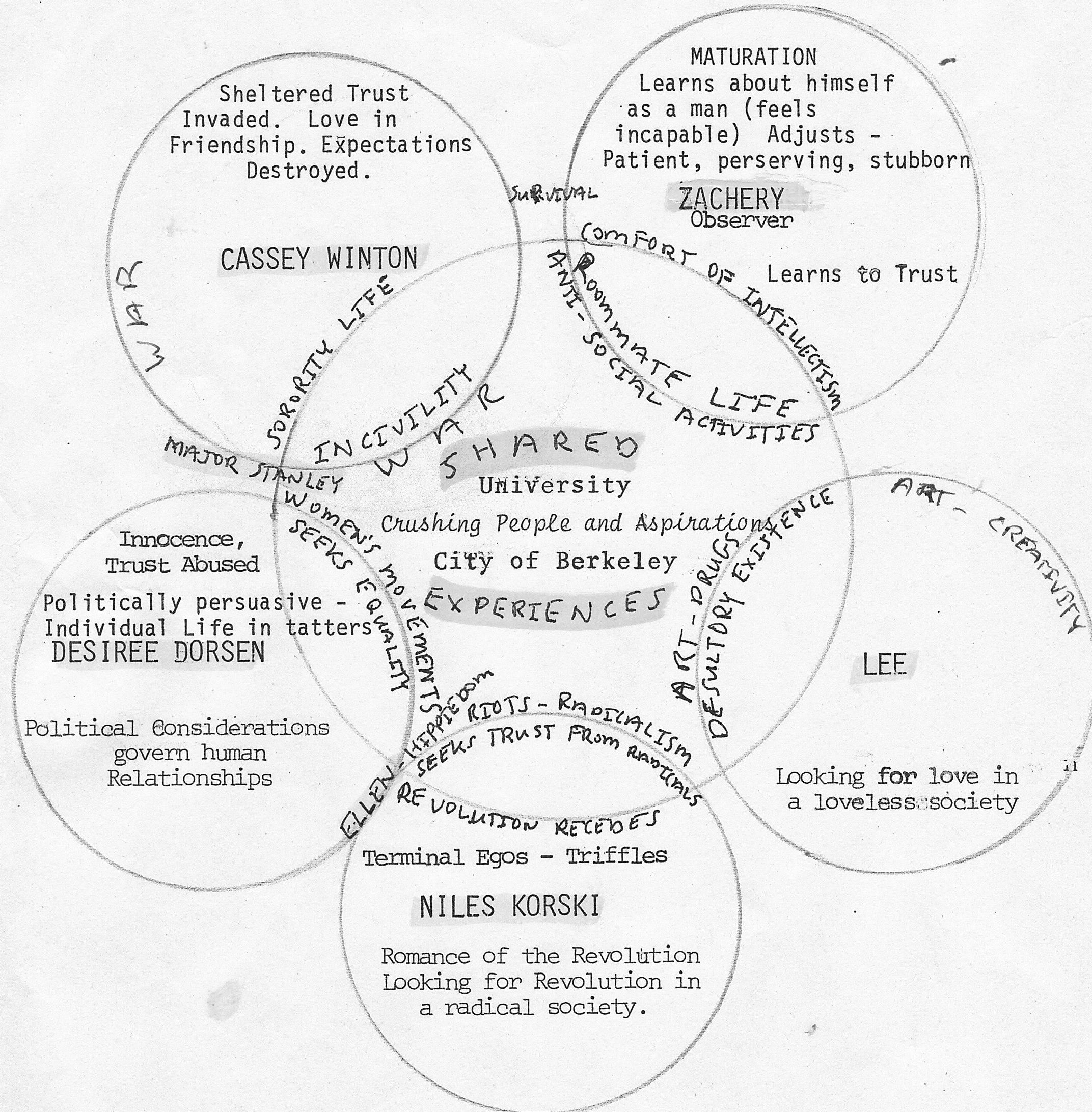
In 200,000 words I came up with the FIVE characters, two guys and three women, living and telling their lives (some aspects of my life) in Berkeley from September 1968 through the summer of 1973. They lived through riots, demonstrations, classes, drugs, life, city and academic events and state and national actions, all told within this novel. [There are 450 notes and a bibliography.]
Also, I could not tell my own story for a personal reason. Who could be truthful about being psychological creepy and sociology awkward then, (probably eccentric today) in a terrifying place. That doesn’t describe the discomfort, the violence and the shock of watching crap on the streets being played out and the acceptance of it by everyone in Berkeley. About 20 years ago I talked to someone I knew as a student. He tried to fit in and spoke the language as a student. His evaluation of those times upon meeting him again was reduced to one word: “Strange.” He didn’t want to talk about what he thought or was doing as a student, which was likely “creepy” and “weird.”
It seemed I was the only person who considered everything going on was strange, weird and ill for society. I may have been suited for a college campus in the 1920s, but I was stuck at Berkeley. I did not want to be a statistic and a loser: Someone told me when I entered that the average stay of a student at Berkeley was four quarters. (The University is much more mellow today which is why it is not a place of excellence.)
While a student at Berkeley, I didn’t like and actually detested loud music, drugs, and the recklessness of students, their lives a step from the street. Everything seemed reenforced by the citizens of Berkeley. Condemning this gross, communal lifestyle is a theme of Bitch.. Indeed, I dislike any communal styles, community standards, something my generation embraced and never let go of, and something which has been passed onto to their children and grandchildren: The collective.
We are not raising children today to be individuals, to think on their own. They are accepting, too much of collective action, group-think, the so-called common good. They have been taught, It Takes a Village – Collective actions are the bases of all advancement. Those are wet dreams rolling from the Left of the Sixties and from Radical Feminism. (See Shulamith Firestone, The Dialectic of Sex.)
Finally, I did not want to be like any of the FIVE. I put a lot of distance between myself and Berkeley. Not in the novel is: at the end of my Berkeley studies, I wanted to be a composer, but I had injured my left hand and couldn’t play the piano. I was lost to the activities I was prepared for. Law school intervened, but within ten years I had turned to writing.
This post is the second using the cover and the diagram (outline) that I have made. The subject is different because the text differs.
 muymue